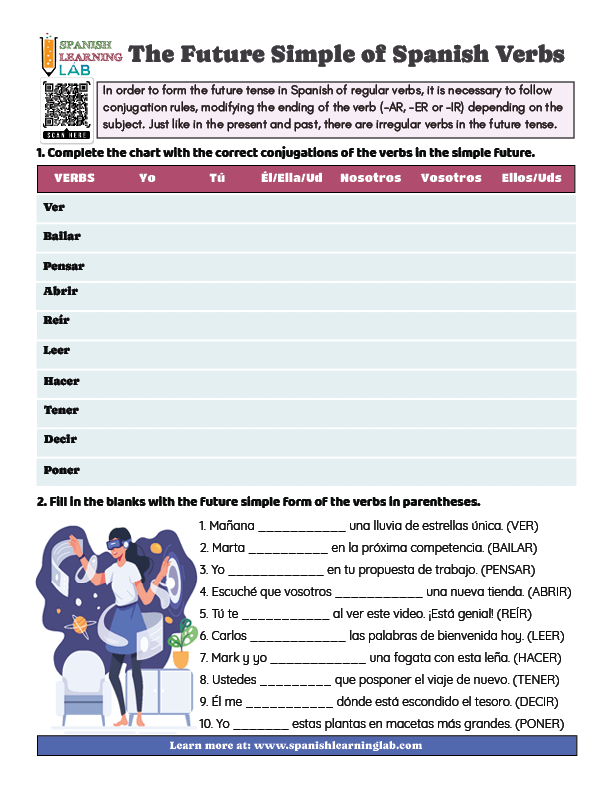
¡Hola! Thanks for using our resources. This PDF worksheet was designed to help you practice grammar by solving two exercises about the future form of Spanish verbs. These two exercises include both regular and irregular verbs in this tense. We hope you can get the best out of this didactic material. Let’s start…
Directions:
Students could work individually or in pairs to solve the exercises on this worksheet.
As it is explained on top of this worksheet, the future tense of Spanish verbs is generally formed by following some specific conjugation rules, modifying the original ending of the verbs (-AR, -ER or -IR) depending on the subject of the sentence. Unlike other tenses, the new endings will be exactly the same for any regular verb. In the future, we will also find irregular verbs like HABER or TENER, so always double-check the form of some verbs.
To solve the first exercise, students must complete the chart on the worksheet containing a list of 10 common verbs using the right conjugations for these verbs in the simple future in Spanish. Some of them are regular, whereas others are irregular, so they could use a conjugation tool to double-check the right form of the verbs in the “futuro simple“ to make sure they are using the right form. As for the second exercise, students must fill in the blanks using the future form of the verbs in parentheses, making sure the sentences make grammatical sense in Spanish.
Worksheet information:
Level: Beginners
Skill: Grammar
Related lessons:
- Forming the Future Tense in Spanish: Rules, Sentences and Practice
- The Future in Spanish with IR A + Infinitive (Sentences + Practice)
- Talking about the Future in Spanish – PDF Worksheet
Solve it online!
Exercise No. 1
Read these sentences and choose the right future form in Spanish of the verbs to complete them.
Exercise No. 2
Fill in the blanks with the simple future tense conjugation in Spanish of each verb in parentheses.
Resultados


#1. Mañana _____________ una lluvia de estrellas única. (VER)
#2. Marta __________ en la próxima competencia. (BAILAR)
#3. Yo ___________ en tu propuesta de trabajo. (PENSAR)
#4. Escuché que vosotros __________ una nueva tienda. (ABRIR)
#5. Tú te _________ al ver este video. ¡Está genial! (REÍR)
#6. Carlos ____________ las palabras de bienvenida hoy. (LEER)
#7. Mark y yo _________ una fogata con esta leña. (HACER)
#8. Ustedes ____________ que posponer el viaje de nuevo. (TENER)
#9. Él me __________ dónde está escondido el tesoro. (DECIR)
#10. Yo ____________ estas plantas en macetas más grandes. (PONER)
Extra in-class activity:
Students work in pairs to work on an ideal travel itinerary for their next vacations. They must choose a place and the top 5 things they will do there during their time in that place. Once they have planned it, they should present for the rest of the class, making sure to use as many sentences in the simple future tense in Spanish as possible, for example:
- ¡Hola! Mi amigo y yo viajaremos a Italia. Es un país genial en Europa. (Hello! My friend and I are traveling to Italy. It’s a great country in Europe.)
- Yo tomaré muchas fotos durante el viaje y él visitará a algunos amigos. (I will take a lot of photos during the trip, and he will visit some friends.)