
In the previous lesson, we covered the most common adjectives to describe people in Spanish. In this lesson, we will put all the pieces together to describe people’s appearance in Spanish using the verbs SER, TENER, LUCIR and others. You will have the chance to practice listening and vocabulary with several interactive exercises. Let’s start…
Vocabulary review: Adjectives to describe people in Spanish
We will begin by watching a short video reviewing a list of common adjectives to describe people in Spanish, the basic ways to ask what someone looks like and how to create simple sentences with these words. Try to stick until the end of the video as it explains some things that you will not see in the rest of the lesson.
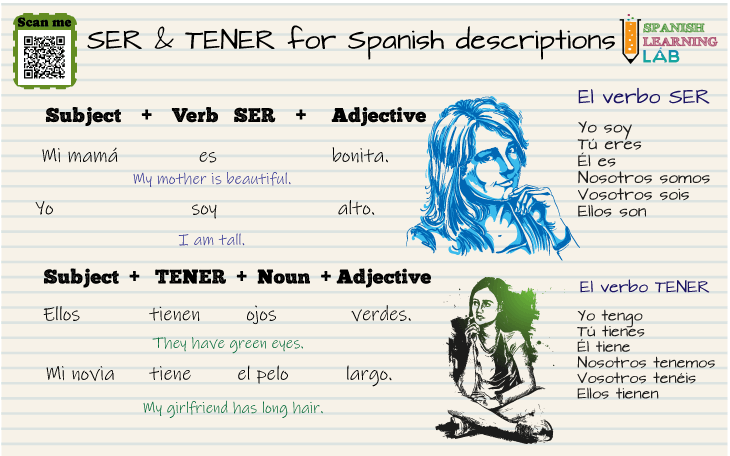
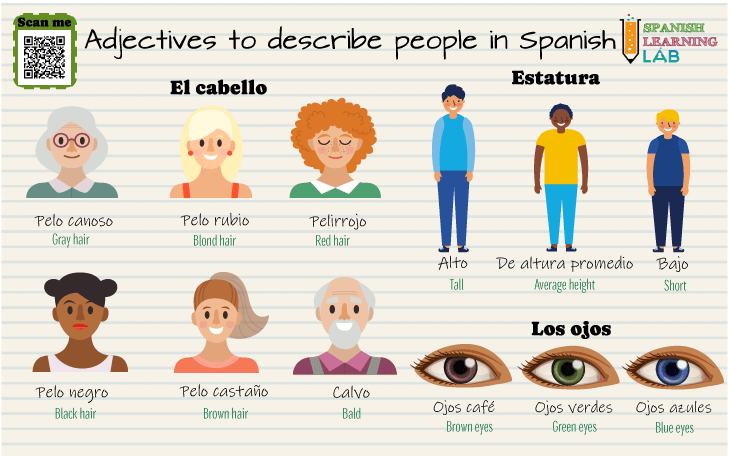
Below you will find a collection of great images including words and essential adjectives to describe people in Spanish, and a short introduction to the verbs SER and TENER, which we will use a lot for physical descriptions in this lesson.

Interactive exercise No. 1
Read these sentences about physical appearance in Spanish, complete them with the correct adjective or noun, and check your answers.
How to describe people’s physical appearance in Spanish
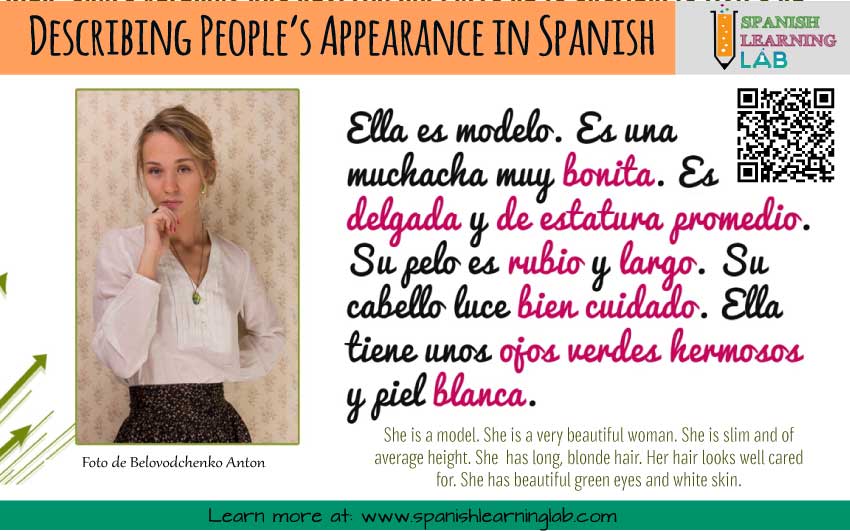
To describe people’s appearance in Spanish, we can use several verbs, but the most common for this purpose are the verbs SER (to be) and LUCIR (to look) for general appearance, weight, height, and body type, and the verb TENER (to have) for physical traits such as hair type, eyes, beard, etc. These uses are briefly shown in the image above and we will study them in more detail next
The verbs SER and TENER for physical descriptions
We often use the verb SER plus a few common adjectives to describe people in Spanish. SER will be used in two forms: ES for a single object and SON for many, for example:
- Él es atractivo. (He is attractive)
- Ellos son altos. (They are tall)
To describe the eyes, nose, and other body parts of people in Spanish, we use the irregular verb TENER, as in these sentences:
- Tengo pelo largo. (I have long hair).
- Ustedes tienen ojos marrones. (You have brown eyes)
Remember that adjective placement and theiragreement with nouns are very important to make accurate descriptions of people in Spanish. In the first example, we will see the verbs SER and TENER in use with some common adjectives for physical descriptions. The next image shows how conjugate and use SER and TENER for this purpose:
Alto, delgado, corto, verde, clara, gordo
Example No. 1
¿Cómo eres tú?
Yo me llamo Alvaro. Tengo 25 años. Soy alto y delgado. Tengo pelo corto y ojos verdes. Tengo piel clara. Peso unos 70 kilogramos. No soy gordo. Me gusta hacer ejercicio
Interactive exercise No. 2
Drag and drop the words into the correct boxes to complete these short descriptions of people with SER and TENER
The verb LUCIR for physical appearance in Spanish
The second example will be about a girl. This time we will use the verbs SER, TENER and will add LUCIR as well. Another important verb for physical descriptions is LUCIR (to look like), though it is kind of formal. When describing people in Spanish, it is also a good idea to talk about parts of the body and the way they look with adjectives, e.g. “una nariz pequeña”, “labios hermosos”, “pelo saludable” and so on. In the description below, you will also see two common adverbs:“siempre”(always) and “todos los días” (every day).
De estatura promedio, rubio, liso, café, joven, saludable, morena, bonito
Example No. 2
¿Cómo es ella?
Ella es de estatura promedio. Tiene pelo rubio, liso y ojos cafés. Es joven y hace ejercicio todos los días así que luce muy saludable. Además, tiene un tono de piel morena muy bonito. Cuando la veo, siempre luce muy bonita.
The verbs ESTAR y LLEVAR for clothes and accessories
Although the verbs ESTAR (to be) and LLEVAR (to have on) are not specific to physical appearance, they are essential for saying what the people we are describing are using or wearing, as in the short descriptions of people in the following image:
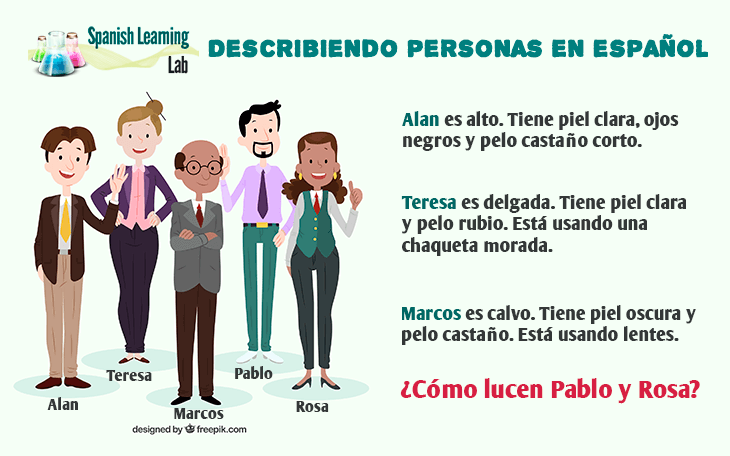
- Pablo es alto y delgado. El está usando una camisa manga larga rosada y lleva una corbata.
- Pablo is tall and thin. He is wearing a pink long-sleeved shirt and a tie.
- Rosa tiene piel morena y pelo rizado. Ella está usando pantalones de vestir, un bléiser y lleva puestos unos aretes dorados.
- Rosa has brown skin and curly hair. She is wearing dress pants, a blazer, and gold earrings.
Common nouns and adjectives to describe people in Spanish
The third example will be about two statues and a thief, something we made up for you to see how we use several different adjectives to describe people in Spanish, and objects in this case too, with SER and LUCIR in the same paragraph. Apart from adjectives, the box below includes common nouns like “nariz”, “bigote”, “pelo” and “barba”:
Joven, alta, bonita, antiguo, guapo, delgado, bajo, pelo largo, castaño, rizado, grandes, de mediana edad, barba, bigote
Example No. 3
Robo en el museo
Anoche, una persona robó dos estatuas en el museo. Una de las estatuas es de una cantante joven, alta y muy bonita. La otra estatua es de un antiguo faraón egipcio. El faraón era un hombre alto, guapo y delgado. Los vecinos dicen que el ladrón es un hombre bajo, de pelo largo, pelo castaño y rizado, nariz y ojos grandes, de mediana edad. El hombre tiene barba y un bigote largo.
Interactive exercise No. 3
Read the following physical description in Spanish and select the correct answer to the questions about it.
Interactive exercise No. 4
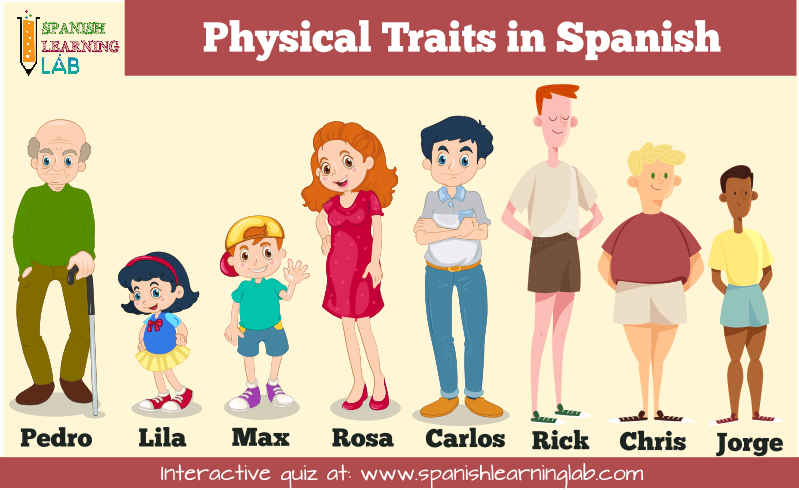
Look at the following image with drawings of people and choose the correct answer to the questions about their physical features in Spanish in the interactive quiz.
Resultados


#1. ¿Cuáles de estos rasgos físicos son apropiados para describir a Pedro?
#2. ¿Cuáles de estos rasgos físicos son apropiados para describir a Rick?
#3. ¿Cuáles de estos rasgos físicos son apropiados para describir a Chris?
#4. ¿Cuáles de estos rasgos físicos son apropiados para describir a Max?
#5. ¿Cuáles de estos rasgos físicos son apropiados para describir a Carlos?
#6. ¿Cuáles de estos rasgos físicos son apropiados para describir a Rosa?
#7. ¿Cuáles de estos rasgos físicos son apropiados para describir a Lila?
#8. ¿Cuáles de estos rasgos físicos son apropiados para describir a Jorge?
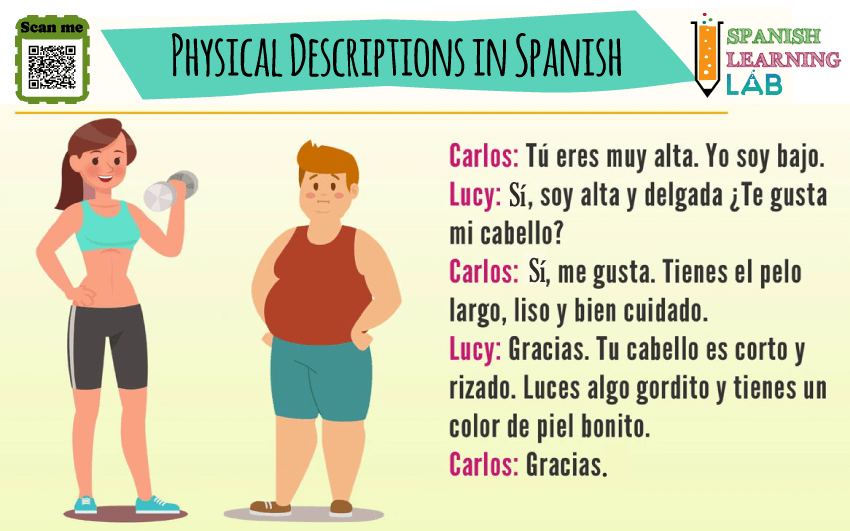
Listening Activity: Talking about people’s appearance in Spanish
Key conversational expressions:
- “Yo mejor…” means “I’d better…”
- “Por cierto…” and “A propósito…” mean “By the way”
Practice: Describing your family members in Spanish
The following interactive quiz uses some of the essential words and verbs for describing people in Spanish that we covered during the lesson. Drag the words to the correct spaces to complete the dialogue, and then check your answers. ¡Suerte!
Lesson Assignment
Choose three people you know and describe their appearance in Spanish using the adjectives and some of the expressions we have covered in this and the previous lesson. Thanks for joining us, and we hope you got an idea on how to describe people in Spanish. ¡Hasta pronto!
Related Spanish Worksheets:
- Adjectives for Appearance in Spanish (Vocabulary)
- Words to Describe People in Spanish – PDF Worksheet
- Physical Appearance in Spanish (Labeling pictures)
- Describing People in Spanish (Vocabulary)
- Physical Descriptions in Spanish (Writing)
- Identifying People in Spanish (Speaking/Reading)
- Writing Physical Descriptions in Spanish (Writing)
- Describing People in Spanish (Reading)
- Physical Appearance in Spanish (Dialogues)
- Describing Historical Figures in Spanish (Reading)
- Clothing and Physical Appearance in Spanish (Reading)
gracias por este sitio web fue muy útil