In the previous lesson, we covered a list of several countries, nationalities and languages. In this lesson, we will focus on the most important verbs, adjectives and phrases to talk about countries and nationalities in Spanish, including those about the languages you speak and the things you love about your country. Let’s start…
Review: Vocabulary of countries and nationalities in Spanish
To begin this lesson, we will review the key vocabulary for countries and nationalities in Spanish using the following image. Spanish is spoken in many of these countries; Spanish is popular as a second language, or the country itself is a popular tourist destination for people from all over the world.

Introductory video: Countries and nationalities in Spanish
Next, we will learn more words related to countries and nationalities in Spanish with a short video. This video shows a list of 20 Spanish-speaking countries – “países donde se habla español”. It also shows six countries where people like to learn Spanish based on our stats and teaches the basic ways to ask “where are you from” in Spanish and answer this important question. Finally, we show two examples of very simple conversations using the vocabulary in the video.
Interactive exercise No. 1
Look at the pictures and flags of each country in these pictures, and then drag and drop the names of these countries in Spanish into the right boxes.
Countries and Nationalities in Spanish (with audio examples)
In order to ask where someone is from, we should say ¿De dónde + the irregular verb SER? as in ¿De dónde eres?. On the contrary, to say where you are from in Spanish, you can use the SER like this: “Soy de Argentina”. You may also answer with the nationality, as in “Soy argentino”. Some important verbs we often use when talking about countries, nationalities and languages in Spanish are: NACER (to be born), VIVIR (live), HABLAR (speak) and CRECER (grow up).
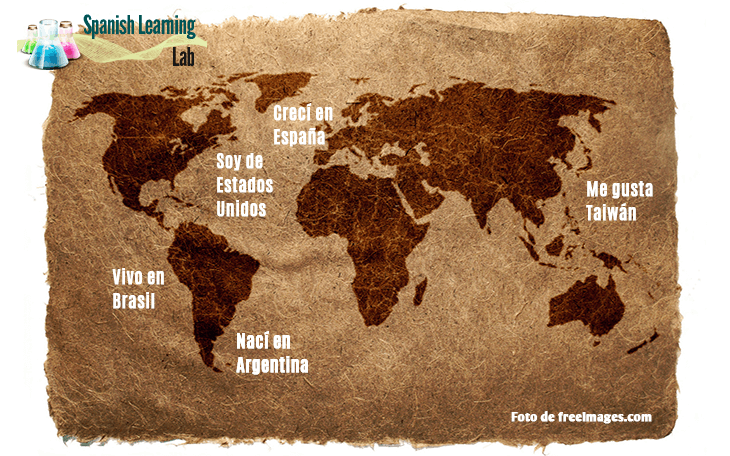
Saying where you were born in Spanish
The first paragraph talks about someone from Nicaragua. The key phrases here are “Nací en…” (in the past tense) and “Hablamos + language”. The first phrase can be used for saying where you were born in Spanish and the second for the languages you speak or have learned. Other important verbs when talking about countries and nationalities in Spanish are: “Comunicar”(to communicate) and “Entender”(to understand). Press PLAY to listen to the first audio example.
Example No. 1: ¿De dónde eres?
¿De dónde eres?
Yo nací en Nicaragua. Nicaragua está en Centroamérica. Crecí en Colombia. Ambos países son hermosos. En Nicaragua, Costa Rica, Panamá, Venezuela, Ecuador, Perú y muchos otros países de América hablamos español. El español de España es bastante diferente al de los países de Latinoamérica, pero podemos comunicarnos y entendernos muy bien. El idioma nos une y nos permite aprender de muchas culturas diferentes.
Interactive exercise No. 2
Read each question about countries in Spanish and choose the answer that makes grammatical sense.
Saying what you like about your country in Spanish
The second paragraph tells about someone from the US. Interestingly, the right translation for American is “Estadounidense”, instead of “Americano”. The word “América” is used for the continent. Know that for describing countries in Spanish, it is really important to use the right adjectives and forms of the verb SER, e.g. “Belice es bonito.” Last, the phrase “Me gusta…” can be used to say what you like about your country and “Me gustaría + an activity” is like saying “I would like to…”
Example No. 2: ¿De qué país eres?
Yo soy estadounidense. Mis padres son mexicanos. Yo puedo hablar inglés y español. Me gusta mucho el español. Crecí en Estados Unidos. Vivo en Los Ángeles. Me gusta viajar. Me gusta mucho Europa. España, Francia, Inglaterra y Alemania son países muy bonitos. Me gustaría visitar Asia para ir a China y a Japón, aunque no puedo hablar japonés ni chino.
Interactive exercise No. 3
Read these questions about countries in Spanish and choose the answer that follow grammar rules correctly.
Saying where you grew up in Spanish and the languages you speak and like
The last paragraph includes prepositions of place, which can be used to indicate the location of the country you are from in Spanish. In addition, we will use more verbs in the preterite tense, such as “Crecí…” and “Me mudé” (I moved…). Again, you will see the phrase “Puedo hablar…” (I can speak…). You can use the words “Idioma” and “Lenguaje” for language. In this example, we will use the phrase “Es un país con…” (It’s a country with…) plus landmarks and adjectives for describing countries in Spanish, e.g. “Es un país con bosques hermosos, edificios modernos…“.
Example No. 3: ¿De dónde eres?
Soy de Chile. Chile está junto a Argentina. Vivo en Brasil. Me gusta viajar mucho. He estado en China, Japón, Canadá y algunos países de Europa. Ir de viajes es mi actividad favorita. Crecí en Chile, pero me mudé a Brasil con mi familia cuando tenía 10 años. Brasil es un país con playas hermosas. Puedo hablar varios idiomas incluyendo español, italiano, portugués, francés, inglés y alemán. Mi idioma favorito es el español.
Interactive exercise No. 4
Drag the words or phrases about countries and nationalities in Spanish to complete the description of a country. Then, check your answers.
Listening Practice: Talking about countries in Spanish
Key expressions in the conversation:
- “¡Claro!”, means “Of course”
- “Eso he escuchado”, means “So I’ve heard”
Related Spanish Worksheets:
- The World Cup Countries in Spanish
- Countries and Nationalities in Spanish
- Guess the Country and Nationality in Spanish
- Countries and Nationalities in Spanish (Reading)
- Facts about Countries in Spanish (Reading)
- The Capitals of Spanish-speaking Countries (Vocabulary)
1/5
90%
2/5
5/5