¡Feliz Cumpleaños! (Happy Birthday!) is one of the most popular and useful phrases to congratulate someone. Birthdays usually include “un pastel” (a cake) and “buena música” (good music). In this lesson, we will learn the most important vocabulary and expressions about birthdays in Spanish through beautiful illustrations and short conversations. You willl also be able to practice with interactive exercises and listening comprehension activities. Let’s get started!
Essential birthday vocabulary in Spanish
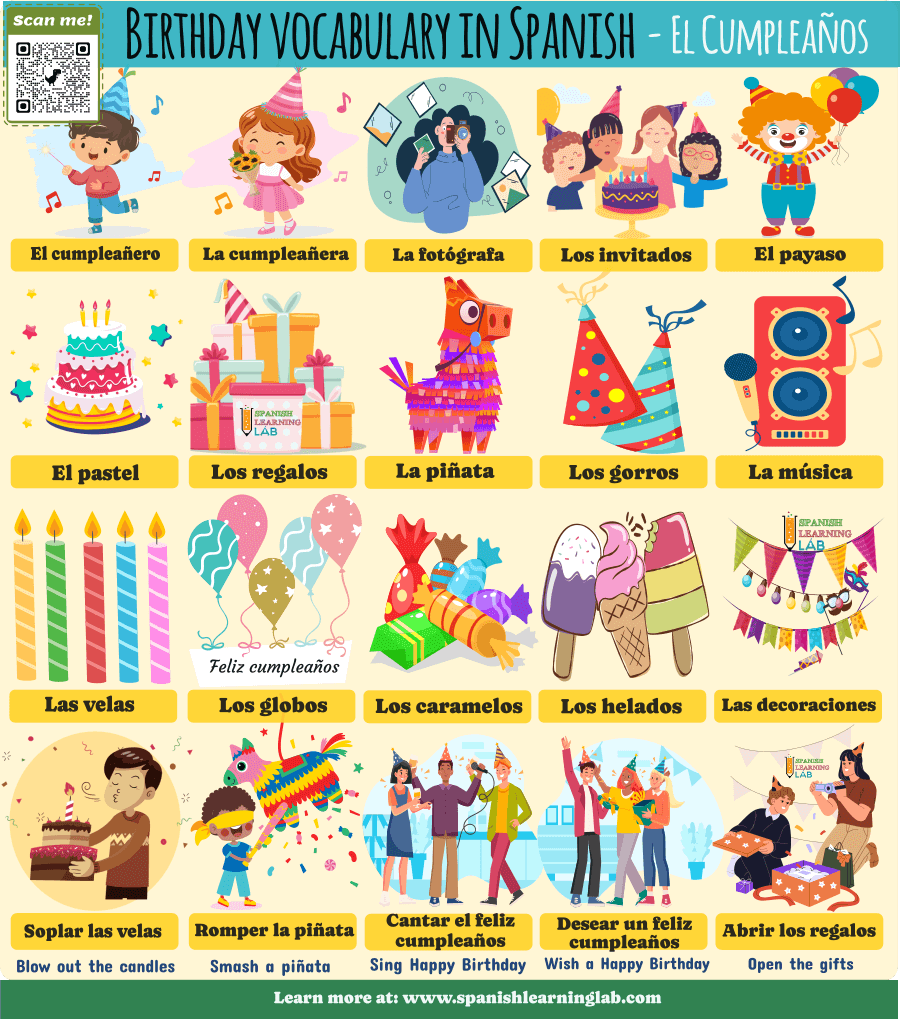
First of all, we will focus on the most important birthday vocabulary in Spanish through simple illustrations featuring these words. Some important words you need to know, especially when planning a birthday party, are REGALO (gift) and PIÑATA (a traditional party toy in some Latin American countries). There’s much more words and phrases about “cumpleaños”, which we have included in the following illustration:
Interactive exercise No. 1
Look at the illustrations, identify the words related to birthday parties in Spanish, and check your answer by turning the cards over.
Questions and Phrases for Wishing Happy Birthday in Spanish
First of all, to say BIRTHDAY in Spanish, we will use the word CUMPLEAÑOS, which in a certain way is a compound noun made out of “CUMPLIR” (accomplish) plus “AÑOS” (years). Some verbs that will come handy for wishing happy birthday in Spanish are: CELEBRAR (to celebrate), DESEAR (to wish), RECORDAR (to remember), SER (to be) and OLVIDAR (to forget). It is great to know how to talk about dates as well, particularly to say what month you are in and the specific day, in case you want to write a card or something more elaborate. Keep in mind the Spanish time expressions:
- “Este mes” (this month),
- “El mes pasado” (last month),
- “El próximo mes“, “Hoy” (today),
- “Mañana” (tomorrow) and
- “Ayer“. (yesterday)
Sometimes people will use different tenses to talk about birthdays in Spanish, for example:
- “Hoy es mi cumpleaños“(present tense),
- “Ayer fue tu cumpleaños” (past tense) and
- “El próximo mes ella cumplirá 5 años” (future tense).
Short conversations about birthdays in Spanish
Example No. 1
Asking “When is your birthday?” in Spanish
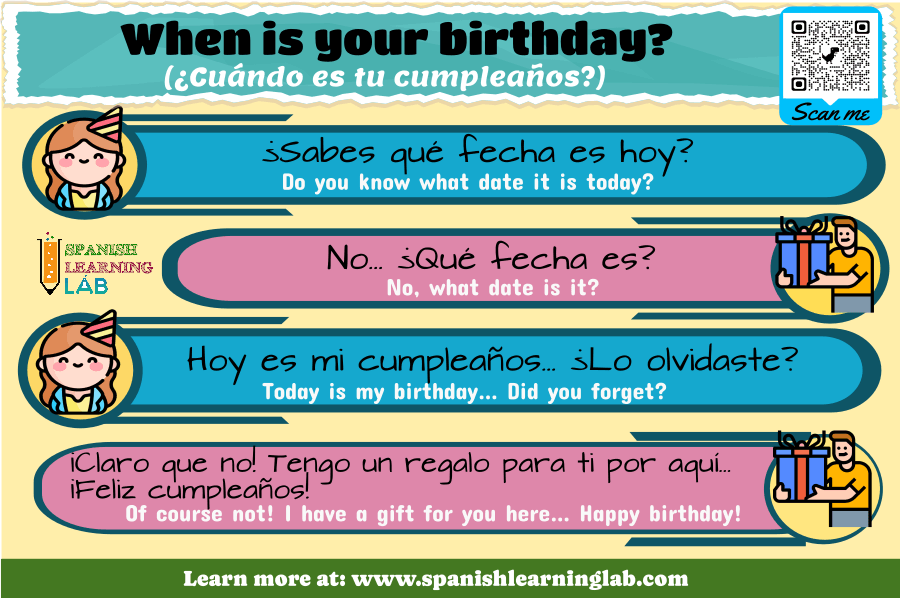
To ask people “when is your birthday?” in Spanish, we can use two questions “¿Cuándo es tu cumpleaños?” and also “¿Cuándo cumples años?”. The phrase “my birthday is” corresponds to “Mi cumpleaños es + fecha”. To return the question and ask for someone’s birthday in Spanish, you can use “¿Cuándo es el tuyo?” (When is yours?). Check how one of these questions and expressions was used in the short conversation below.
Example No. 2
- Itzan: ¿Cuándo es tu cumpleaños?
- Claudia: Mi cumpleaños es el 15 de Noviembre. ¿Cuándo es el tuyo?
- Itzan: El mío es el 25 de octubre.
- Claudia: ¡Genial! Tenemos que hacer una fiesta para celebrarlo.
Expressions for wishing happy birthday in Spanish
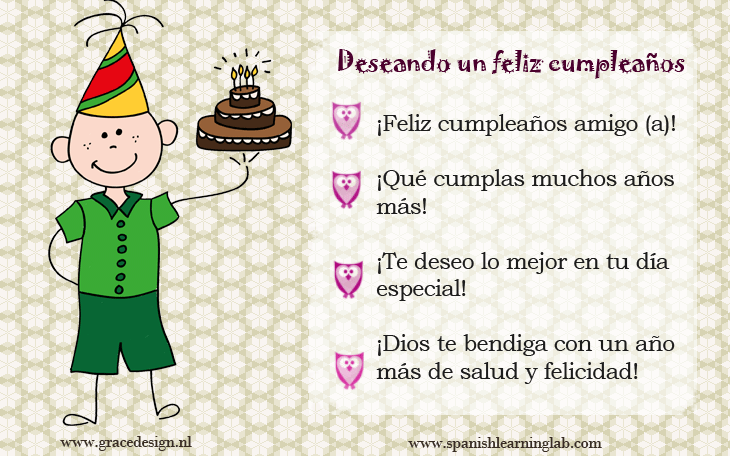
The easiest way for wishing happy birthday in Spanish is by using the expression ¡Feliz cumpleaños! The translation of the phrase is literal. However, this is not the only thing you should say, so apart from saying ¡Feliz cumpleaños!, make sure to add one or two simple phrases to say what your wishes are, for example:
- “Te deseo lo mejor” (Wish you all the best.)
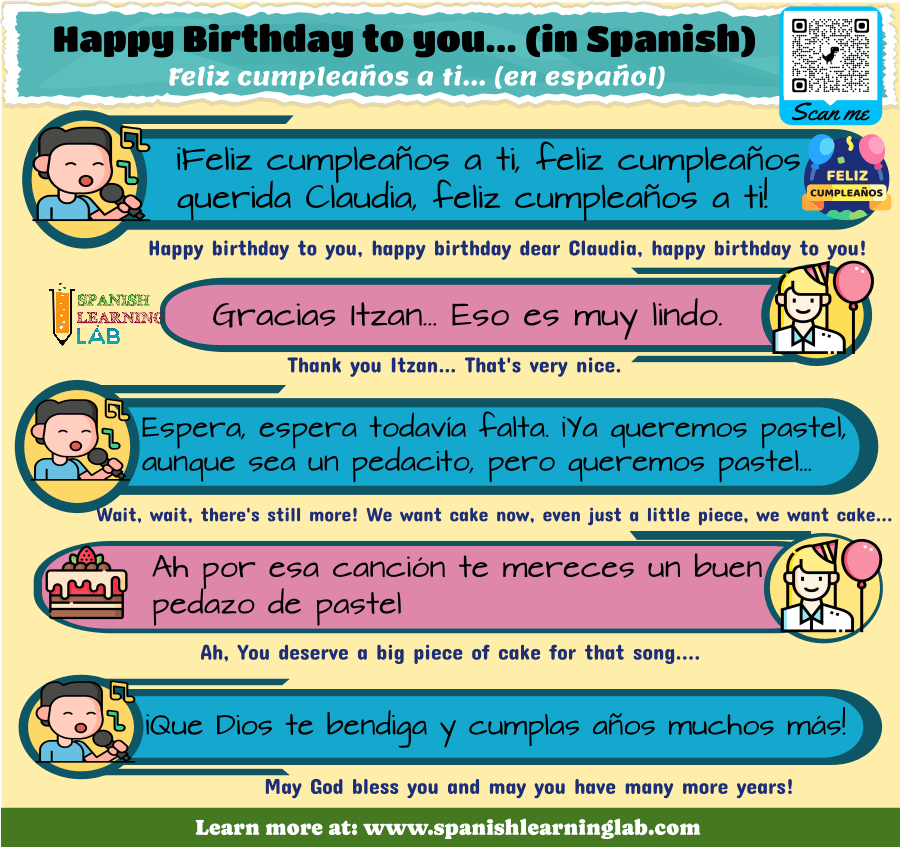
- “Que Dios te bendiga“, (God bless you!)
- “Que cumplas muchos más“, (May you have many more birthdays!)
- “Espero que disfrutes de tu día especial“, (I hope you enjoy your special day)
Pay attention to the common expressions for wishing a happy birthday in Spanish in the following illustration:
Example No. 3
- Claudia: ¡Feliz cumpleaños Itzan! Te deseo lo mejor en tu día especial.
- Itzan: Gracias Claudia… Me pregunto si tienes algún regalo para mí.
- Claudia: Lo siento, no pude comprarte nada pero podemos salir a cenar después
- Itzan: Está bien. Acepto eso como mi regalo de cumpleaños, solo que tú pagas.
- Claudia: Claro que sí Señor cumpleañero
Example No. 4
Planning a birthday party in Spanish: verbs and phrases
For planning a birthday party in Spanish, you need to know a few common verbs and phrases, apart from the ones needed to wish the “cumpleañero” a happy birthday in Spanish. Here are a few of them:
- PLANEAR – This verb means “to plan” and it is a regular verb. It will be normally used in infinitive after “Tener que” as in the sentence “Tengo que planear una fiesta”. It can placed before “IR A” for the future tense as in “Voy a planear mi cumpleaños” too.
- CELEBRAR – Perhaps the most important verb would be “Celebrar”, e.g. “Hoy estamos celebrando mi cumpleaños número 100”
- ORGANIZAR – “Organizar” is used almost the same way as “Planear”
- NECESITAR– This verb will be used to say what we need for the birthday party in Spanish, e.g. “Necesito comprar un pastel”. It is a regular verb too, and one to remember due to its multiple uses in the language.
- REVENTAR UNA PIÑATA – Piñata is a word used to refer to an object made of clay, wrapped up with colorful paper, and filled with candies. People will try to hit them while dancing with their eyes covered until all the candies inside the “Piñata” have fallen. The verb “Reventar” means “to hit/to crush”, e.g. “Vamos a reventar una piñata”.
- DECORAR – This verb means “to decorate” and will be used with other words such as “Adornos” (ornaments), “Globos” (baloons), “Flores” (flowers) and more, e.g. “Decoremos las mesas con flores”
- TE INVITO A MI FIESTA DE CUMPLEAÑOS – You can use this phrase to invite others to your party in Spanish.
- YA QUEREMOS PASTEL, AUNQUE SEA UN PEDACITO… – This is part of the lyrics for the happy birthday song in Spanish. It literally means “We want to eat cake, even if it is just a little piece…”
Interactive exercise No. 2
Read these sentences and questions about birthdays in Spanish with the verbs above and drag the missing words into the correct areas.
Listening Activity No. 1: Talking about birthdays in Spanish
Key expressions in the conversation:
- Siento que olvidé algo means “I think that I forgot something”
- No pude escucharte means “I couldn’t hear you”
- No es nada means “It’s nothing!”
Listening Activity No.2: Planning a birthday party in Spanish
Key questions and phrases in the lesson:
- “¿Tienes bastante tiempo esperándome?” means “Have you been waiting for a long time? ”
- “Yo tengo que planear” means “I have to plan…”
- “¡El tiempo vuela!” means “Time flies!”
Listening Activity No. 3: Listening for the right birthday phrases in Spanish
We hope you found the first listening activity easy to solve. The conversation is based on the examples provided, so it includes a lot of the birthday phrases in Spanish we explained.
Hopefully, you will be able to reproduce this knowledge and use it very soon to talk about your birthday in Spanish or someone else’s. Before you go, check if you are able to remember the most important phrases and questions in the lesson with the interactive quiz below. ¡Hasta pronto!
¡Feliz cumpleaños!