
Describing your room in Spanish is very easy if you know a few common adjectives and the verb SER. In this lesson, we will learn the vocabulary for common bedroom objects and parts of a room, and how to use colors and other adjectives to describe your room in Spanish. You will find many examples, and you will have the chance to practice with several interactive exercises too. Let’s get started…
Vocabulary: A list of common bedroom objects in Spanish
First, there are several ways to say “bedroom” in Spanish, including “habitación”, “cuarto,” “recámara,” and “dormitorio,” which are the most common in the language. To describe a room in Spanish, we first need to learn the vocabulary for the objects that are usually found in a bedroom. Below are some illustrations with the names of objects and parts of a room in Spanish.

Interactive exercise No. 1
Drag and drop the names of the bedroom objects in Spanish in this picture based on their numbers, and then check your answers.
Writing Negative Sentences in Spanish
Let’s start with negative sentences. Negative sentences in Spanish, “las oraciones negativas”, are formed by adding the word “NO” before the verb like this:
Subject + NO + verb + complement. e.g. Ella no va a la escuela.
The subject is optional most of the time, so it is possible to leave it out. Negation in questions is very similar to the way it works for sentences, although you need to be careful with question marks and give the right intonation to the question. Know that it is actually more common to ask negative questions in Spanish than it is in English, e.g. ¿No tienes un ropero? (Don’t you have a closet?)
| ¿No tienes un espejo en tu cuarto? Don’t you have a mirror in your bedroom? |
| ¿No crees que ese guardarropa es demasiado grande? Don’t you think that closet it too big? |
Describing your room in Spanish with adverbs of quantity
Now, we will talk about adverbs of quantity in Spanish or “adverbios de cantidad/grado”. In our lesson about the living room, we explained how to use adverbs such as MUCHA, POCA and others in sentences like “Hay mucha agua”. Adverbs of quantity in Spanish will be used to increase or decrease the grade of an adjective in a sentence. These adverbs are words like: MUY (very), UN POCO (a little), BASTANTE (quite), REALMENTE (really), TOTALMENTE (totally) and PARCIALMENTE (partially). They can be used like this:
- Esta almohada es realmente cómoda. (This pillow is really comfortable)
- Esa cómoda de madera es muy elegante. (That wooden dresser is very elegant.)
- Este ropero es demasiado pesado. (This wardrobe is too heavy.)
Try not to confuse MUCHO with MUY in Spanish. The adverb “MUY” will be used before adjectives like BONITA (pretty) and MUCHO will be used before nouns like ORO (gold). Here are some examples of sentences with bedroom objects, adverbs of quantity and demonstrative adjectives in Spanish (ESE/ESTE/ESTOS/AQUELLA…). They include a few important irregular verbs like TENER, SER, ESTAR and IR. TENER will be used to say what objects you have in your room in Spanish, ESTAR to say where an item is located or how the room looks in a given moment, SER for general descriptions and IR as an auxiliary for the future in Spanish.
|
Su habitación está totalmente desordenada.
His room is totally messy.
|
|
¿Tienes un nuevo gavetero?
Do you have a new drawer chest?
|
|
¿De quién es esta cama?
Whose is this bed?
|
|
¿Qué opinas de la cabecera de la cama?
What do you think of the headboard?
|
|
Este edredón es relativamente barato.
This quilt is relatively cheap
|
|
¡Vaya! Esta almohada es realmente cómoda.
Wow! This pillow is really comfortable
|
|
Aquella lámpara de noche es muy frágil.
That night lamp is very fragile.
|
|
La mesa de noche del cuarto es un poco baja
The night table in the room is a little short.
|
|
Esta cobija está algo sucia
This blanket is a little dirty
|
|
Voy a dormir como rey con este colchón.
I am going to sleep like a king with this mattress
|
Interactive exercise No. 2
Drag the parts of these sentences using Spanish adverbs and drop them in logical order. Then, check your answers.
Describing your bedroom in Spanish and its objects
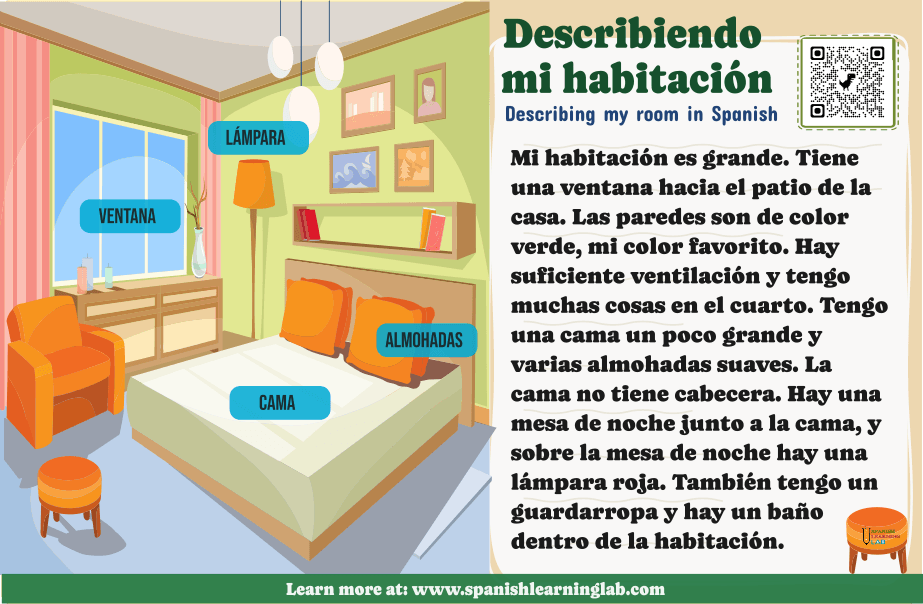
Now that we know how to say a few common bedroom objects in Spanish, it is time to use them for describing your bedroom in Spanish. First, you should use a few adjectives in Spanish like BONITO, CÓMODO, ESPACIOSO, PEQUEÑO, GRANDE, VENTILADO, MODERNO, LUJOSO…” and so on. To make sentences with those adjectives, we will use SER in its form ES and the verb TENER in its form TIENE.

You could also use some of the vocabulary we have covered in other lessons, for example: parts of the house(ventana, puerta, baño…), some colors and preposition of place in to indicate the location of the bedroom objects in Spanish. Here are two audio examples with people describing a bedroom in Spanish using the vocabulary for bedroom objects, negative sentences and some common adverbs.
Example No. 1 – Describing my room in Spanish
Example No. 2
Mi habitación es pequeña, pero bastante moderna. Mi cama es cómoda y tiene una cabecera elegante. El colchón de la cama es realmente suave y duermo como rey. Es un cuarto sin ventanas, pero es bastante fresco. Las paredes son de color blanco con detalles en gris y verde claro. Tengo un gavetero y hay varias fotografías colgadas en la pared. No tengo baño en el cuarto.
Interactive exercise No. 3
Drag and drop these words to the correct spaces to complete this short description of a bedroom in Spanish.
Listening Activity: Describing a room in Spanish
Key expressions in the conversation:
- “¿Por qué (tú) no….?”, means “Why don’t you…?”
- “No te preocupes”, means “Don’t worry”
Related PDF Worksheets:
- House objects and Furniture in Spanish
- The House and Prepositions of Place
- Rooms and Parts of the House in Spanish
- Describing Houses in Spanish (Pictures + Sentences)
75%
100%
100%
I love this thank you