
There are several ways to say our name, greet people and say goodbye in Spanish. Most of these expressions have been covered in two separate lessons, one teaching how to introduce yourself and another about common greetings and farewells. This time we are going to focus on how to use Spanish greetings and introductions to hold basic conversations. The lesson includes four simple sample conversations in Spanish, as well a listening activity to test yourself. Let’s start…
Vocabulary review: Basic Spanish greetings and introductions
Firstly, we will review some of the vocabulary and sentence structure for common Spanish greetings and introductions. To introduce yourself, you can start with a phrase like:
- “Hola”. (Hello!)
- “Buenos días”/”Buenas tardes”/”Buenas noches” (Good morning/Good afternoon/Good evening)
Then, you can say your name. You can use three different expressions, one using the verb SER, to say your name in Spanish:
- “Me llamo” + nombre. (Lit. I am called + name)
- “Mi nombre es” + nombre (“My name is” + name)
- “Yo soy” + nombre (“I am” + name)
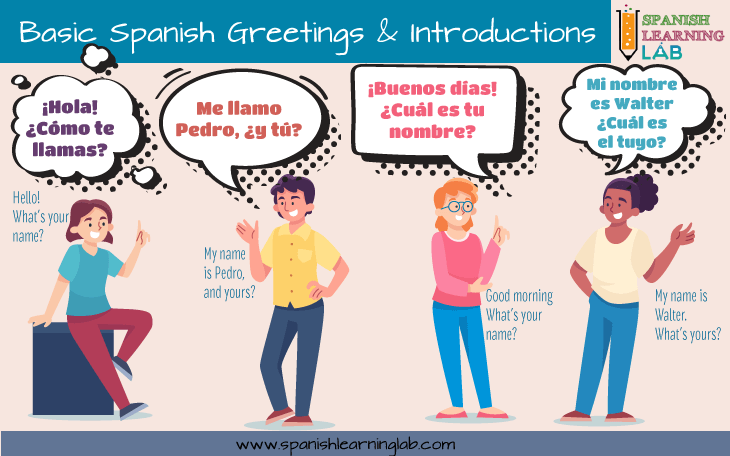
Following the previous examples, we could say something like “¡Hola! Me llamo Alex” o simply “Yo soy Alex”. To ask someone his or her name, we could use “¿Cómo te llamas?” or “¿Cuál es tu nombre?” It is polite to say something like MUCHO GUSTO after you hear someone’s name. Take a look at the examples in the following illustration.
Interactive exercise No. 1
Drag and drop the phrases for greetings and introductions in Spanish next to their correct English translation.
Basic conversations with Spanish greetings and introductions
Many simple conversations in Spanish begin with a simple greeting like “¡Hola!” (Hello) or “¡Buenos días!”(Good morning!). In order to make it sound even better, you may add the name of the person you are greeting at the end, for example:¡Hola Sra. Gonzalez! If you want to begin the conversation because you need help, then a nice way would be:
- “Disculpa, ¿puedes ayudarme?” (Excuse me, can you help me?)
- “Disculpe, ¿podría ayudarme con algo?“. (Excuse me, can you help me with something?)
Saying and asking names in Spanish
It is time to see how the vocabulary for “saludos y presentaciones” in use through basic conversations. The first min-conversation shows how to say and ask for names in Spanish and use the greetings <<¡Mucho gusto!>> and <<¡El gusto es mío!>>, which would be the same as <<¡Mucho gusto también!>>.
Dialogue No. 1
- Carlos: ¡Hola! Mi nombre es Carlos. ¿Cómo te llamas?
- Ana: ¡Mucho gusto Carlos! Me llamo Ana.
- Carlos: El gusto es mío
Dialogue No. 2

Formal vs Casual questions in Spanish
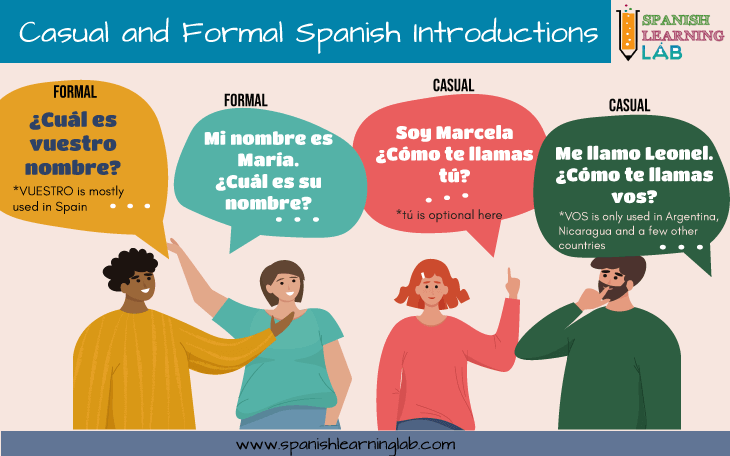
In the second conversation example, Ana will use a more casual or informal way to talk with the subject pronoun TÚ, whereas Carlos will reply formally by asking ¿Cuál es SU nombre? (USTED) instead of the casual question ¿Cuál es TU nombre? The possessive adjective makes the difference here.
Dialogue No. 3
- Ana: Tu nombre es Carlos, ¿verdad?
- Carlos: Sí, así es. ¿Cuál es su nombre?
- Ana: Yo soy Ana, la hermana de Jack.
- Carlos: Ahh…¡Es un placer conocerla!
Dialogue No. 4: Introducing someone in Spanish
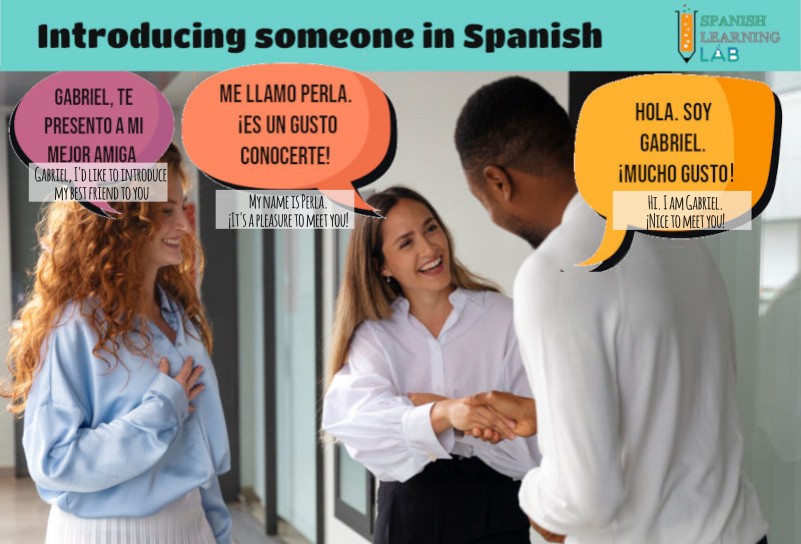
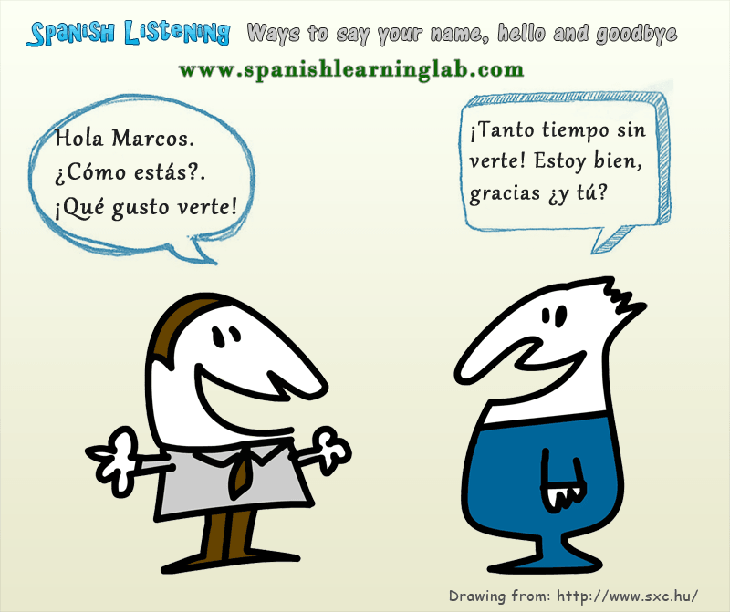
In the third basic conversation, we used “TANTO TIEMPO SIN VERTE” (Long time no see). Carlos introduces a friend in Spanish to Ana by using “PERMÍTEME PRESENTARTE A” + name. Take a look at the examples in the following picture:
The next dialogue includes common greetings and replies that are very useful when you meet someone else for the first time.
- Carlos: ¡Hola! ¿Cómo estás?
- Ana: ¡Hola! Tanto tiempo sin verte. Yo estoy bien, ¿y tú?
- Carlos: Bien. Permíteme presentarte a mi novia. Su nombre es Jenifer.
- Ana: ¡Es un gusto conocerte, Jenifer!
- Jennifer: Mucho gusto conocerte también.
Dialogue No. 5: A few other useful phrases
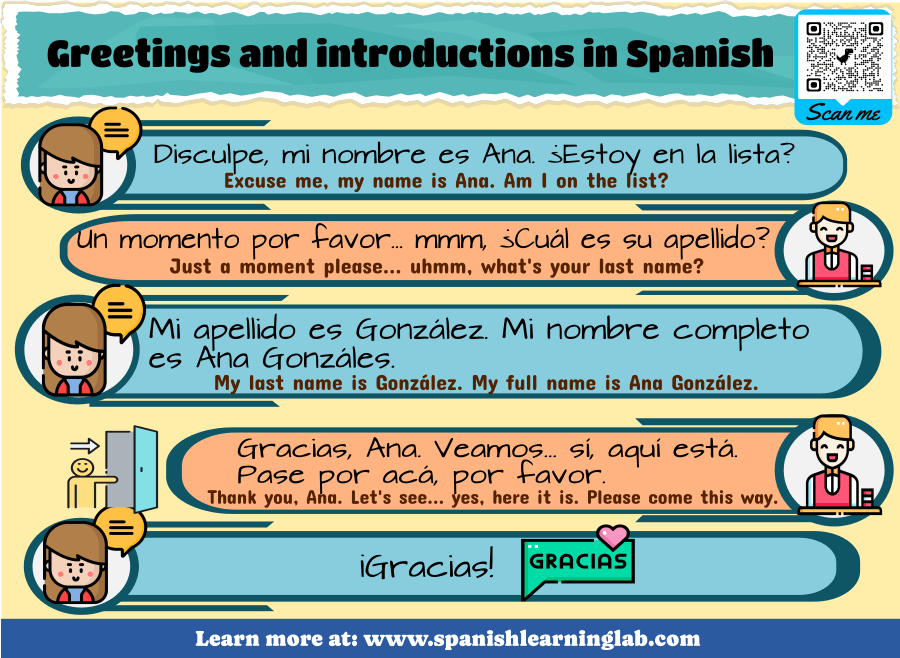
The last conversation example features the expression “MI NOMBRE ES + name” and then a few other important phrases that you may not find in a regular conversation of this kind, but are still important such as: UN MOMENTO POR FAVOR (wait a moment please), PUEDES ENTRAR (you can come in) and GRACIAS (thanks).
Interactive exercise No. 2
Drag the missing words to complete these short dialogues about greetings and introductions in Spanish, and then check your answers.
Ways to say goodbye in Spanish
There are many ways to say goodbye in the language. You might use a very simple “¡Adiós!” but for your first conversation in Spanish, it would be better to use more polite, cool expression such as:
- “¡Fue un placer hablar contigo! (It was a pleasure talking to you!)
- “¡Nos vemos pronto!” (See you soon!)
- “ ¡Me alegra haberte visto! ¡Nos vemos!” (It was great to see you! See you!)
- “¡Fue bueno verte! (It was good to see you!)
- “Es tiempo de irme. Cuídate mucho”, (It’s time for me to go. Take good care of yourself.)

These expressions are more appropriate if you already know the person you’re talking to. Pay attention to this last example:
Dialogue No. 6
- Ricardo: ¡Hola Mercedes! ¿Cómo estás?
- Mercedes: Bien, ¿y tú? Tanto tiempo sin verte.
- Ricardo: Sí, tanto tiempo. voy para el trabajo, ¿y tú?
- Mercedes: Yo voy para mi casa.
- 5 minutos después
- Ricardo: ¡Me alegra haberte visto! ¡Nos vemos pronto!
- Mercedes: Está bien. ¡Fue bueno verte! ¡Cuídate!
Grammar Note:
The verbs ENCONTRAR and CONOCER mean TO MEET in Spanish, but ENCONTRAR is used when we meet old friends or other people we have met before, eg. “Me encontré a Logan”, whereas CONOCER is more appropriate when you meet someone for the first time, eg. “Conocí a Logan”. ENCONTRAR and CONOCER are really important when having a conversation with Spanish greetings and introductions.
Interactive exercise No. 3
Match each of these commonly used Spanish conversation starters with the most appropriate answer in each case. Then, check your answers.
Listening Activity No. 1: Meeting old friends in Spanish
Key expressions in the audio:
- “Estaba un poco distraído” means I was a little distracted
- “Creo que es tiempo de irme” means I think it is time to go
Listening Activity No.2: Making friends in Spanish
Key phrases and questions in the conversation:
- Voy a llegar tarde… means “I’ll be late”
- No me fijé… means “I didn’t notice”
- ¿Por qué la prisa?… means “¿Why are you in a hurry?”
Listening Activity No. 3: Meeting a Patient in Spanish
Extra interactive exercise: Ordering a basic conversation in Spanish
Read the lines of the following basic conversation and put them in the correct order in Spanish. Then, check your answers.
Lesson assignment:
Find a partner and practice the phrases we studied in this lesson by making up your own dialogue using the vocabulary for Spanish greetings and introductions. You can choose any of the situations for introductions presented below, or any other situation you prefer.
- Role play #1: You are a new student in a Spanish class and meet a new classmate. Tell him your name and ask him how he is doing.
- Role play #2: You meet an old friend in a restaurant and introduce your boyfriend/girlfriend in Spanish to your friend.
Spanish introductions and greetings PDF Worksheets
- Greetings and farewells in Spanish (Vocabulary)
- Getting to Know People in Spanish (Speaking)
- Talking about Yourself in Spanish (Speaking)
- Meeting People in Spanish (Reading)
- Essential Phrases and Questions in Spanish – Dialogues in PDF
- Practicing Spanish Introductions – PDF Worksheet
- Basic Farewells in Spanish (Vocabulary exercises)
- Basic Greetings in Spanish (Vocabulary)
- Basic Spanish Phrases and Questions (Vocabulary)
i like this site its very helpful
¡Gracias! We appreciate that 🙂