
Knowing how to introduce yourself in Spanish is always the first step to begin a good, simple conversation, especially with someone you just met. This lesson will cover some common ways to introduce yourself and others in Spanish. You will find many examples of sentences, great illustrations, and several interactive exercise to practice this topic. Let’s start…
The basics for Spanish Introductions – Las presentaciones
First, we will ask you to watch a short video explaining a few basic ways to introduce yourself in Spanish, plus some expressions that are really common in order to introduce someone else too. Please watch the video carefully, as it will be useful to understand and get the best out of this lesson. Please activate the subtitles if you need them. Once you have finished, solve the exercises in the interactive quiz.
How to introduce yourself in Spanish
Before introducing yourself in Spanish, you should use simple greeting like HOLA and then add an expression like MUCHO GUSTO or ask the other person politely ¿Cómo estás?. Here are two examples:
1. ¡Hola! ¡Mucho gusto conocerte!
2. ¡Hola! ¿Cómo estás?
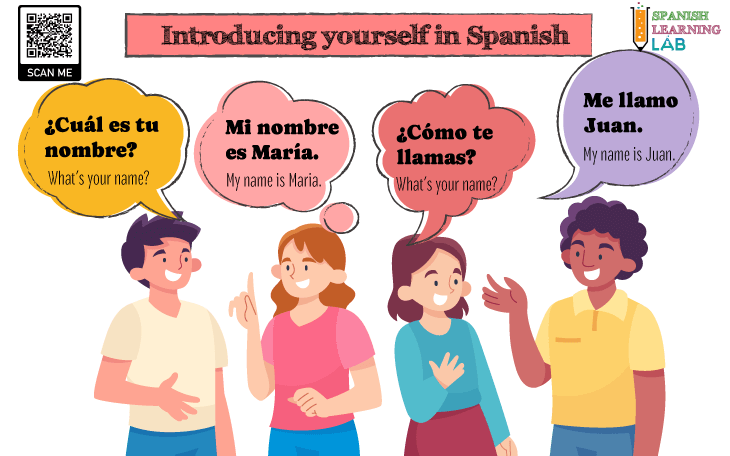
There are three different ways to say your name in Spanish. One of them is by using “Me llamo...”, the other is using “Mi nombre es…” and the last one is using “Soy…” plus your name, just as shown in the following illustration:

Question words like CÓMO (How) and CUÁL (Which) are essential to ask for names, just like in these two very common examples: ¿Cómo te llamas? and ¿Cuál es tu nombre?. In general, the subject pronoun TÚ is more informal than USTED, but it is also more common. Omitting the subject pronoun in a sentence is normal, but make sure you are using the right conjugation of the verb for the subject even if you leave it out.
Here is a list of ways to introduce yourself in Spanish and ask for people’s names:
- ¡Hola! Mi nombre es Alex (traducción literal)
- Hello! My name is Alex
- ¡Hola! (Yo) Me llamo Jon (LLAMO la conjugación del verbo LLAMAR)
- Hello! My name is Jon
- ¡Hola! (Yo) soy Jon. (SOY es una forma del verbo SER – to be)
- Hello! I am Jon
- ¿Cuál es tu nombre? (TU es un adjetivo posesivo que se refiere a EL o ELLA)
- What’s your name?
- ¿Cuál es su nombre? (SU es un adjetivo posesivo para algo que le pertenece a USTED)
- What’s your name?
- ¿Cómo te llamas (tú)? (Manera un poco informal de preguntar nombres)
- What’s your name?
- ¿Cómo se llama (usted)? (Manera un poco formal en Latinoamérica de preguntar nombres)
- What’s your name?
- ¿y tú? (Forma de regresar una pregunta en español)
- And you?
Let’s briefly analyze the structure of the Spanish introductions that we have covered so far. First, the word “tu” in TU NOMBRE and “su” in SU NOMBRE are possessive adjectives. Notice that the verb LLAMAR (to call) changes its form depending on the pronoun we use. Grammar is important but for now, we will ask you to focus on their meaning and pronunciation as we will develop more on grammar in future lessons.
Interactive exercise No. 1
Drag the words into the correct spaces to complete these basic expressions and questions for personal introductions in Spanish.
How to introduce someone else in Spanish
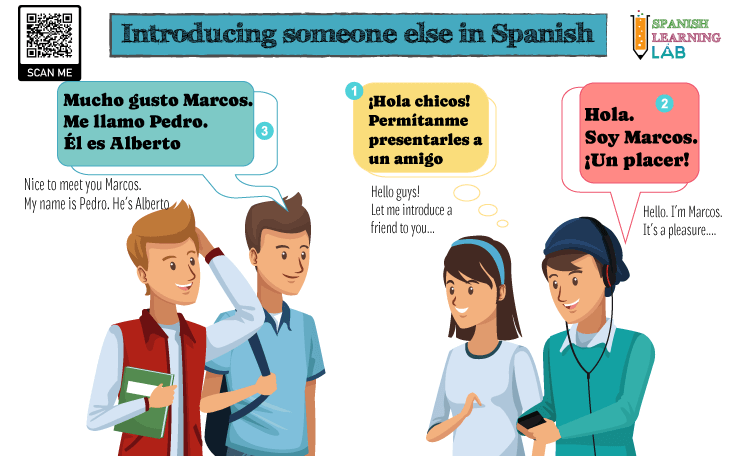
In order to introduce someone in Spanish, we will need the verb SER in its forms ES and SON. Basically, if we are referring to one person, we will use “ES” as in “ÉL ES…” (he is) and “ERES“for “TÚ“as in “TÚ ERES…”, but if we are referring to several then we must use “SON” as in “ELLOS SON…” (they are). If you would like to sound more formal, you can use “Permíteme presentarte a...” (Let me introduce…) and similar expressions, as shown in the following image:

Please mind the pronoun you choose so that you use a pronoun that corresponds properly in gender and number to the person you are introducing. Also, when you introduce someone else in Spanish, it is important to mention if this person is your friend, relative or something else using possessive adjectives, for example: “Él es mi amigo” (he is my friend). Take a look at the examples in the following picture:
Here are some more examples of Spanish introductions that you can read and listen to. Focus on pronunciation and try to find out grammatical patterns in the following examples:
- Su nombre es Ana (Presentando a una mujer – SU es un adjetivo posesivo que significa HER)
- Her name is Ana
- Ella es Mary (ES es una forma de SER, to be)
- She is Mary
- ¿Cuál es su nombre? (“su” = his/her)
- What’s her name?
- ¿Cuáles son sus nombres? (“sus” = their)
- What are their names?
- ¿Cómo se llama (ella)? (Forma de preguntar por una tercera persona)
- What’s her name?
- ¿Cómo se llaman (ellos)? (Forma de preguntar por terceras personas)
- What are their names?
- Permíteme presentarte a mi amigo.
- Let me introduce my friend to you
- Les presento a la nueva maestra
- I introduce the new teacher to you
As we explained before, if you want to introduce a friend in Spanish, you can begin with:
- “Ven, quiero presentarte a alguien” (Come, I want to introduce someone to you)
- “¿Te puedo presentar a alguien?” (May I introduce someone to you?).
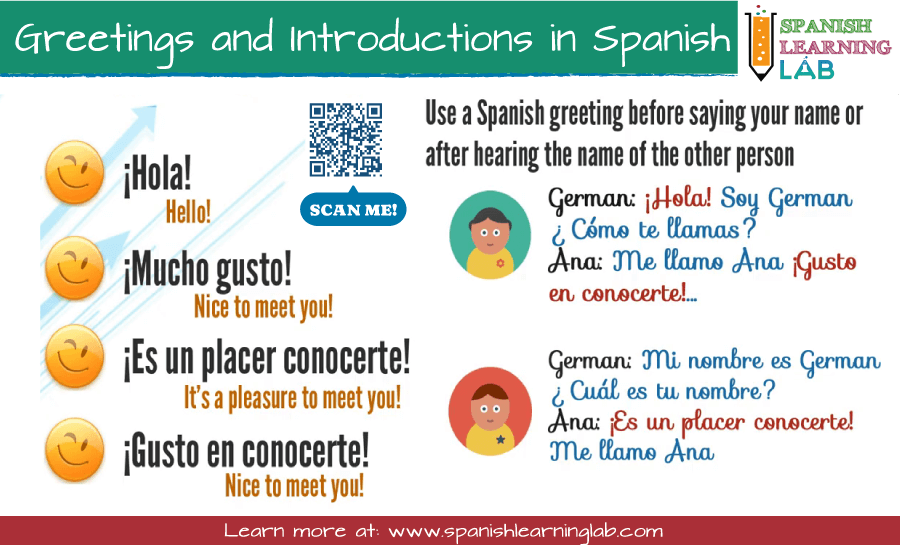
Perhaps you want your friend to introduce his/her friend to you, in which case you can tell him/her “Presentame a tu amigo/a” (Introduce your friend to me). When introducing “un amigo”, try to choose the best greeting according to the person’s age and the formality of the situation. Remember that using the correct greetings in Spanish before saying your name is customary, and there are many you can use to sound casual or a bit more formal, as shown in the examples in this picture:
Interactive exercise No. 2
Complete each of the expressions or questions used to introduce other people in Spanish by dragging the correct words into the spaces.
Listening Activity: Ways to introduce yourself and others in Spanish

Listening Activity No.2: Greeting and introducing oneself in Spanish
Spanish introductions and greetings PDF Worksheets
- Greetings and farewells in Spanish – PDF Worksheet (Vocabulary)
- Practicing Spanish Introductions – PDF Worksheet
- Getting to Know People in Spanish: PDF Worksheet (Speaking)
- Talking about Yourself in Spanish: PDF Worksheet (Speaking)
- Meeting People in Spanish – PDF Worksheet (Reading)
- Dialogues – Introductions and greetings in Spanish
- Talking to Friends in Spanish – Conversation in PDF Worksheet
- Introducing Yourself in Spanish Class – PDF Conversation
Hi, am I right if I think “Les presento a la nueva maestra” should be translated as ” I introduce the new teachers to you”. I mean, “Les” refers to plural nouns, so it would be “teachers” not “teacher”?
Great question! The translation we provided is fine as “I introduce the new teacher to you (the students)”. The reason is that “LES” refers to the students, not the teacher in this sentence. If we want to introduce the new teacher to the principal of the school, then we would say “LE presento a la nueva maestra” (a usted). Similarly, if we were to introduce the teacher to a friend, then we could say “TE presento a la nueva maestra” (a ti). Hope it helps a little!
Ya!
¿Cómo te llamas?
Hola! Me llama Mariah. ¿Y tu?
Just so you know, I came up with a fake name, because I don’t want people to know my personal info… That is not my real name! 🙂
¿Como estas?
My mother grew up in Mexico city and is teaching me, so I already knew a couple of those things, but I didn’t know some of the greetings. I really liked it! Thank you!
We’re glad you liked this article. Best of luck learning Spanish. ¡Hasta pronto! 🙂
¡Hasta pronto!:)
I love speaking Spanish! Thank you!
This fun yes:)
My name is Andrew and I am just learning spanish
¡Buena suerte aprendiendo español! Saludos
Why can’t question 5 be answered “mi hombre es Diana”?
Hola. Well, the question is “¿Cuál es el nombre de tu mamá?” (What is her mother’s name?) so we are asking about “HER”. HER/HIS are translated as “Su” into Spanish. Her name is Marta – Su nombre es Marta.