
Reflexive pronouns in Spanish are words that are used to talk about actions that are reflected on the subject of the sentence. In this lesson, we will present you with a chart of these words, along with many examples, simple explanations on how to use them in different situations. You will have the chance to practice with exercises through engaging interactive quizzes. Let’s begin…
What are reflexive pronouns in Spanish?
Reflexive pronouns in Spanish are a special type of pronoun that, unlike “Yo, tú, él…“, do not refer to a subject but to an object and indicate who is affected or will be affected by an action (verb), for example:
- “Yo me baño temprano” (Here, the pronoun “ME” indicates that the action of “bathing” affects me)
- “Tú te duermes tarde” (Here, the pronoun “TE” indicates that the action of “falling asleep” falls on yourself.)
In a previous lesson on reflexive verbs, we explained that reflexive verbs and pronouns are not the same thing. A reflexive verb is simply a verb in infinitive plus a reflexive pronoun, e.g. VERTIRSE, where VESTIR represents the verb in infinitive form and SE is a pronoun. Take a look at the examples in the following picture, which includes some sentences with the reflexive verb BAÑARSE:
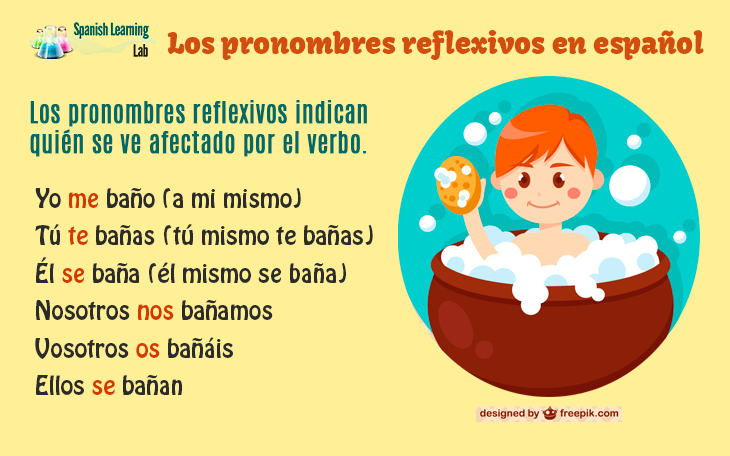
Spanish reflexive pronouns chart and placement
Spanish reflexive pronouns are always placed before a conjugated verb they are related to, just like the pronouns “ME” and “SE” in these two examples:
- (Yo) me baño (I take a shower)
- “Ella se acostumbró a su trabajo” (she got used to her job).
They could also be placed after a verb in infinitive to form a reflexive verb like “BAÑARSE” as we saw above. Keep in mind that the reflexive pronoun must match the subject in the sentence, which means that after a subject pronoun like YO, we will use the reflexive pronoun ME, and after NOSOTROS we will add NOS. You must memorize which reflexive pronouns corresponds to each personal pronoun. Here is a chart showing this relationship:
| Subject Pronoun | Reflexive Pronoun | Verb (bañar) |
|---|---|---|
| Yo | Me | Baño |
| Tú | Te | Bañas |
| Él/Ella/Usted | Se | Baña |
| Nosotros | Nos | Bañamos |
| Vosotros | Os | Bañáis |
| Ellos/Ustedes | Se | Bañan |
Interactive quiz No. 1
Drag and drop these Spanish reflexive pronouns next to the corresponding personal pronouns in these basic sentences. Then, check your answers.
Making sentences using Spanish reflexive pronouns
It’s important to know that not all verbs in Spanish have a reflexive form, so this type of pronoun will not be used in every sentence. Also, note that each personal pronoun has its corresponding reflexive pronoun. If we change the reflexive pronoun to one that does not correspond to the personal pronoun, then the reflexive pronoun will become an indirect object pronoun, for example:
- “Yo me cepillo los dientes” (Here, the reflexive pronoun “me” indicates that I perform the action myself, and it affects me.)
- “Ella me cepilla los dientes” (The indirect object pronoun “me” indicates that someone else is doing the action for me, even though it affects me.)
Let’s illustrate this with an example; in the sentence “Yo me baño todos los días“, I am saying that I myself take soap and other things to bathe, that is, the action of “bathing” affects me. Similarly, if we say, “Ellos se ponen la ropa” (they put their clothes on), then it means that they perform that action by themselves.
Interactive quiz No. 2
Read these simple sentences and select the pronoun that correctly reflects the main action on the subject of each sentence.
Reflexive pronouns in Spanish are particularly useful when talking about your daily routine, for actions like “Yo me baño” (I take a shower – by myself implicitly), “Tú te bañas” (You take a shower by yourself) and “Ellos se bañan” (They take a shower by themselves). Here are some examples of sentences using Spanish reflexive pronouns properly to talk about different topics. Check how each subject pronoun matches each reflexive pronoun.
|
BAÑARSE – Yo me baño a las 7 de la mañana
BATHING – I bathe at 7 in the morning
|
|
DIVERTIRSE – Ella se divierte con sus amigos
HAVE FUN – She has fun with her friends
|
|
CONFUNDIRSE – Tú te confundes todo el tiempo.
CONFUSING – You get confused all the time.
|
|
OLVIDARSE – Nosotros nos olvidamos de la tarea
FORGET – We forgot about homework
|
|
DESPERTARSE – Vosotros os despertáis tarde siempre
TO WAKE UP – You wake up late always
|
|
ENOJARSE – Ellos se enojaron con el presidente
ENOJARSE – They got angry with the president
|
Interactive quiz No. 3
Read these sentences and select the one that uses reflexive pronouns correctly to reflect the action on the subject.
Interactive quiz No. 4
Fill in the blanks with the correct reflexive pronoun in Spanish for each case and check your answers.
As a final note, remember that we do not need to use reflexive pronouns for all verbs. In fact, knowing when to use them is a challenge even for native speakers when we are little, and we learn to master them as we grow up by making a lot of mistakes. Make sure to check the related lessons and good luck learning Spanish – ¡Hasta pronto!
Related Spanish Worksheets:
- Reflexive Verbs in Spanish – PDF Word Search
- Conjugating Reflexive Verbs in Spanish (Chart + Sentences)
- Spanish Direct Object Pronouns – PDF Worksheet
- Possessive Adjetives in Spanish – PDF Worksheet
I am very confused in my understanding reflexive verbs are used when the action of the verb is reflected back onto the subject.(shaving yourself, loving yourself). Yo te amo is not reflective verb.
Hi Gloria,
Yes, reflexive verbs and pronouns are very confusing. We will improve the lesson to include some more examples. AMAR is not a reflexive verb, that is true, but you can add a reflexive pronoun in some cases for example: “Yo me amo (a mí mismo)” (I love myself), “(a ti) Yo te amo” (I love you – here the action is reflected onto the object “a ti” which is implicit) and “Ellos son lindos. Yo los amo” (They are cute. I love them – here LOS refers to ELLOS as well, even if you omit the first part of the sentence). You can do the same with many other verbs, for example: “(a ti) Yo te cocino el desayuno” (I cook breakfast for you). When you see a non-reflexive verb like GUSTAR, AMAR or COCINAR, think there is a prepositional phrase hidden at the beginning of the sentence, eg. “(A mi) me gusta…”, “(A ustedes) les cocino” and so on.
“Esperamos que sea de ayuda”. ¡Gracias por expresar tu duda!