
Being able to express wishes in any language is very important in both formal and informal conversations. In this lesson, we’ll learn different ways to express wishes in Spanish through many examples in the present tense with verbs like “desear” (to wish) and “querer” (to want), others in the simple conditional like “gustaría” (I would like), and expressions like “ojalá + subjunctive” in Spanish. You will be able to practice with two listening activities and interactive exercises. Let’s begin…
Vocabulary and Grammar: Expressing wishes in Spanish.
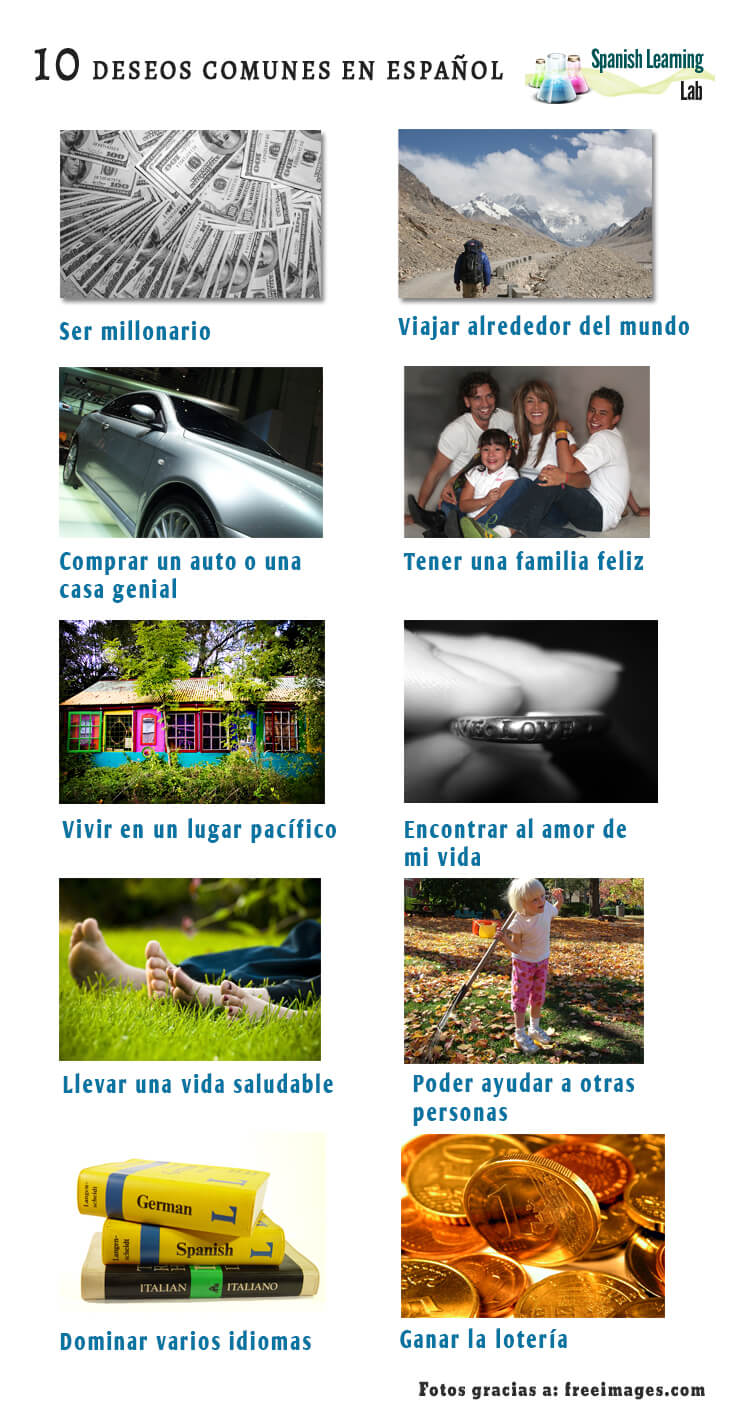
Let’s begin by introducing 10 common wishes in Spanish people have, such as “Ser millonario” (being a millionaire) or “Vivir en un lugar pacífico” (living at a peaceful place). Know that you can check their pronunciation later with the audio examples in this lesson.
Saying “I wish” and “I want” in Spanish
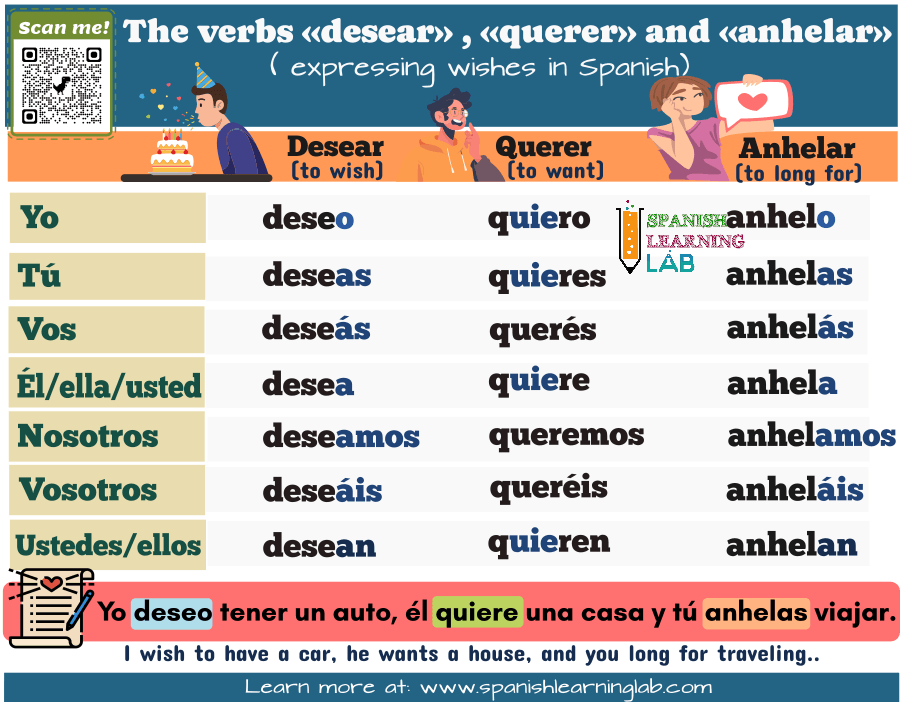
In order to say what we “wish” and “want” in Spanish, we can use two verbs: “DESEAR” (to wish) and “QUERER” (to want). These verbs are commonly followed by a verb in infinitive such as “TENER” (to have), for example:
- “Yo deseo tener un auto” (I wish to own a car.)
- “Yo quiero tener una casa grande“. (I want to have a big house.)
Notice that QUERER is a stem-changing verb, so its stem will change to “QUIER-” for all pronouns, except for “Nosotros”. Pay attention to the conjugation of these verbs in the present tense:
Listen to the following examples using both DESEAR and QUERER for expressing wishes in Spanish.
|
Yo deseo ser millonario
I wish to be a millionaire
|
|
Nosotros deseamos comprar una casa muy pronto.
We wish to buy a house very soon.
|
|
Yo quiero ganarme la lotería
I want to win the lottery
|
|
¿Tú quieres conocer a alguna celebridad?
Do you want to meet a celebrity?
|
Interactive exercise No. 1
Complete these sentences about personal wishes in Spanish with the correct conjugations of the verbs in parentheses.
Expressing wishes with verbs in the conditional tense in Spanish
Another way to express our desires in Spanish is by using the verbs “desear” (to wish), “gustar” (to like), and “encantar” (to love) in their conditional form. Keep in mind that both “gustar” and “encantar” are conjugated the same way as “desear” in the conditional, but most of the time they are used with indirect object pronouns for this purpose. When accompanied by these pronouns, we simply add the ending “-ía,” as shown in the following conjugation table:

Following this structure, it will be necessary to use a direct object pronoun before GUSTARÍA, such as “ME” in “Me gustaría…” (I would like to) and “TE” in “Te gustaría…” (you would like to). After the word GUSTARÍA, we will add an activity like the ones in the image above, for example:
- “Me gustaría poder ayudar a otras personas” (I would like to be able to help other people).
|
Me gustaría viajar alrededor del mundo
I would like to travel around the world
|
|
¿Te gustaría dominar varios idiomas?
Would you like to master several languages?
|
|
¿A ustedes les gustaría vivir unos noventa años?
Would you like to live 90 years?
|
As explained in the image, the verb “desear” (to wish) has a conditional forms for each subject pronoun in Spanish, while “gustar” (to like) and “encantar” (to love) are used with indirect object pronouns plus the verb with the suffix “-ía,” as in the previous examples. It is very common to use the verb “desear” in its conditional form and then add a verb in the infinitive, for example: “Desearía tener” (I wish I had…) and “Desearía poder” (I wish I could). Pay attention to the following sentences with wishes using the conditional tense in Spanish and the verb “desear”:
|
Desearía poder ayudar a otras personas
I would like to help other people
|
|
Desearía vivir en un lugar pacífico.
I wish I could live in a peaceful place
|
|
Ellos desearían explorar el espacio como en las películas.
They wish they could explore the space like in the movies
|
Interactive exercise No. 2
Drag the missing words to complete these sentences about wishes using the conditional tense in Spanish. Then, check your answers.
Expressing wishes with the subjunctive in Spanish
It’s very common to express wishes in Spanish using the words “ojalá” and “que” plus a verb in a subjunctive tense, such as the present or imperfect subjunctive tenses. Keep in mind that you must conjugate the extra verb in either tense correctly according to your intention. The parts “que yo,” “que usted,” “que vosotros,” etc., indicate the subjunctive conjugation we should use and are entirely optional, as shown in the following examples:

- Present subjunctive: Ojalá (que yo) me gane la lotería. (I hope I win the lottery.)
- Present subjunctive: Ojalá (que ellos) terminen la operación con éxito. (I hope they complete the operation successfully.)
- Present subjunctive: ¡Que (usted) tenga un muy buen día! (Have a great day!)
- Imperfect subjunctive: Ojalá (que tú) vinieras a visitarme más seguido. (I wish you would come to visit me more often.)
- Present subjunctive: Ojalá (que nosotros) fuéramos millonarios. (I wish we were millionaires.)
Last but not least, another way to say what you would like to do is by using the verb “QUERER”(to want) in its subjunctive form too as “Quisiera” as in “(Yo) quisiera ser millonario“. Here are more sentences about wishes in Spanish with the subjunctive tense:
|
Quisiera tener un auto o una casa genial.
I would like to have a nice car or a nice house
|
|
La fundación quisiera ayudar a más niños en la comunidad.
The organization would like to help more children in the community.
|
Listening Activity No.1: Talking about wishes in Spanish
Listening Activity No.2: “If I won the lottery” – Si ganara la lotería
Key phrases in the conversation:
- “¿Escuchaste las noticias?”, means “Did you hear the news?”
- “¡Imagínate!”, Means “Imagine!”
- “Luna de miel”, means “Honeymoon”
We got to the end of this lesson. We hope that you are able to get a general idea on how you can express what you wish for in Spanish with the verbs QUERER, DESEAR and GUSTAR. Keep on practicing with our resources! ¡Hasta la próxima!
Related Spanish Worksheets:
- The Conditional Simple in Spanish – PDF Worksheet
- The Conditional Perfect in Spanish – PDF Worksheet
- “What would you do if …?” in Spanish – Conversation Cards
- Problem-Solving Scenarios in Spanish (Conversation cards)