
Feelings and emotions in Spanish, los sentimientos y las emociones, are a special kind of adjectives often found in everyday conversations. In this lesson, we will learn a list of moods through a nice video and explain how you can use them to make simple sentences. You will find examples of conversations using a list of feelings and emotions in Spanish, plus a main listening activity and quizzes that will test if you can recognize the key vocabulary in the lesson. Let’s start…
Introductory video: A list of feelings and emotions in Spanish
First, we will ask you to watch a short video showing pictures and drawings representing a list of feelings and emotions in Spanish. We have included some notes about the images as well. We recommend you to watch the video as some of its main points and vocabulary will be used later in the conversations. It is only in Spanish, but you can activate the captions (cc) if you need translation.
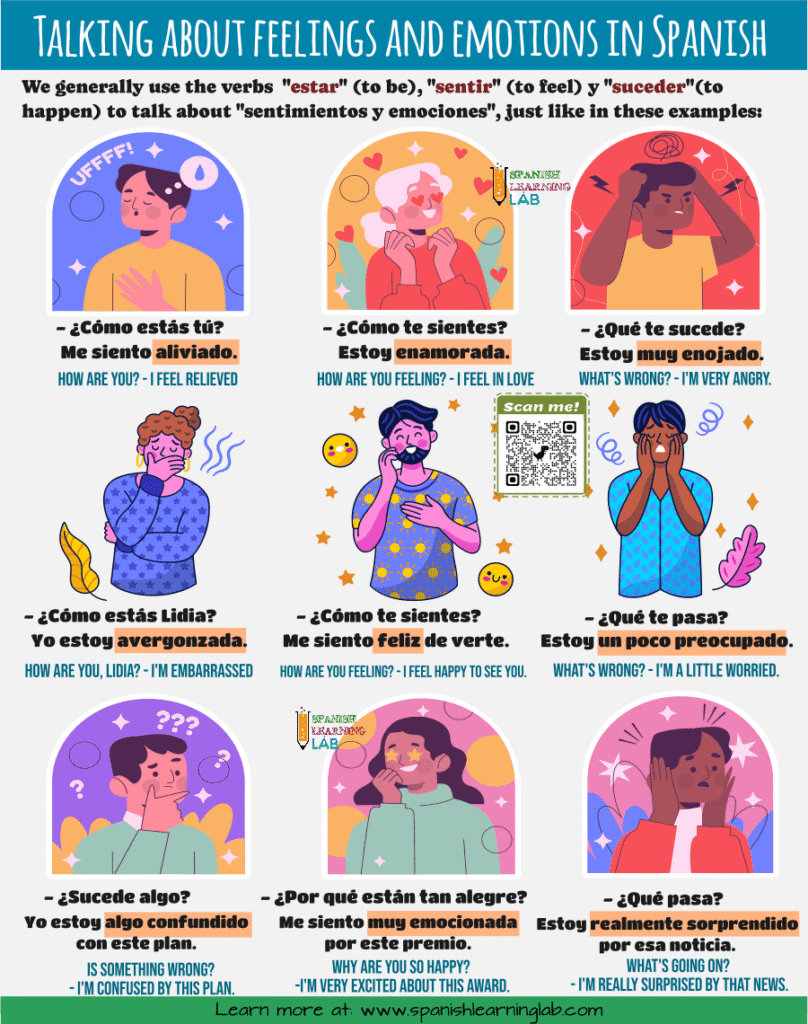
The image below shows the most important vocabulary for feelings and emotions in Spanish with some great illustrations. Look at them and try to memorize these words.

Interactive exercise No. 1
Read the words for emotions in Spanish in this interactive quiz and drag them under the illustrations that match their meaning.
Expressing feelings and emotions in Spanish with ESTAR
First, words that are used to describe features or state are all Spanish adjectives. For the purpose of expressing feelings and emotions in Spanish, it is necessary to understand the basics to use adjectives, which in this case are words like “enojado” and that can suffer a few variations while talking about a subject,e.g. “enojado”, “enojada”, “enojados” and “enojadas”. The form of the adjective has to agree with the noun it describes. Since moods are temporary states, then we can use ESTAR plus feelings to describe how we feel at a given moment. The verb ESTAR will be used following this structure:
Subject(optional) + ESTAR (conjugated) + Spanish feelings (emociones/sentimientos) e.g. Yo estoy alegre
- Yo estoy emocionado. (I am excited!)
- Ella está avergonzada. (She is ashamed,)
Some of the words for emotions have synonyms, words that mean the same, and antonyms, words that mean the opposite. To illustrate this, the synonyms for ENOJADO are MOLESTO, BRAVO and ENFADADO. In order to ask how someone feels in Spanish, you could use: ¿Cómo estás? (How are you) and ¿Cómo te sientes? (How do you feel?). ¿Cómo estás? is a little more casual. Moreover, it is possible to ask with: ¿Qué te pasa?/ ¿Qué te sucede? (What´s wrong?).
- ¿Cómo estás? – Estoy estresada. (How are you? – I’m stressed.)
- ¿Cómo te sientes? – Me siento decepcionado. (How do you feel? – I feel disappointed.)
- ¿Qué te pasa? – Yo ando un poco triste hoy. (What’s wrong? – I’m a little sad today.)
These two ways to ask are a little more informal for everyday conversations, but they are something a doctor would ask normally. You can also ask using ESTAR + an emotion, for example: ¿Tú estás enojado? (Are you angry?). Pay attention to these example sentences about emotions and feelings in Spanish with some of the expressions and questions above.
Interactive exercise No. 2
Look at the people on the cards, complete the sentence with the correct emotion in Spanish, and turn the card over to check your answers.
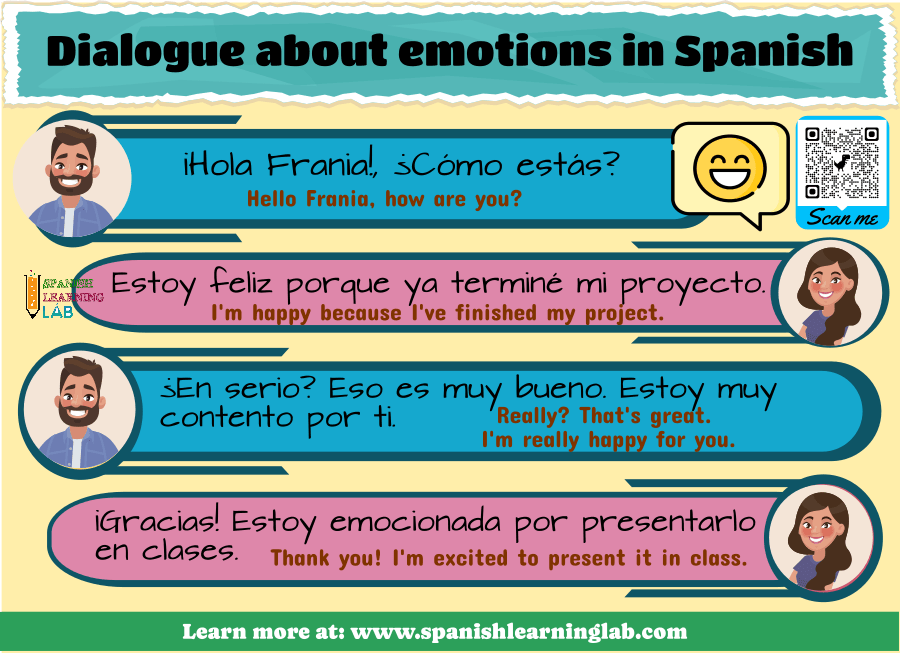
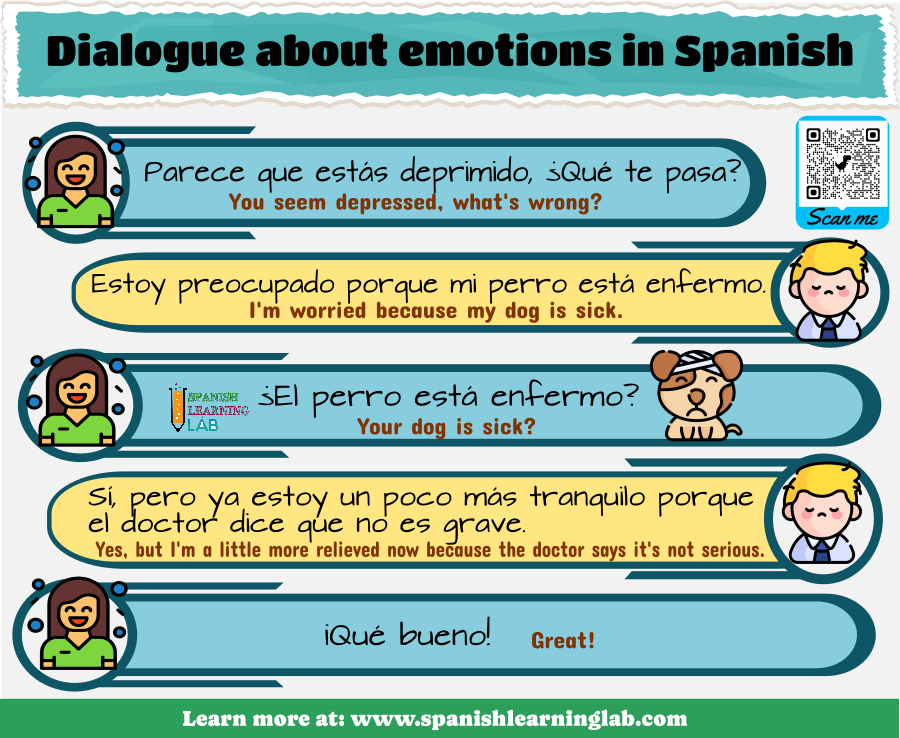
Conversations with ESTAR + feelings and emotions in Spanish
Example No. 1
Example No. 2
- Frania: Hola Jorge. Vine a visitarte. ¿Cómo te sientes?
- Jorge: Me siento enfermo, o más bien, estoy enfermo. Tengo gripe.
- Frania: Estoy apenada por no venir antes. Discúlpame.
- Jorge: No te preocupes. Me alegra que tú estés saludable.
Interactive exercise No. 3
Read the sentences and drag the adjectives that have the same meaning as the main emotion in each sentence.
Making feelings and emotions stronger with Spanish adverbs
The verb SENTIR (to feel) can also be used for expressing feelings and emotions in Spanish. It is often accompanied by a reflexive pronoun, e.g. “Yo me siento + emoción”. If you want to maximize or minimize a feeling in Spanish, you can use adverbs of quantity such as MUY, BASTANTE, UN POCO, REALMENTE and so on as in the sentences: “Me siento muy emocionada” (I feel very excited) and “Estoy un poco deprimida” (I am a little depressed).
Finally, you can say the reason why you are in a certain mood using the word PORQUE (because) + a simple sentence giving a reason, for example: “Estoy alegre porque hoy es mi cumpleaños“. Here are a few more conversations. Try to discover other expressions and rules we have not explained and find the vocabulary presented in the video.
Example No. 3
- Jorge: ¿Qué te sucede Frania?
- Frania: Estoy cansada de trabajar y todavía tengo cosas que hacer.
- Jorge: ¡Vaya! Estoy sorprendido de ver todo lo que has hecho.
- Frania: Ya estoy soñolienta…
- Jorge: Pobre… mejor ve a dormir
Example No. 4
Example No. 5
- Jorge: ¿Cómo estás?
- Frania: Muy aburrida y enojada porque no puedo salir por la lluvia.
- Jorge: A mí me gusta la lluvia. Estoy enamorado de este clima.
- Frania: Yo no… Estoy asustada de tantos truenos.
Interactive exercise No. 4
Drag the verbs or other words into the correct spaces to complete these sentences and questions about feelings and emotions in Spanish.
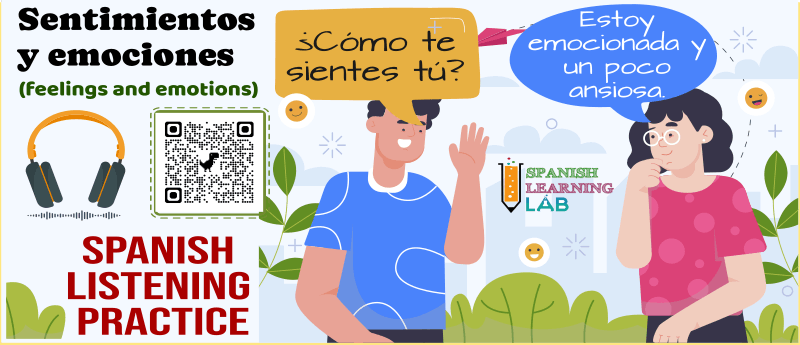
Listening activity: “How are you feeling?” in Spanish
Key expressions in the conversation:
- “Te estaba buscando…”, means “I was looking for you…”
- “Nos estamos mudando…”, means “We are moving”
- “Pronto se les pasará…”, means “They will forget it soon”
Final notes and lesson quiz: Los sentimientos y las emociones
When talking about feelings and emotions in Spanish, it is important that you know that ESTAR is used for things that change over time, whereas SER has a more permanent character. SER will be used to describe personality traits or people’s appearance. In addition, SENTIR has a more formal connotation, but it is very common in the language. In order to remember these words and expressions easily, you can create a chart with synonyms and antonyms, and practice as much as you can.
Related Spanish Worksheets:
- Adjectives for Feelings and Emotions in Spanish
- Emotions and Feelings in Spanish – PDF Worksheet
- Talking about Personality in Spanish – Speaking cards
- Feelings and Emotions in Spanish (Reading exercises)
I LOOOOVE this site
¡Muchas gracias!