
¡Hola! We have already studied how to write and use numbers from 1-20 and numbers 20-100 in two independent lessons. In this lesson, we will learn about Spanish numbers over 100, “los números después del cien”, which are normally used to talk about money transactions, dates and many other purposes. You will find many examples of sentences with these numbers, recordings, simple explanations and several interactive quizzes for practice. Let’s start…
Writing and saying Spanish Numbers 100 to 1000
The first group of words we will study are those in a range between 100 and 1000. For these numbers, we must write the words independently, similar to the way they are written after 30. Thus, we will use the conjunction “Y” to separate the last two numbers, for example:
- “Doscientos cincuenta y cinco” (“Two hundred and fifty-five”)
- “Trescientos cuarenta y tres”. (“Three hundred and forty-three”)
The number 100 by itself will be called “CIEN”, but when used with other numbers it will change to CIENTO. That being said, the number 103 would be “CIENTO TRES” not “CIEN TRES”.
Spanish Numbers 100-200
For Spanish numbers between 100 and 200 like 135, first we will use CIENTO, and then we write the remaining numbers the way we did in the previous lessons. Remember that the numeral “35” would be written as “TREINTA y CINCO”, so the final number would be CIENTO TREINTA Y CINCO. As you can see, to write and say Spanish numbers over 100 you really need to know those between 1 and 100 very well. Listen to some sentences using Spanish numbers 100-200 and try to recognize the patterns we have explained.
|
CIEN- ¿Me puedes prestar cien dólares?
Can you lend me 100 dollars?
|
|
CIENTO UNO – Hay ciento un dálmatas
There are 101 Dalmatians
|
|
CIENTO VEINTICINCO – Hay ciento veinticinco especies
There are 125 species
|
|
CIENTO OCHENTA Y NUEVE – El vestido cuesta ciento ochenta y nueve dólares
The dress is 189 dollars
|
Interactive quiz No. 1
Read each number sequence and fill in the blank with the written forms of the missing Spanish numbers 100 to 200. Then, check your answers.
Spanish Numbers over 200
Spanish numbers over 200 suffer a gender change to agree with the gender of the noun they modify. This means that if the number precedes a masculine noun like LÁPICES, we should say “doscientos lápices“, but if it precedes a feminine noun like ROSAS, then we would say “doscientas rosas” changing the end of the number from –OS to -AS. Know that to write the numbers in-between 200 and 300, for instance, we just write “doscientos” plus numbers 1-100, as in “Doscientos veintiuno” (221). Below, there is a list of Spanish numbers over 200 and sentences using them in real situations.
| Sentences using numbers over 200 |
|---|
|
Soy el número doscientos en la fila
I am number 200 in the row
|
|
Tú eres el número doscientos diecinueve
You are number 219
|
|
Ellos son trescientos guerreros
They are 300 warriors
|
La Catedral de Santo Domingo tiene más de cuatrocientos años de existencia. The Cathedral of Santo Domingo is over four hundred years old. |
Hay cerca de quinientas especies de tiburones, pero solamente treinta han atacado humanos. There are about 500 species of sharks, but only 30 have attacked humans. Learn more about SHARK here. |
|
Tenemos seiscientos dólares ahorrados
We have saved up 600 dollars
|
|
Hay setecientas personas audicionando
There are 700 people auditioning
|
|
Ella tiene ochocientas fotos famosas.
She has 800 famous pictures
|
|
Eso cuesta novecientos dólares.
That costs 900 dollars
|
|
Tengo mil años para ser feliz.
I have 1000 years to be happy
|
Interactive quiz No. 2
Drag these numbers 200 to 1000, and drop them in the correct order to form their written form in Spanish.
Writing and saying Spanish numbers over 1000
All Spanish numbers over 1000 have a cumulative behavior. To illustrate this, the number “a thousand two hundred and fifty” would translate it almost literally as “mil (1000) + doscientos cincuenta (250)”. In addition, a number such as “five thousand nine hundred and three”, would be translated as “cinco (5) + mil (1000) + novecientos (900) + tres (3)” that is “cinco mil novecientos tres”. The behavior is the same for larger numbers.
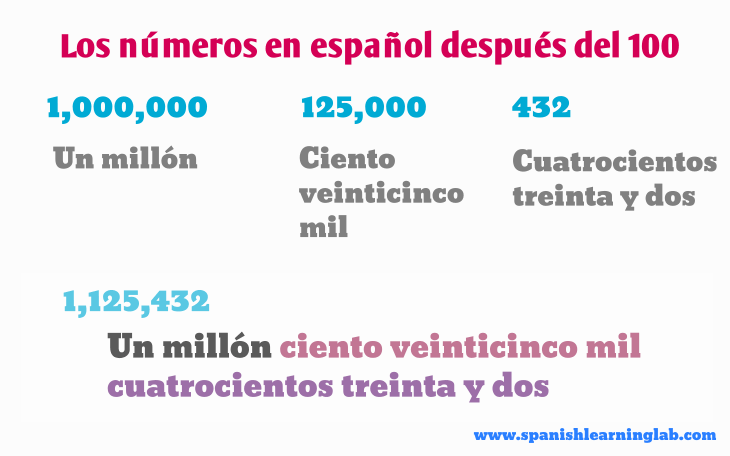
Listen to some sentences using Spanish numbers over 1000 and check the names of other specific numbers.
|
1756- Mozart nació en mil setecientos cincuenta y seis
Mozart was born in 1756
|
|
3658 – Su cuenta tiene tres mil seiscientos cincuenta y ocho seguidores
Here acount has 3658 followers
|
|
100,000 – El auto vale cien mil dólares
The car is 100,000 dollars
|
|
1,000,000 – La lluvia va a parar en un millón de años
The rain will stop in a million years
|
Interactive quiz No. 3
Read these sentences and fill in the blanks with the written form of the Spanish numbers over 100 in parentheses. Then, check your answers.
Listening Activity: Recognizing numbers in Spanish
Related Spanish Lessons:
- Numbers in Spanish from 1 to 20
- Numbers in Spanish from 20 to 100
- Ordinal Numbers in Spanish
- Spanish Numbers 1-20 – PDF Word Soup
- Numbers in Spanish 1 to 100 (Matching + sentences)
- Numbers over 100 in Spanish (Matching + sentences)