
¡Hola y bienvenido! We have already learned some basic ways to make comparisons in Spanish using MÁS plus adjectives in a previous lesson. This time, we will learn how to use the structure «TAN COMO» to compare things in Spanish. We will study this structure through several examples and exercises in interactive quizzes. Let’s start…
Using TAN + Adjectives + COMO for comparisons of equality in Spanish
It is really common to say things like “Más interesante” or “Menos importante” when we make comparisons in Spanish. People will definitely use that structure a lot in daily conversations. However, people will also discuss how things are similar and that’s when we will need the structure TAN + Adjectives + COMO, which would be the equivalent to “As + adjectives + as” from the English language. Check these two sentences:
- Él es tan guapo como un actor famoso. (He is as handsome as a famous actor).
- Alberto es tan rápido como Pedro. (Francisco is as tall as Pedro.)
When the word “TAN” is used by itself without “COMO” it has the same meaning as SO in English to emphasize a quality or trait, for example: “tan guapo” (so handsome). However, when used as TAN… COMO (“AS + adjective + as”), it will become a comparison between objects or people, just as shown in the examples in the following picture:
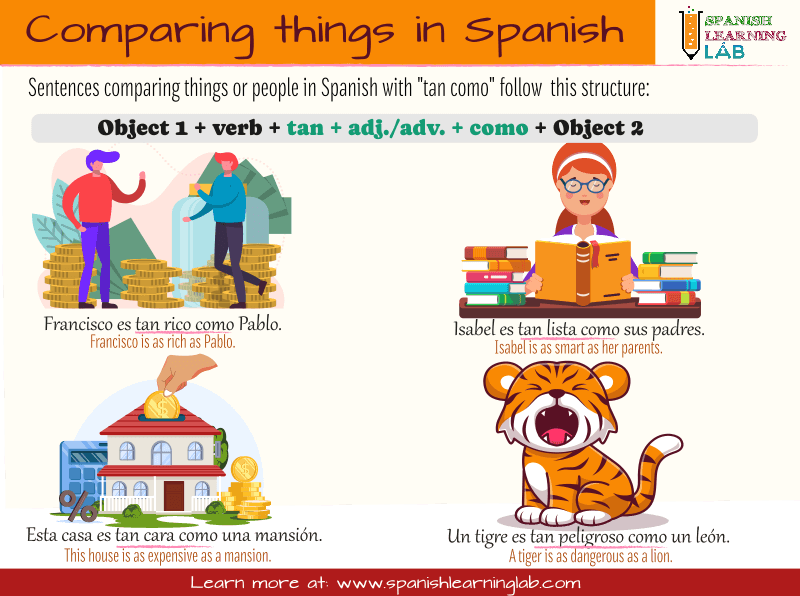
Read the following examples of sentences applying the rules to make comparisons of equality in Spanish using «TAN COMO» and notice how similar they are to their English translation.
|
Fernando es tan alto como Francisco.
Fernando is as tall as Francisco.
|
|
Ana es tan inteligente como Alberto.
Ana is as smart as Alberto.
|
|
Mi trabajo es tan difícil como el tuyo.
My job is as difficult as yours.
|
|
Una libra de oro pesa tanto como una libra de plumas.
A pound of gold weighs as much as a pound of feathers.
|
|
Mi español es tan bueno como el tuyo.
My Spanish is as good as yours.
|
|
¿Una gacela corre tan rápido como un leopardo?
Does a gazelle run as fast as a leopard?
|
Interactive quiz No. 1
Fill in the blanks with the missing words to make comparative sentences with «TAN COMO» in Spanish, and then check your answers.
Some special uses of TAN COMO for comparing things in Spanish
Now, we will study some special situations in which you will have to use the structure TAN COMO in Spanish differently.
Using Adverbs with TAN COMO in Spanish
It is also possible to use adverbs for comparisons of equality in Spanish too. The difference is that we will not be comparing two things, but the way actions are performed by the subject of the sentence, for example:
|
Ella dice que puede hablar español tan bien como habla inglés.
She says she can speak Spanish as well as she speaks English.
|
|
María puede resolver estos ejercicios tan fácilmente como Ana.
Mary can solve these exercises as easily as Ana.
|
|
Ella canta tan mal como una cabra.
She sings as badly as a goat.
|
Notice that we did not say “habla tan bueno como…” because we have to use the adverb BIEN (well) instead of the adjective BUENO (good). It is almost the same with MALO (bad as an adjective) and MAL (badly), but “MAL” will become an adjective to be used instead of MALO only before masculine nouns, e.g. “Mal amigo” (bad friend) not “Malo amigo”. Other adverbs that could be used are “fácilmente, rápidamente, impecablemente” (easily, quickly, flawlessly) and many more. There are various ways to use these words to compare things in Spanish, as shown in these examples:
- “Ella canta tan bien como tú”. (“She sings as well as you.”)
- “Él conduce tan mal como Carlos.” (He drives as badly as Carlos.)
- “Puedo resolver esto tan eficientemente como tú.” (I can solve this as efficiently as you.)

The differences between TAN and TANTO in Spanish
The word TANTO can be translated into “So much”, “So many” and “As much”. For the purpose of comparing things in Spanish, we would think of TANTO as “as much”. Listen to the following examples:
|
Karen estudia tanto como tú.
Karen studies as much as you do.
|
|
A mis amigos les gusta el futbol tanto como a mí.
My friends like football as much as I do.
|
|
Carlos tiene tantos amigos como Rodrigo.
Carlos has as many friends as Rodrigo.
|
Notice that one of the main differences between TAN and TANTO in Spanish is that we will not use a noun after TANTO. Also, we will place the word COMO directly after TANTO or after a noun such as “amigos” (friends) or “dinero” (money), for example:
- “Yo estudio tanto como tú” (I study as much as you.)
- “Ella tiene tantas obligaciones como tú”. (She has as many obligations as you. )
Another difference is that TANTO may have a plural and feminine form depending on the nouns it accompanies, such as in “Tanto dinero” (singular and masculine form) and “Tantas amigas” (plural and feminine form).
To sum up, make sure to use TAN with adjectives and adverbs; and use TANTO with nouns, just like this:
- “Thomas es tan inteligente como tú.” (Thomas is as smart as you.)
- “Thomas tiene tanta inteligencia como tú”. (Thomas has as much intelligence as you.)
Interactive quiz No. 1
Follow the instructions and solve this pair of exercises on Spanish comparatives with “tan como” and “tanto como”.