
In our previous lesson, we introduced different ways to ask and tell time. This topic is very useful in our daily life so we will continue exploring it by reading and listening to people talking about time in Spanish. This lesson covers new, interesting phrases and questions through several examples of short conversations about time in Spanish. You will also have the chance to practice with several interactive quizzes and two listening activities. Let’s start…
Introductory video: How to tell time in Spanish?
The following video explains in detail, with many examples, how to ask for the time in Spanish and how to respond appropriately. The video includes key expressions and questions on the topic, as well as a conversation similar to those we will see later in this lesson.
Vocabulary review: Common questions and expressions about time in Spanish
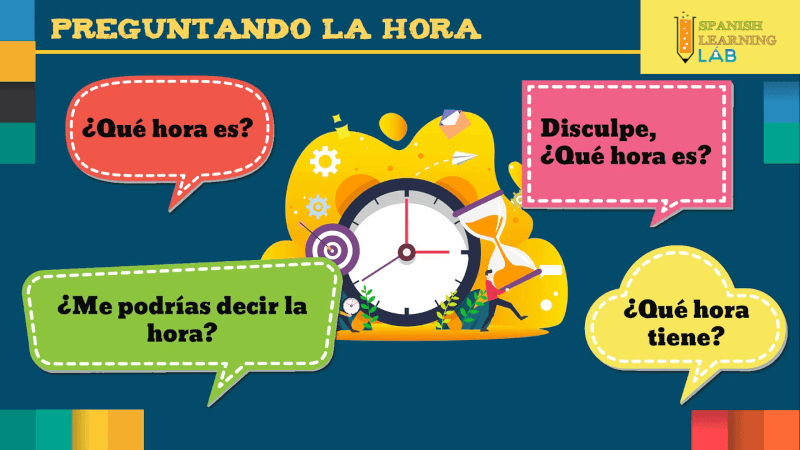
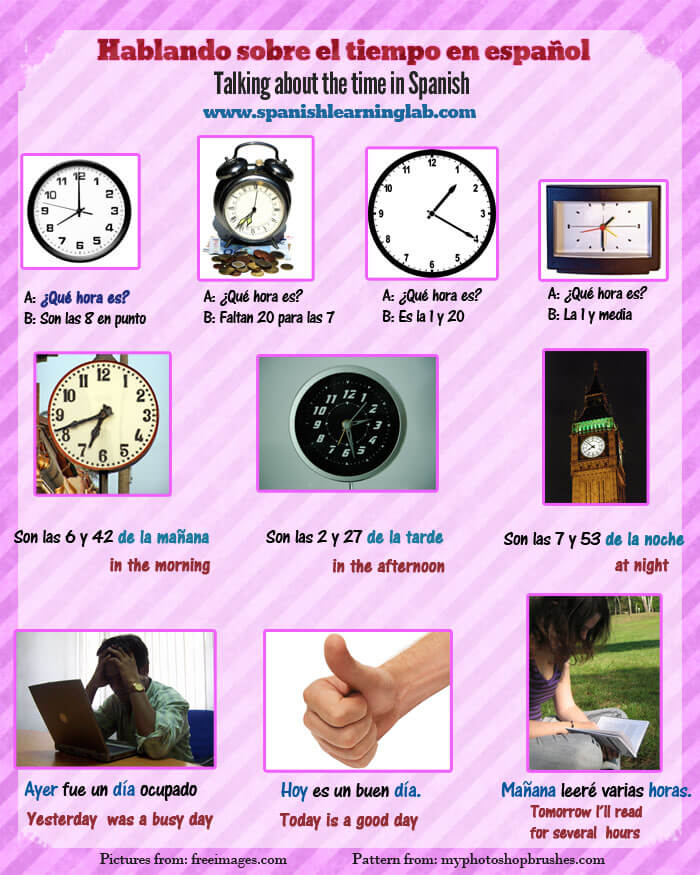
We will begin this lesson by reviewing some key questions and phrases for asking and telling time in Spanish. Below is a picture with several clocks and examples. Basically, the simplest way to ask time is by using ¿Qué hora es?. To answer we will use the verb SER in its forms ES and SON. For a specific hour in a part of the day, you will need the time expressions: DE LA MAÑANA, DE LA TARDE and DE LA NOCHE e.g. “Son las 5 de la tarde” (It’s 5 in the afternoon).
When these expressions are not linked to a specific hour, we use the preposition EN instead of DE, so these expressions would change to EN LA MAÑANA, EN LA TARDE and EN LA NOCHE like in the sentence “Yo cocino el desayuno en la mañana”. All the words in blue in the picture are very common Spanish time phrases, so do your best to remember them.
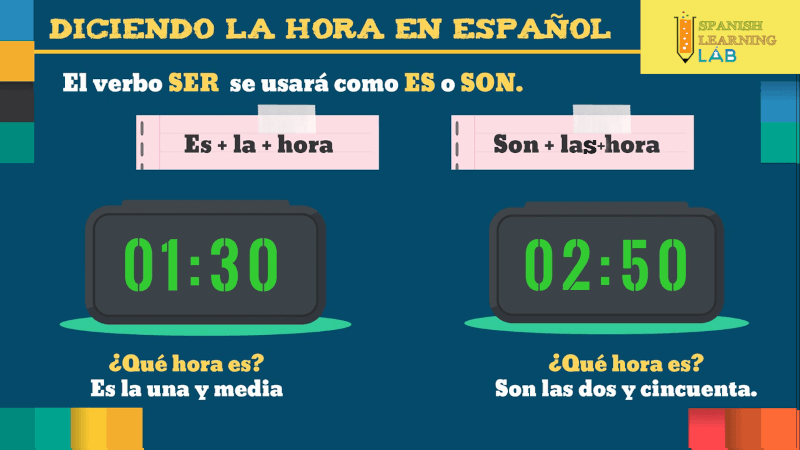
As you can see in the examples in the image above, we use the verb SER in its “ES” form only between 1:00 and 1:59. Otherwise, we use the “SON” form. Similarly, to talk about the past, we use the imperfect tense of “SER” in its forms “ERA” (it was) during that same interval and “ERAN” for the rest of the day. Pay attention to these examples:
Interactive quiz No. 1
Read these sentences about daily activities, look at the clocks and drag the missing parts about time in Spanish into the correct boxes.
Talking about time in Spanish: phrases & sample conversations
Next, we will see how the time phrases in Spanish in the picture plus some new vocabulary can be used in basic conversations. In the first example, one of the actors will say “Disculpa” before asking time to sound polite. The verb “SALIR” (leave) will be used to indicate what time the bus leaves. “Deberías…” is a way to give suggestions to others. Last, the prepositions EN and DENTRO DE are used to talk about time intervals as in “Comeré en 5 minutos” (I’ll eat in 5 minutes). Let’s see how all of these things can be used for talking about time in Spanish:
Example No. 1: Asking for departure time
- Turista: Disculpa ¿Sabes qué hora es?
- Estudiante: Son las 10 y treinta.
- Turista: Gracias, creo que voy a perder mi bus.
- Estudiante: ¿A qué hora sale el bus de la estación?
- Turista: El bus sale a las 11 de la mañana
- Estudiante: Creo que deberías tomar un taxi. Llega en 10 minutos.
- Turista: Gracias, eso haré entonces
Boletos para el bus de las 11:30 – Buying bus tickets in Spanish
The second conversation will be based on the same scenario, but this time we will be using the preposition PARA (for), which often confused with POR. In the conversation, PARA will be used to show the purpose of something, in this case in “para el bus” to show that he wants a ticket to take the bus somewhere. Actually, “para el bus” could be said in two other ways: “para tomar el bus” and “del bus”. Notice that in order to say the specific time the bus leaves, we should use “de las + hora” as in “El bus de las 11 de la mañana” (The 11:00 am bus). Listen to how these Spanish time phrases are used in the example below:
Example No. 2
- Turista: Buenos días ¿Me puede vender una ticket para el bus de las 11 de la mañana?
- Vendedor: Lo siento, ya no tenemos boletos para ese bus, pero hay boletos para el bus de las 11:30.
- Turista: Entiendo, ya casi son las 11 de la mañana. Entonces voy a comprar un boleto para el bus de las 11:30.
- Vendedor: Es 1 dólar con 50 centavos. Puede abordar el bus a las 11:15 y llega a su destino a la 1:30. ¡Qué tenga un buen viaje!
- Turista: Muchas gracias.
Example No. 3
Soy Francisco. Normalmente, me levanto a las seis y cuarto, o mejor dicho a las seis y quince de la mañana. Desayuno a las siete y luego tomo el autobús al trabajo a las siete y media. Casi siempre llego a mi lugar de trabajo a las ocho. A veces, el autobús se retrasa y llego a eso de las ocho y media. Mi mañana suele ser bastante ocupada, pero aun así me gusta tomar una taza de café a las diez si tengo la oportunidad. Almuerzo con mis colegas a las doce. Por la tarde, me tomo otro descanso a las tres y cuarto. Termino de trabajar a las cuatro y media, y llego a casa alrededor de las cinco y media de la tarde. Por la noche, suelo acostarme a las once.
Interactive quiz No. 2
Read this short conversation about the time of different events in Spanish and drag the missing words to the correct spaces.
Listening Activity No. 1: “What time is it?” in Spanish
Listening Activity No. 2: Expressions and questions about time Spanish
Extra work: Your own time and activities in Spanish
For this last activity, you should work with a partner and talk about the time you do some activities. Use the examples provided to figure out the answers to these questions:
- ¿A qué hora te levantas en la mañana?
- ¿A qué hora desayunas y almuerzas?
- ¿Con qué otras personas comes?
- ¿A qué hora te vas a dormir?
Related Spanish Worksheets:
- Telling Time in Spanish – PDF Worksheet
- Daily Activities & Time in Spanish – PDF Worksheet
- Job Schedules in Spanish (Reading)
- Daily Activities and Time in Spanish (Timetable + Sentences)
- Practicing Telling Time in Spanish (Clocks + sentences)
Muy provechoso! Muchisimas gracias.