
This lesson will cover some common words for body parts in Spanish. You will also learn some common verbs associated to the human body and the right way to use them in meaningful expressions. Moreover, you will be able to practice with two Spanish listening activities and quizzes. Let’s start…
Video Lesson: Parts of the body in Spanish + the imperative mood
In terms of anatomy, the human body has far too many parts, and we would likely need an entire book and many lessons to cover them all. This lesson will cover the most important vocabulary for daily conversations, and we will begin with a great video presenting the most common words for parts of the human body in Spanish, plus basic explanations about the imperative mood, and more.
Vocabulary: Body parts in Spanish – Las partes del cuerpo
If you watched the video, you will recognize the body parts in Spanish that have been numbered in the following illustration more easily.
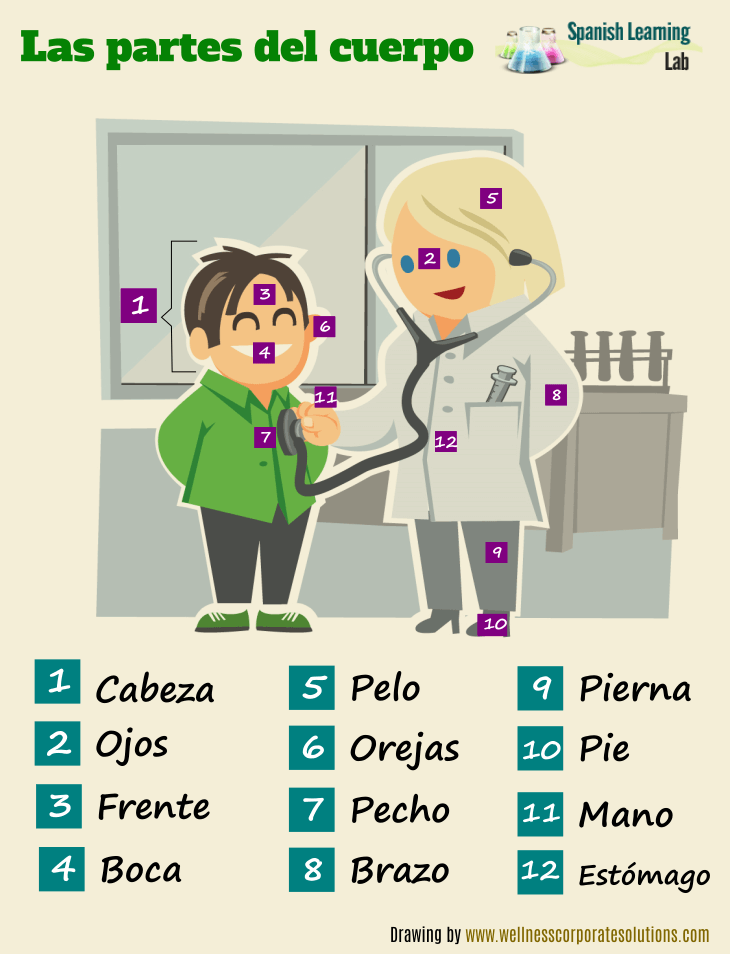
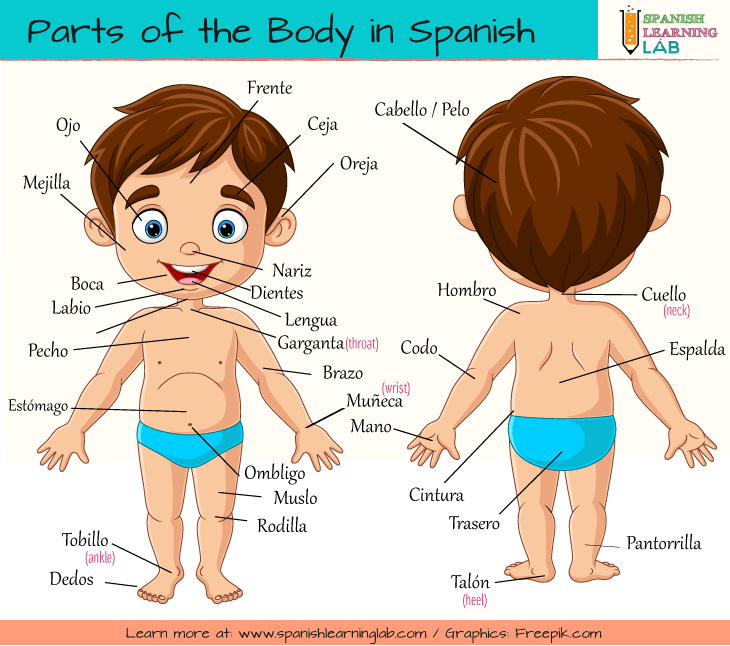
As we mentioned before, the vocabulary on this topic is somewhat broad. The previous words are definitely essential, but if you do want to learn a few more, here is a very nice picture illustrating most of the body parts and their names in Spanish, at least the ones for everyday conversations. The more you can memorize, the better because they could help you in real situations like a visit to the doctor or any time you need to talk about your body.
The head – La cabeza
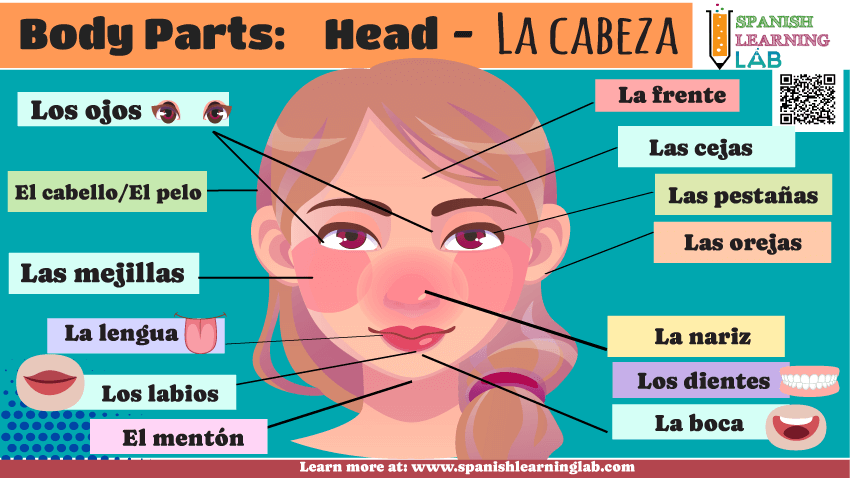
The essential parts of the head in Spanish that you should know are:
el cabello o el pelo (hair), la frente (forehead), las cejas (eyebrows), las pestañas (eyelashes), los ojos (eyes), las orejas (ears), la nariz (nose), la boca (mouth), los dientes (teeth), la lengua (tongue), los labios (lips), las mejillas (chicks) y el mentón (chin)
El torso
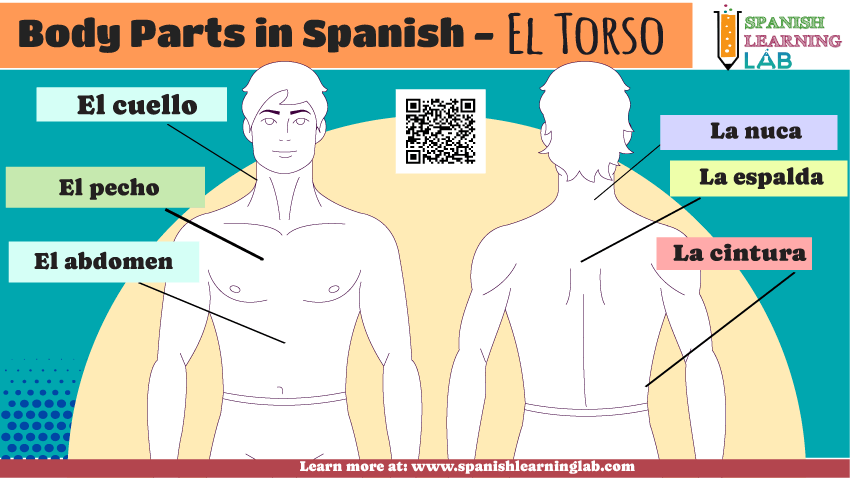
Let’s move now to the torso, below the head. Here we have:
el cuello (neck), el pecho (chest), el abdomen, el ombligo (navel), la nuca (nape), la espalda (back) y la cintura (waist).
Las extremidades – Limbs
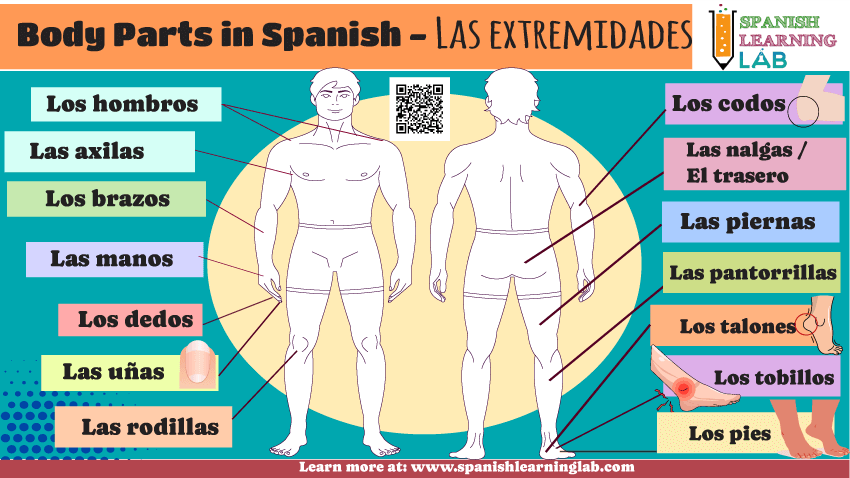
Finally, the limbs (las extremidades) also contain several important body parts, including the following:
los hombros (shoulders), los brazos (arms), las axilas (armpits), las manos (hands), los dedos (fingers), las uñas (nails), las rodillas (knees), los codos (elbows), las nalgas (buttocks) o el trasero (bottom), las piernas (legs), las pantorrillas (calves), los talones (heels), los tobillos (ankles) y los pies (feet)
Interactive quiz No. 1
Look at the pictures again, and then write each of the body parts illustrated on the interactive vocabulary flashcards below.
Phrases and verbs for talking about parts of the body in Spanish
Now, we will focus on using the vocabulary for body parts in Spanish in real situations. First, we will often use these verbs when talking about the human body in Spanish:
“Servir” (useful for…), “Ver/Mirar” (to see), “Mover” (to move), “Levantar” (to raise), “Sostener” (to hold/grab), “Caminar” (to walk), “Comer” (to eat), “Beber” (to drink) and “Respirar” (to breathe).
Here are some examples using these and other verbs to talk about the human body in Spanish. Click on PLAY to listen to the examples.
|
Me gusta mucho el color de sus ojos.
I really like the color of his eyes.
|
|
Me duele la cabeza ¿Tienes alguna pastilla para el dolor?
I have a headache. Do you have any pills?
|
|
En anatomía, la frente es la parte frontal de la cabeza.
In anatomy, the forehead is the front part of the head.
|
|
¿Puedes abrir la boca?
Can you open your mouth?
|
|
Necesito un corte de pelo – Si quieres, yo te lo puedo cortar.
I need a haircut – If you want, I can cut it for you.
|
|
Ese muchacho tiene las orejas muy grandes.
That boy has very big ears.
|
|
¿Te duele el pecho al respirar profundo?
Does your chest hurt when you breathe deeply?
|
|
Levanta este libro con el brazo. Lo debes sostener por 10 segundos.
Raise this book with your arm. You must hold it for 10 seconds.
|
|
Mueve la pierna derecha y luego mueve la izquierda un poco.
Move your right leg and then move the left one slightly.
|
|
Ella no puede caminar bien porque tiene una herida en el pie.
She can not walk well because she has a foot injury.
|
|
Sostén la cuerda fuertemente con ambas manos.
Hold the rope tightly with both hands.
|
|
El estómago sirve para procesar los alimentos.
The stomach is used to process food.
|
The imperative mood in Spanish and the human body
It is very common to hear sentences about the human body in Spanish using the imperative mood, a very useful conjugation form for giving orders or directions, which is especially helpful when you go to the doctor. Imperative verbs are conjugated in the second person, that is, for the personal pronouns “tú,” “vos,” “usted,” “vosotros,” “ellos,” and “ustedes.” Pay attention to the examples in the following image with the verbs “levantar” (to lift), “abrir” (to open), and “mover” (to move).
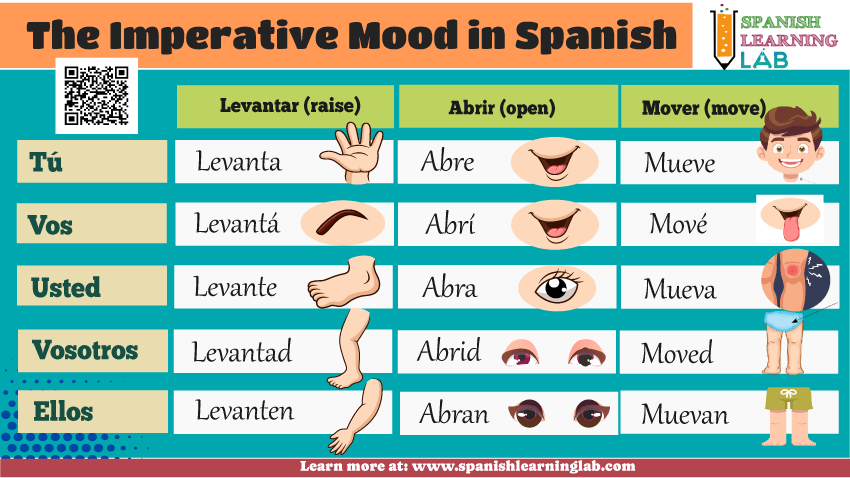
As you can see in the image, when dealing with regular verbs ending in -AR like “Levantar” (to lift), we will follow the rules in the first column. In this way, we can make sentences like the ones below:
- Levanta este libro con el brazo. Lo debes sostener por 10 segundos.
- Raise this book with your arm. You must hold it for 10 seconds.
- (Tú) Levanta la mano derecha, por favor.
- (You) Raise your right hand, please.
- (Usted) Levante un poco la pierna.
- (You) Lift your leg a little.
- (Vosotros) Levantad los brazos y estirad los dedos.
- (You) Raise your arms and stretch out your fingers.
- (Ustedes) Levanten los pies y póngalos sobre la camilla.
- Lift your feet and place them on the stretcher.
Similarly, we can use the endings in the second column of the image for the verb “Abrir” for other verbs ending in “-IR” in the imperative mood, to say things like:
- (Tú) abre la boca, por favor. (abrir)
- (You) open your mouth, please.
- (Usted) suba a la pesa, por favor. (subir)
- Please step on the scale.
- (Vos) Erguí la espalda, Pedro. (erguir)
- Straighten your back, Pedro.
- (Vosotros) Cubrid vuestras piernas. (cubrir)
- (You all) Cover your legs.
Finally, with verbs ending in -ER such as “mover”, we will follow the model in the third column of the table, just like this:
- (Tú) mueve los dedos rápidamente. (mover)
- You move your fingers quickly.
- (Usted) Muerda con sus dientes frontales. (morder)
- Bite with your front teeth.
- (Vos) Poné los pies en alto sobre almohadas. (poner)
- (You) Put your feet up on pillows. (put)
- (Vosotros) Sostened la barra sobre los hombros. (sostener)
- (You) Hold the bar on your shoulders. (hold)
Interactive quiz No. 2
Read the following sentences about activities with body parts in Spanish and drag the missing words to the correct spaces. Then, check your answers.
Listening Activity No.1: Describing parts of the body in Spanish
Listening Activity No.2: The human body in Spanish – El cuerpo humano
Key phrases in the recording:
- “Las extremidades” is a word used to refer to our arms and legs.
- “Sirve para…” means “It is used to…”
- “Podemos encontrar” means “We can find…”
Related Spanish worksheets:
- Parts of the Body in Spanish – PDF Crossword Puzzle
- The Vocabulary for Illnesses in Spanish
- Adjectives for Appearance in Spanish
- Let’s talk about Health in Spanish – Conversation cards
- At the Hospital in Spanish (Key Vocabulary)
- Medical Breakthroughs in Spanish (Reading)
- Body Parts in Spanish (Vocabulary)
- Pharmacy Vocabulary in Spanish (Labeling items)