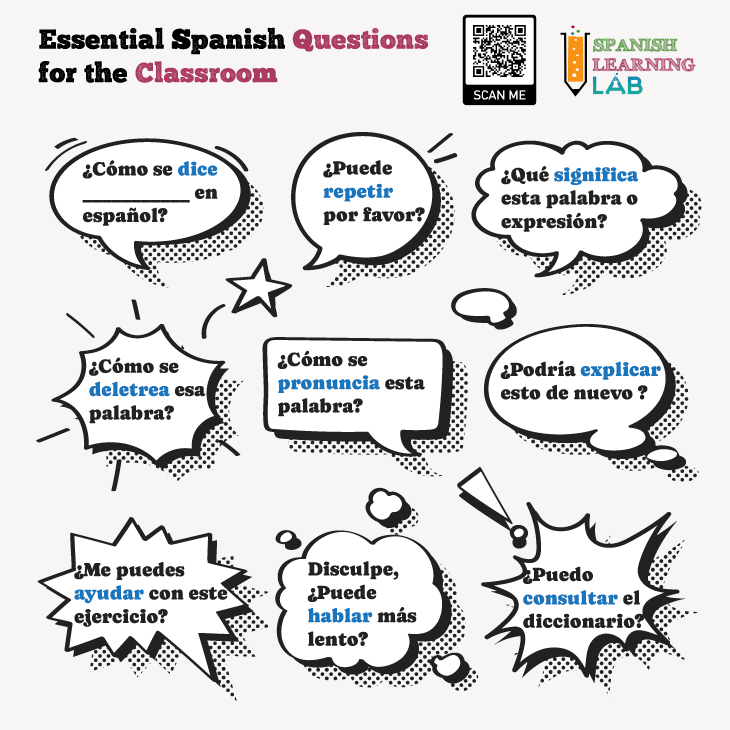
“¿Puede repetir por favor?” is a very common classroom question when you are learning Spanish. In this lesson, you will learn a list of the most important questions in the Spanish class and essential expressions to communicate with your classmates and teacher. You will find many examples and exercises in interactive quizzes to practice as you progress. Let’s get started…
Introductory video: 10 Basic Questions to Learn Spanish
Firstly, we will ask you to spend a few minutes watching this video. It presents ten Spanish questions that are very useful in the classroom in a clear and simple way. Remember that you can activate the subtitles if you need them.
A few useful classroom expressions in Spanish – Expresiones del aula
There are many expressions in the language that can be very useful in class. Some of them are single words and others phrases such as “No sé” (I don’t know). “No sé” could be a proper answer when someone asks “¿Sabes cuál es la tarea?”(do you know what the homework is?) or for “¿Cómo se deletrea esa palabra?” and you do not know. A few other important Spanish classroom phrases are “No entiendo” (I don’t understand) and “Repita por favor” (please repeat). Read and listen to more expressions for the Spanish class in the chart below:
|
No entiendo
I don’t understand
|
| Explique de nuevo, por favor. Please explain again. |
|
Disculpe (formal)/Disculpa (informal)
Excuse me
|
|
Profesor, hable más despacio por favor.
Teacher, please speak more slowly.
|
|
¡Tengo una pregunta!
I have a question
|
|
¡Gracias!
Thank you
|
|
Es fácil / Es difícil.
It is easy/It is hard
|
Interactive quiz No. 1
Read this short conversation between a teacher and a student in Spanish, and complete it by dragging the missing words into the correct spaces.
Common Spanish classroom questions – Preguntas del aula
Most Spanish classroom questions, “las preguntas de la clase”, follow the same rules for any other question in the language. First, they need a question mark at the beginning and one at the end. The intonation of your question should change a bit depending on what you mean to ask. Some new verbs you will often find in Spanish classroom questions are: EXPLICAR (to explain), REPETIR (to repeat), DECIR (to say), PRONUNCIAR (to pronounce), SIGNIFICAR (to mean) and PODER (can, be able to).
“Explicar, hablar, significar, pronunciar” are regular verbs so you only need to learn a few rules to conjugate them. On the other hand, the verbs “repetir, poder, decir” are irregular verbs, which means they vary their stem with some pronouns. Know that questions beginning with the verb PODER are requests, a topic that is explained with more details in a different lesson.
Listening to a list of basic Spanish classroom questions
| ¿Puedo entrar? – Sí/No May I come in? |
| ¿Puedo ir al baño? – Sí/No May I go to the bathroom? |
| ¿Puede explicarme esto por favor? – Sí/No Can you explain this to me please? |
| ¿Podría repetir por favor? – Sí/No Could you repeat please? |
|
¿Podría hablar más despacio?
Could you speak more slowly?
|
|
¿Cómo se dice “house” en español? – HOUSE se dice CASA en español
How do you say HOUSE?
|
|
¿Cómo se pronuncia esta palabra en español? – Se pronuncia corazón, con acento en la “o” de la última sílaba
How do you pronounce this word?
|
|
¿Qué significa esta palabra? – Corazón significa HEART en inglés
What does this word mean?
|
|
¿Cuál es la respuesta correcta? – La respuesta correcta es la A
Which one is the correct answer?
|
Interactive quiz No. 2
Read these classroom questions in Spanish and drag the most appropriate answer for each situation. Then, check your answers.
Listening Activity No. 1: Asking questions in the Spanish Class
Key expressions in the conversation:
- “Hoy vamos a aprender…” means “Today we are going to learn…”
- “Disculpe maestra…” means “Excuse me teacher”
A few more verbs for the classroom in Spanish
There are many other important verbs you could use in the Spanish class including DELETREAR (spell), HACER (do), DIBUJAR (draw), COMENZAR (begin) and TERMINAR (finish). The key is conjugating the verbs correctly and knowing when they will be accompanied by a reflexive pronoun, as it is the case for DECIR, which will be used as “SE DICE”, for example:
- ¿Cómo se deletrea esta palabra? (How do you spell this word?)
- ¿Qué tenemos que hacer acá? (What do we have to do here?)
- Ustedes deben dibujar un mapa de la ciudad con los lugares en español. (You must draw a map of the city with the places in Spanish.)
- Bien chicos, vamos a comenzar la clase. (Okay guys, let’s start the class.)
- ¿Ya terminaron de resolver el ejercicio? (Have you finished solving the exercise yet?)
that’s would be so useful for me… thanks so much in advance for your help in learning Spanish
¡Hola! You are welcome. We are glad this was useful for you!
Thanks to you, am picking up so soon.
this was quite useful gracias
The Quiz is weird. It gives me a 30% when I should ve gotten a 100. Otherwise great!
We will check. Thanks for the feedback 🙂
Eu amo sus contenidos ! muchas gracias por compartir, estoy ganando mucho conocimiento pues puedo estudiar inglés mientras estudio español !!! Gracias desde Brasil !!!
De nada. ¡Nos alegra que nuestro contenido sea de utilidad! Buena suerte aprendiendo inglés y español 🙂