Asking questions is very important to keep a conversation flowing. The way we ask about something in Spanish is somewhat similar to the way it is done in English, with slight differences in the use of question marks. In this lesson, we will cover of the most important differences, present to you a list of basic questions in Spanish and how to answer them. Let’s start…
How to ask basic questions in Spanish and use question marks
Questions marks in Spanish are called “signos de interrogacíon“. As a general rule, these punctuation marks are used at the beginning and at the end of all questions in the language. The question mark at the beginning should be placed upside down, just like the icon in the picture below, whereas the other should be written just like in English.
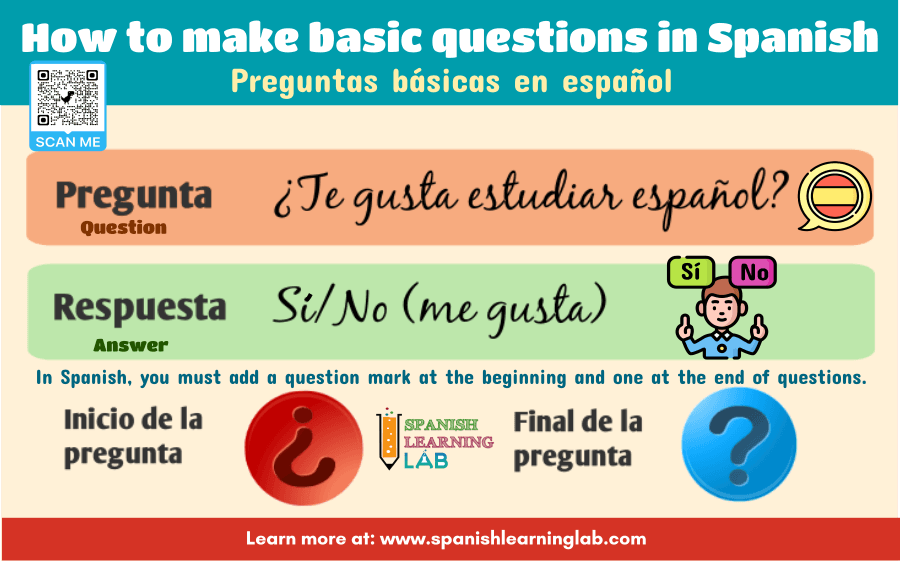
When we are writing a question, it is incorrect to omit any of the two Spanish question marks. Questions in Spanish are actually sentences which happen to have these marks and that once pronounced have a different intonation sometimes.
- Correct written form ¿Estás estudiando español? (Are you studying Spanish?)
- Incorrect written form: Estás estudiando español?
The most basic Spanish questions are those whose answer is “Sí” or “No”. In English, we ask questions using auxiliaries like DO or DID, but in Spanish you just need to say the same sentence without any auxiliary changing its basic structure.
- Sentence (oración): Tú tienes que hacer algo hoy
- Question (pregunta): ¿Tú tienes que hacer algo hoy?
The verbs SER, ESTAR, TENER, PODER and HACER are often used to make Sí/No Spanish questions, so when someone asks using any of these verbs we can reply with “sí” or “no”. Most of the time, we add information besides SÍ or NO, and more importantly, when we pronounce this type of basic Spanish questions, the intonation should go up in the end.
Examples of basic questions in Spanish
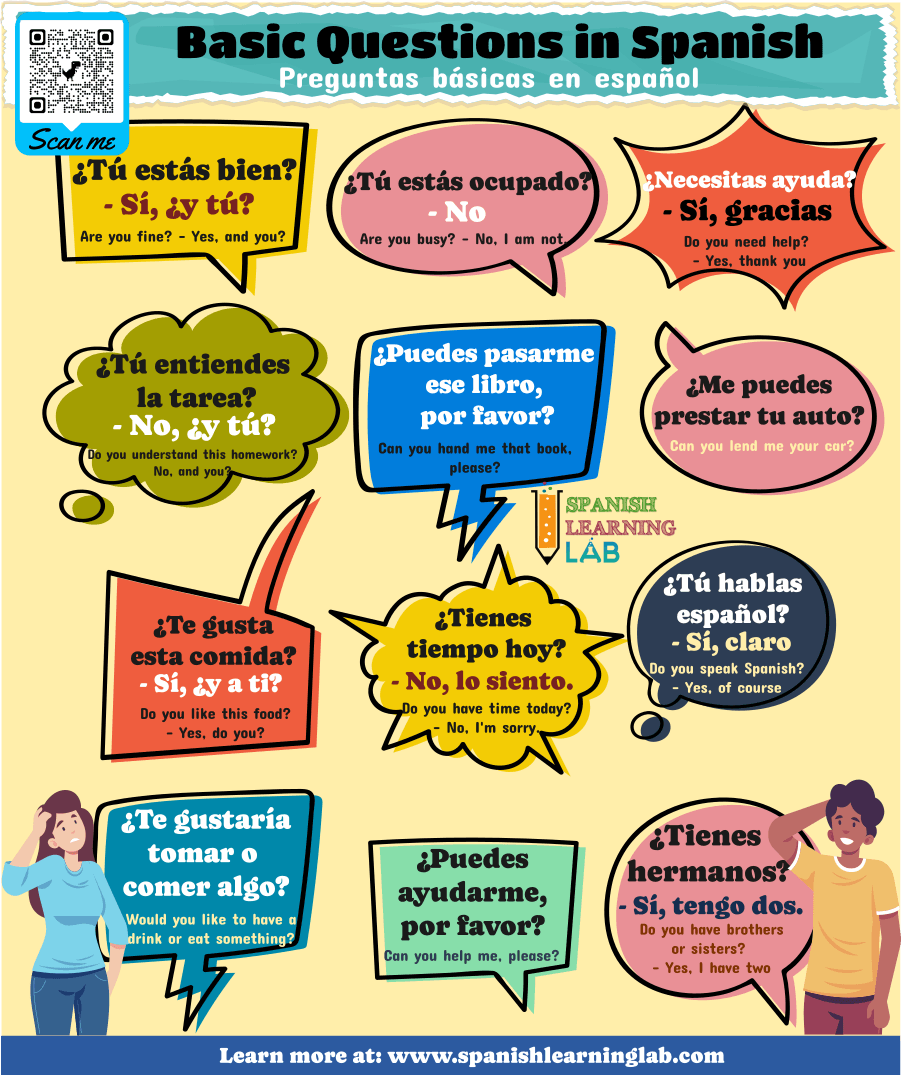
Read and analyze some examples of basic questions in Spanish in the following illustration and their possible answers. Notice that we use both question marks and these questions will be answered with “Sí” or “No” plus a little extra information.
Interactive exercise No. 1
Read all three versions of each question and select the one that follows the punctuation and grammar rules appropriately.
A list of basic Spanish questions + Practice
Here is a list of basic questions in Spanish using some of the common verbs we mentioned before. Here you can check how Spanish questions marks are used, as well as when to use “SÍ” or “NO” to answer, which normally happens when we want to begin the question with a verb. Use the audio player to listen to the examples and then practice with the interactive quiz about this topic.
|
¿(Tú) eres casada o soltera?
Are you married or single?
“Tú” is optional. “Eres” is a conjugation for “ser” (to be)
|
|
¿(Usted) está enojada conmigo?
Are you angry with me?
A formal question with two using the conjugation “está” from “estar” (to be)
|
|
¿Tu hermana está ocupada ahorita?
Is your sister busy right now?
Using the possessive adjective, tu, and “estar” (to be)
|
|
¿(Tú) tienes su nuevo album?
Do you have her new album?
Using the conjugation for “tú” from the verb “tener”(to have)
|
|
¿(A ti) te gusta cocinar?
Do you like to cook?
“A ti” is a prepositional phrase and “te” a reflexive pronoun.
|
|
¿Tu mamá te ayuda con la tarea?
Does your mom help you with the homework?
“Te” is a reflexive pronoun that emphasizes who needs help.
|
|
¿(Tú) puedes prestarme tu computadora?
Can you lend me your computer?
“Puedes” comes from the verb “Poder” (to be able to). There are no modals in Spanish. “Prestarme” is a reflexive verb.
|
|
¿(Yo) puedo ayudarle?
May I help you?
The “Yo” form for “Poder” plus a reflexive verb. (ayudar + le)
|
|
¿(Ellos) finalizaron su proyecto?
Did they finish their project?
A question in the simple past, just following the rules for the verb “finalizar”
|
A conversation with basic questions in Spanish
Below is a simple conversation with basic questions in Spanish. Notice that all the questions use question marks at the beginning and end, and the answers are quite simple. If you’d like to learn more about asking questions with words like “¿Qué?”, ”¿Cómo?”, and other interrogative words, be sure to check out the next lesson.

Interactive exercise No. 2
Drag the missing questions or answers to the correct spaces in this interactive exercise.
Interactive exercise No. 3
Drag and drop the words below the boxes in the correct areas to form basic questions in Spanish. Then, check your answers.
Related Spanish Worksheets:
- Question Words in Spanish – PDF Worksheet
- Sharing Personal Information in Spanish – PDF Worksheet
- Asking Questions in Spanish – PDF Worksheet No. 2
- Talking about Yourself in Spanish: PDF Worksheet
- Questions about the Family in Spanish: PDF Worksheet
- Making Questions in Spanish – PDF Worksheet