
¿Qué tareas domésticas te gusta hacer? “Los Quehaceres“, “Las tareas del hogar” and “Los oficios de la casa” are three ways to refer to household chores in Spanish. This lesson will introduce the vocabulary for these activities through a short video and several mini-conversations. In addition, we will cover different ways to express obligations in Spanish using “Tener que”, “Hay que” and “Deber”. Let’s get started…
Vocabulary Introduction: A list of chores in Spanish
First, please watch a short video introducing a list of chores in Spanish. These words will be used later in short conversations. The video consists of pictures representing different chores, as well as some useful questions and phrases related to these new words. In addition, it contains a few grammar notes explaining how the examples work.
The image below shows the most important vocabulary for household chores in Spanish for everyday conversations. We have added some of the words mentioned in the video, as well as others.

Interactive quiz No. 1
Drag the name of each household chore in Spanish below the correct pictures, and then check your answers.
HAY QUE + Infinitive for obligations in Spanish
LOS QUEHACERES or household chores in Spanish are just verbs indicating a simple action like LIMPIAR (to clean), “LAVAR” (to wash) and so on. We will relate the vocabulary for these tasks with verbs used to express obligations in Spanish, as they are often connected in real life. In order to say what someone has to do in Spanish, three verb forms can be used: HAY QUE, TENER QUE and DEBER.
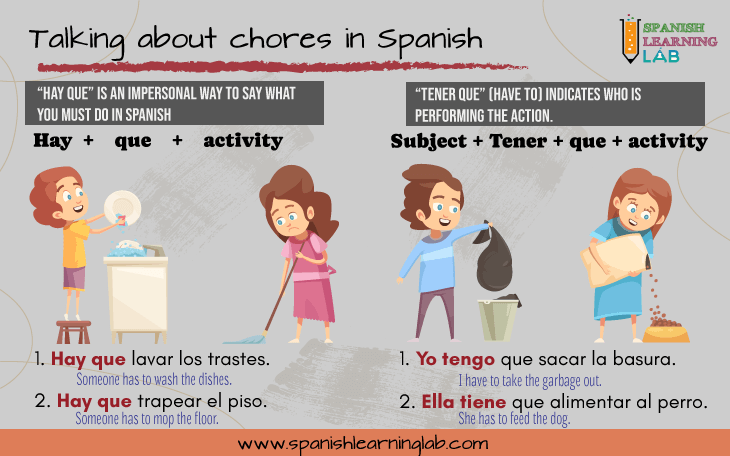
Let’s discuss HAY QUE + infinitive for expressing obligations in Spanish. HAY comes from the verb HABER and means THERE IS/THERE ARE, but when it is accompanied by the word QUE it means something different: HAVE TO. The phrase “Hay que…“ is normally used to express obligations in Spanish without specifically saying who has to do a task or chore in this case, so it is somewhat impersonal, for example:
- “Hay que lavar los trastes” (alguien tiene que lavar los platos)
- “Hay que cocinar” (alguien tiene que cocinar).
Example No. 1
- Jack: ¡y…! ¡La casa está súpersucia!
- Xochilt: Sí, ni lo menciones. Hay que limpiar ahorita.
- Jack: Hay que mover estos muebles primero.
- Xochilt: Te dejo eso a ti. Yo tengo que lavar los trastes y arreglar la cocina.
Example No. 2
- Jack: ¿Qué estás haciendo?
- Xochilt: Estoy cocinando el desayuno para los niños.
- Jack: ¿Te ayudo a lavar los trastes?
- Xochilt: Sí, por favor… También hay que sacar la basura ¿Lo puedes hacer?
- Jack: Sí, no hay problema
TENER QUE + Infinitive to express obligations in Spanish
Now, let’s talk about TENER QUE. TENER means “to have” in Spanish, and it happens to be an irregular verb too, just like HABER, so it will change a little depending on the subject of the sentence, e.g. Yo tengo, tú tienes and so on. We normally add the word QUE after the conjugation of TENER to express obligations in Spanish. Basically, the grammatical structure will be:
Example No. 3
- Xochilt: Tú tienes que hacer las compras hoy.
- Jack: Está bien. ¿Qué quehaceres tienes que hacer esta mañana?
- Xochilt: Bueno, solo tengo que barrer y trapear el piso, entre otras cosas.
- Jack: ¡Ya es tarde! Al menos voy a ayudarte a regar las plantas.
Example No. 4
- Xochilt: Jack, ¿Ya hiciste la cama?
- Jack: Sí, no te preocupes.
- Xochilt: Recuerda limpiar tu habitación después. ¿Tienes ropa sucia?
- Jack: Sí, tengo que lavar mi ropa hoy porque ya no tengo ropa limpia.
- Xochilt: Mientras tanto, yo voy a poner la mesa.

Using DEBER to say “You must…” in Spanish
Finally, the last verb we will discuss is DEBER. It is very easy to express obligations in Spanish with DEBER because it acts just like the modal verb MUST from the English language. DEBER is a regular verb so we just need to follow some rules to use it correctly, and unlike TENER and HAY, it will not need the word QUE. Here are two examples using DEBER in Spanish:
- “Yo debo hacer las compras.” (I have to go shopping)
- “Tú debes regar las plantas“. (You should water the plants)
Language tip:
It is common to use IR A + a chore to say what you will do later. We use IR A meaning going to in Spanish. Just remember that IR is an irregular verb, so it is really important to use the right conjugation for each subject pronoun, e.g. “Yo voy a…”, “tú vas a…” and so on.
Interactive quiz No. 2
Drag the correct answers next to these questions about chores and obligations in Spanish. Then, check your answers.
Listening Activity No. 1: What are your chores in Spanish?
Key expressions in the conversation:
- “¿Por qué preguntas?”, means “Why do you ask?”
- “La casa está hecha un desastre…” means “The house is a total mess”
- “Manos a la obra…” means “Down to work”
Listening Activity No. 2: Finding the right household chores in Spanish
Lesson assignment:
Make a list of household chores in Spanish you do at home. It can be make-believe. You could use sequence words like PRIMERO, LUEGO and POR ÚLTIMO to make your sentences follow a specific order.