LA COCINA or the kitchen in Spanish is another important room in the house. There are many different items and utensils that can be found in a kitchen, from simple objects like UNA CUCHARA (a spoon) to appliances like UNA REFRIGERADORA (a refrigerator). In this lesson, you will learn common kitchen objects in Spanish through pictures, sample sentences and the exercises in several interactive quizzes. Let’s start…
Vocabulary Introduction: Common Kitchen Objects in Spanish
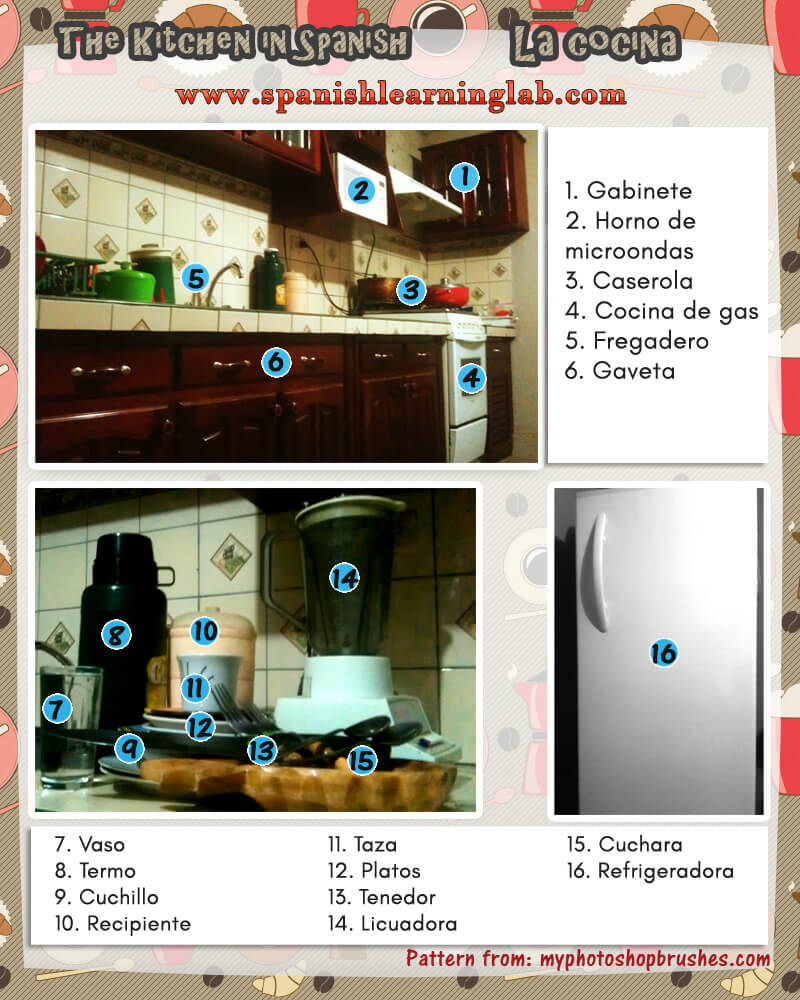
We will begin by learning how to write a few kitchen objects in Spanish with the picture below. In order to learn these words faster and meaningfully, please go to your kitchen and try to look or touch the items that appear in the picture, and then say the name of these things in Spanish. We will be using the throughout the rest of the lesson.
Interactive quiz No. 1
Look at these vocabulary flashcards and write the names of these kitchen objects in Spanish. Keep in mind that some things can be said in other ways, such as “sartén” and “paila”.
Platos / Cacerola / Licuadora / Cucharas / Taza / Espátula / Tenedores / Cuchillos / Tetera / Bandeja / Lavaplatos / Rallador / Batidora / Palillos chillos / Jarra / Tabla de picar / Sartén / Gabinete / Delantal / Saleros / Panas / Estufa / Colador / Cucharón
Using IR A + Infinitive for future actions
Second, the verb IR plus the preposition “A” plays the role of GOING TO in Spanish. The verb IR will be conjugated depending on the subject pronoun in the sentence, and then we will add the main action in infinitive form, for example:
- Yo voy a cocinar. (I am going to cook)
- Nosotros vamos a limpiar la cocina. (We are going to clean the kitchen)
Below, there are several sentences using kitchen utensils and appliances in Spanish. Some of the sentences include structures we have studied in other lessons including likes and dislikes, some verbs in the past tense and many other important topics. Focus on the meaning of the sentences and try to see if you can learn one or more new expressions.
Some sentences and questions with kitchen objects in Spanish
|
Me gusta mucho tu cocina.
I like your kitchen a lot.
|
|
El gabinete de la cocina necesita algo de pintura
The cabinet in the kitchen needs some paint.
|
|
El horno microondas dejó de funcionar de repente
The microwave oven stopped working
|
|
¿No crees que estas cacerolas son muy viejas?
Don’t you think those cooking pots are very old?
|
|
(Yo) Voy a cambiar el fregadero
I am going to change the sink
|
|
¿Puedes poner eso en la gaveta?
¿Can you put that in the drawer?
|
|
¿Dónde compraste esos vasos?
Where did you buy those glasses?
|
|
No hay café en el termo.
There is no coffee in the vacuum flask.
|
|
¿Me puedes pasar el cuchillo verde?
Can you get me the green knife?
|
| Ya no hay azúcar en este tarro (de azúcar) There is no sugar in the sugar pot. |
|
¿Podemos poner los platos en la mesa?
Can we put the dishes on the table?
|
| No veo ningún tenedor por aquí. I don’t see any fork here. |
|
¿Qué le pasó a la licuadora?
What happened to the blender?
|
|
A los niños les encantan estas cucharas
The kids love these spoons.
|
|
Vamos a comprar una nueva refrigeradora
We are going to buy a new refrigerator.
|
|
Vamos a utilizar esta sartén para cocinar la cena
We are going to use this pan to cook dinner
|
Interactive quiz No. 2
Drag these words about the kitchen in Spanish to the correct spaces in these sentences, and then check your answers.
Describing a kitchen in Spanish – Describiendo la cocina en español
In previous lessons, we covered how to describe a living room and a bedroom and talk about basic descriptions of houses in Spanish. That being said, in order to describe a kitchen in Spanish we need to know some objects we can find in it and also some adjectives to describe how the room looks, as well as the basics about LUCIR (to look), SER (to be), TENER (to have) and HAY (there is/there are). You must be very careful to use the right definite article or indefinite article before the object or room you are referring to, for example, saying LA PLATO would be wrong as PLATO is a masculine, singular noun, and for that we have to use the article EL and say “El plato”.
SER is typically used in its conjugation ES to say things like “La cocina ES grande”(being grande an adjective). TENER and HAY will be used to talk about the objects in the kitchen in Spanish and point out something special about the room or the house itself. These verbs are usually accompanied by quantifiers (muchos, pocos, un, unos…) and adverbs (muy, bastante, realmente…) to make the adjectives weaker or stronger when describing something. Please read and listen to the following short kitchen descriptions in Spanish.
Example No. 1
¿Cómo describiría mi cocina? Bueno, mi cocina es mi lugar favorito de la casa porque me gusta cocinar todo tipo de comidas. Tiene un gabinete de madera de color café con suficientes gavetas para guardar las cucharas, los tenedores, los platos y otros utensilios de cocina. La cocina es pequeña, pero está bien iluminada. Hay algunos electrodomésticos como una refrigeradora, un horno microondas y una licuadora. La cocina de gas es algo vieja pero todavía funciona.
Example No. 2
La cocina de mi casa es bastante espaciosa. Eso nos permite cocinar con más facilidad. Mi mamá ha comprado varias cacerolas de todo tipo y también varias colecciones de vasos, platos, panas y cubiertos. La cocina luce elegante. Las paredes son de color amarillo claro y todos los electrodomésticos funcionan bien y son muy modernos también. Siempre está ordenada, llena de luz y de olores deliciosos.
Interactive quiz No. 3
Read this description of a kitchen in Spanish and fill in the blanks with the most appropriate words according to the illustration. Then, check your answers.
PODER for requests in Spanish
First, we will discuss a few important things so you can get the best out of the examples. Knowing how to make requests in Spanish may help you a lot in real conversations. In English, we use MAY and other modal verbs, but in Spanish we use the verb PODER which plays the role of MAY, CAN and BE ABLE TO. A simple request in Spanish follows this structure:
¿Poder (conjugación) + verbo en infinitivo + preposición / artículo /adjetivo demostrativo + objetos de cocina
- ¿Puedes poner estas salsas en la gaveta? (Can you put these sauces in the drawer?)
- ¿Puedes abrir la puerta del gabinete? (Can you open the door?)
- ¿Me puedes pasar la batidora, por favor? (Could you pass me the blender, please?)
In some cases, we can use indirect object pronouns like “te, se, me” in requests to make clear who the person that will receive help is. For instance, here is a request about things in the kitchen: ¿Me puedes pasar el cuchillo verde?. In the last example, ME is an object pronoun. Know that in a real conversation, the structure presented for requests in Spanish may be slightly different, but not so hard to understand if you master three basic things: how to make questions, the right conjugations for the stem-changing verb PODER and direct object pronouns.
Listening Activity: Talking about the kitchen in Spanish
Key expressions in the conversations:
- “Espero que seas bueno(a) en + actividad”, means “I hope you are good at + activity”
- “No te preocupes“, means “Don’t worry”
Related PDF Worksheets:
- Kitchen Utensils in Spanish
- Kitchen Appliances in Spanish
- House objects and Furniture in Spanish
- Rooms and Parts of the House in Spanish
- The House and Prepositions of Place
- Describing Houses in Spanish (Pictures + Sentences)
70%
100%