¡Hola! This time, we will learn how to use the alphabet to spell words in Spanish. This lesson includes several sample conversations with phrases and questions that are helpful when spelling words in Spanish, such as names or other information. Yo will have the chance to practice with exercises on the Spanish alphabet and listening comprehension activities, like a spelling bee competition. Let’s get started!
Spelling words in Spanish: Ways to ask and related phrases
In this section, we will cover some of the most common situations in which you’d need to spell words in Spanish. You will realize that these situations are similar in English. The sample conversations include basic questions like:
- ¿Cómo se deletrea + palabra? (How do you spell + word?)
- ¿Cómo se escribe + palabra? (How do you write + word?)
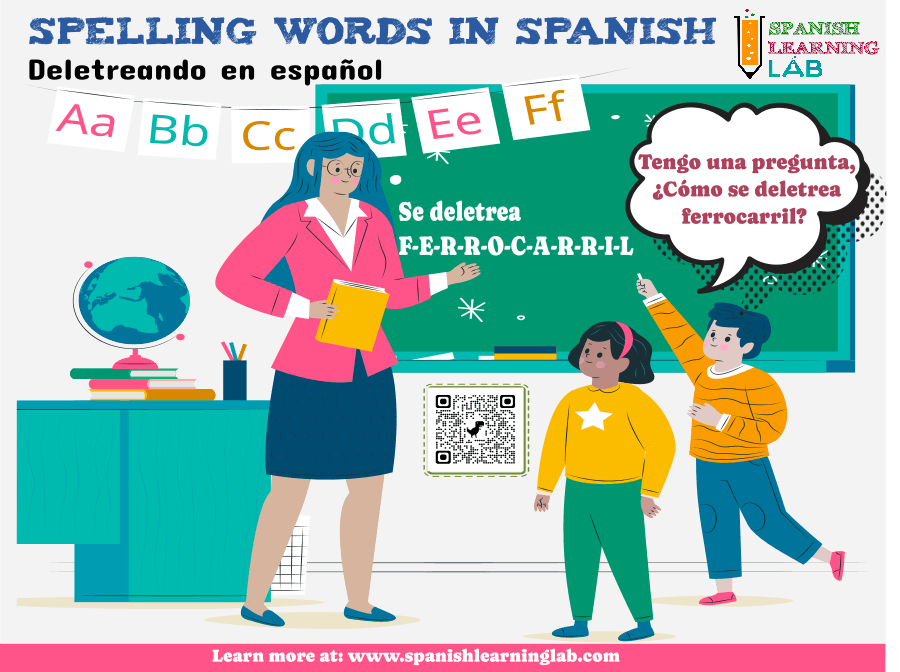
People will usually reply with “Se deletrea” + spelling, just as shown in the following illustration:
To be able to spell words in Spanish, it is essential that you know all the letters of the Spanish alphabet. Furthermore, when spelling words, it’s very common to use other words familiar to both people as a reference. For example, it’s very common to say things like:
- <<Baya>> se escribe con <<B>> de burro cuando nos referimos a la fruta. (“Baya” is spelled with a “B” of “Burro” when referring to the fruit.)
- <<Vaya>> se escribe con <<V>> de vaca cuando nos referimos a una conjugación del verbo <<ir>> (“Vaya” is spelled with a “V” of “vaca” when referring to a conjugation of the verb “ir”)
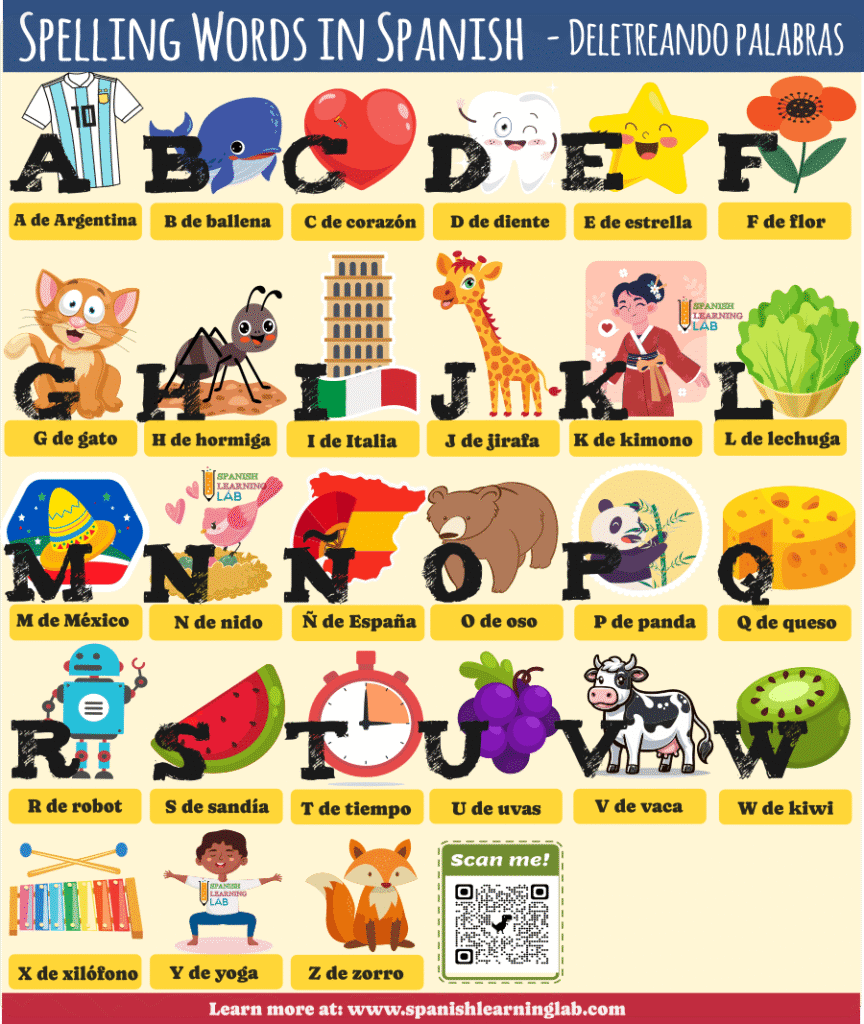
There is no fixed list of words in Spanish to use as reference. The image below shows some common words you could use to help to spell others in the language:
Exercise No. 1
Listen to the spelling of several common Spanish verbs and write them in capital letters without spaces between letters.
Short dialogues about spelling in Spanish
When listening to the examples below, pay attention to the pronunciation of the letters that are part of the Spanish alphabet, as well as the main words that are being spelled. Also, before reading the translation, try to identify the real context in each of the examples, that is the place and people who are spelling words in Spanish.
Example No. 1
- Ximena: ¡Buenos días! ¿Me puede buscar en la lista?
- Asistente: Sí, claro, ¿Cuál es su nombre?
- Ximena: Me llamo Ximena.
- Asistente: ¿Cómo deletrea su nombre?
- Ximena: Se deletrea X-I-M-E-N-A.
- Asistente: Muy bien, está en la lista. Gracias Señorita. Puede pasar adelante.
Example No. 2
- Maestra: Bien, como les decía, algunas prendas de vestir en español son: “la camisa”, “el pantalón” y “los zapatos”
- Estudiante: Disculpe maestra, ¿Cómo se deletrea “Zapatos”?
- Maestra: Se deletrea “Z-A-P-A-T-O-S”
- Estudiante: ¿Entonces no se escribe con S al principio?
- Maestra: No, aunque nosotros pronunciamos “Zapatos” como “S”, se escribe con “Z” al principio.
Example No. 3
- Chico: Oye, tengo una duda ¿Cómo se deletrea esta palabra?
- Chica: Se deletrea “D-I-S-C-I-P-L-I-N-A”. Disciplina.
- Chico: Entonces debo agregar las letras S y C en la primera sílaba.
Example No. 4
- Maestro: Ok, revisemos su ensayo… uhmm.. Esta palabra no se deletrea con la letra “B” sino con la letra “V” aunque la pronunciación es la misma.
- Estudiante: Entonces se deletrea “V-A-S-O”, no “B-A-S-O” ¿verdad?
- Maestro: Si, así es. La palabra “CORAZÓN” se deletrea “C-O-R-A-Z-Ó-N”, con “Z” no con “S” y con tilde en la última sílaba.
- Estudiante: Entiendo, gracias maestro.
Listening Activity No. 1: ¿Cómo se deletrea en español? – How do you spell…?
Listening Activity No. 2: How do you spell that word in Spanish?
Listening Activity No. 3: Spelling Names in Spanish
Vocabulary: A Spanish spelling competition
Here are some keywords, phrases, and questions related to Spanish spelling skills. Analyze them carefully and think about real-life situations where they might also be useful.
|
Competencia – Esta es una competencia de deletreo muy reñida.
Competition – This is a hard-fought spelling competition.
|
|
Competidores – Los competidores tendrán solamente una oportunidad.
Competitors – Competitors will only have one chance.
|
|
Jurado – El jurado evaluará el deletreo correcto de las palabras.
Jury – The jury will evaluate the correct spelling of the words.
|
|
Reglas – Ahora explicaremos las reglas de la competencia…
Rules – Now we will explain the rules for the competition…
|
|
Deletrear – Los participantes tienen que deletrear las palabras sin cometer errores.
To spell – Participants have to spell words without making mistakes.
|
|
Intento – Este es su último intento. Si falla, no podrá seguir en la competencia.
Attempt – This is your last attempt. If you fails, you will not be able to continue in the competition.
|
|
Correcto/Incorrecto – Eso es incorrecto. La respuesta correcta es la opción B..
Right / Wrong – That’s wrong. The correct answer is option B.
|
|
Ganar – Lo importante no es ganar, sino participar y aprender.
Winning – What is important is not to win, but to participate and learn.
|
|
Perder – Antonio perdió en las finales porque no estudió lo suficiente.
Losing – Antonio lost the finals because he did not study enough.
|
|
Ganador – El ganador de la competencia es Raúl.
Winner – The winner of the competition is Raúl.
|
|
Premio – Los ganadores de la competencia de deletreo recibirán un premio de $100.
Prize – The winners of the spelling competition will receive a prize of $ 100.
|
|
Usar – ¿Puede usar esa palabra en una oración?
Use – Can you use that word in a sentence?
|
Listening Activity No. 4: A spelling bee competion in Spanish
We have reached the end of this lesson. Spelling is a great way to practice the alphabet, and it’s even more fun to do it through Spanish spelling competitions, whether with your friends or classmates. We hope you found it helpful. See you soon!