
“Aló” is often the starting phrase for many phone calls in Spanish. Just like in other languages, there are important expressions you can learn to answer the phone correctly or take a simple message for a friend or relative. This lesson will cover a few of these key phrases and questions through examples of phone conversations in Spanish and interactive exercises for practice. Let’s start…
Common phrases and questions in phone conversations Spanish
A home phone is called a “teléfono convencional” or “teléfono domiciliar,” and our personal phone is often called a “teléfono celular“” or “teléfono móvil” Smartphones are often translated as “teléfono inteligente,” although most people would understand if you say “smartphone.”
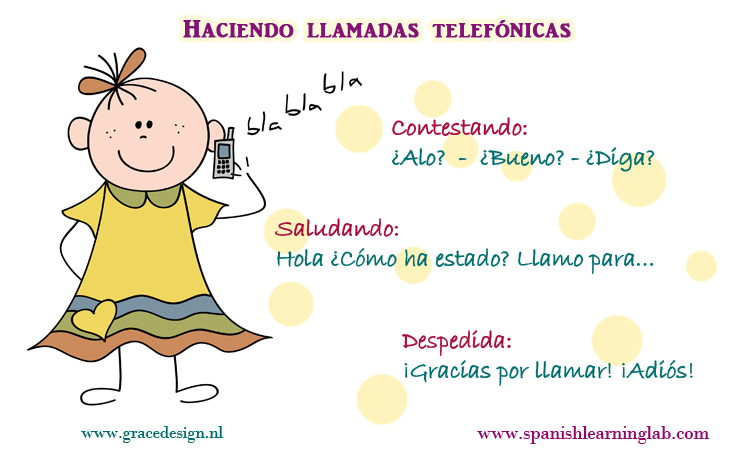
In order to answer the phone in Spanish, we normally use phrases like “Aló” (hello), “Hola” (hello), Diga (hello, tell me), Bueno (hello). Know that the expressions people use to pick the phone may vary from one country to another, but a simple HOLA may work anywhere. In fact, greetings play an important role in phone conversations in Spanish too, so make sure you know some of them.
Some verbs like LLAMAR (to call), DECIR (to say) and HABLAR (to talk) are very useful in Spanish telephone conversations. They can be used as shown in the following illustration and examples:

- “Te llamo porque hoy tienes cita con el médico” (I am calling because you have an appointment with the doctor.)
- “Llamaba para saber cómo estás.” (I just called to know how you are doing.)
The verb DECIR, on the other hand, is frequently used as a complement of LLAMAR in reflexive forms like DECIRTE and DECIRLE, for example: “Llamo para decirte…” and “Llamaba para decirle…”. DECIR is useful to leave phone messages as well, with the verb in its forms DÍGALE (tell him/tell her) and DILE (tell him/tell her). Next. you can read and listen to some ways to answer the phone in Spanish and other important expressions for phone conversations:
- ¿Hola? – Hola, llamo para avisarte que hoy es la fiesta.
- Hello? – Hello, I’m calling to let you know that the party will be held today.
- ¿Sí? – Hola, estoy llamando del banco para informarle que su préstamo ha sido aprobado.
- Yes? – I am calling from the bank to inform you that your loan has been approved.
- ¿Aló? – Aló, Habla Carlos. Llamaba para confirmar su cita de hoy.
- Hello? – Hello, It’s Carlos. I was calling to confirm your appointment for today.
- ¿Bueno? – Buenas tardes, ¿Puedo hablar con Ana?
- ¿Hello? – Good afternoon, may I speak with Ana?
- ¿Diga? – Sí, habla Francisco. Dígale a María que olvidó su teléfono, por favor.
- Hello? – Hi, It’s Francisco. Tell Maria that she forgot her phone, please.
Examples of short phone conversations in Spanish
Phone conversation No. 1
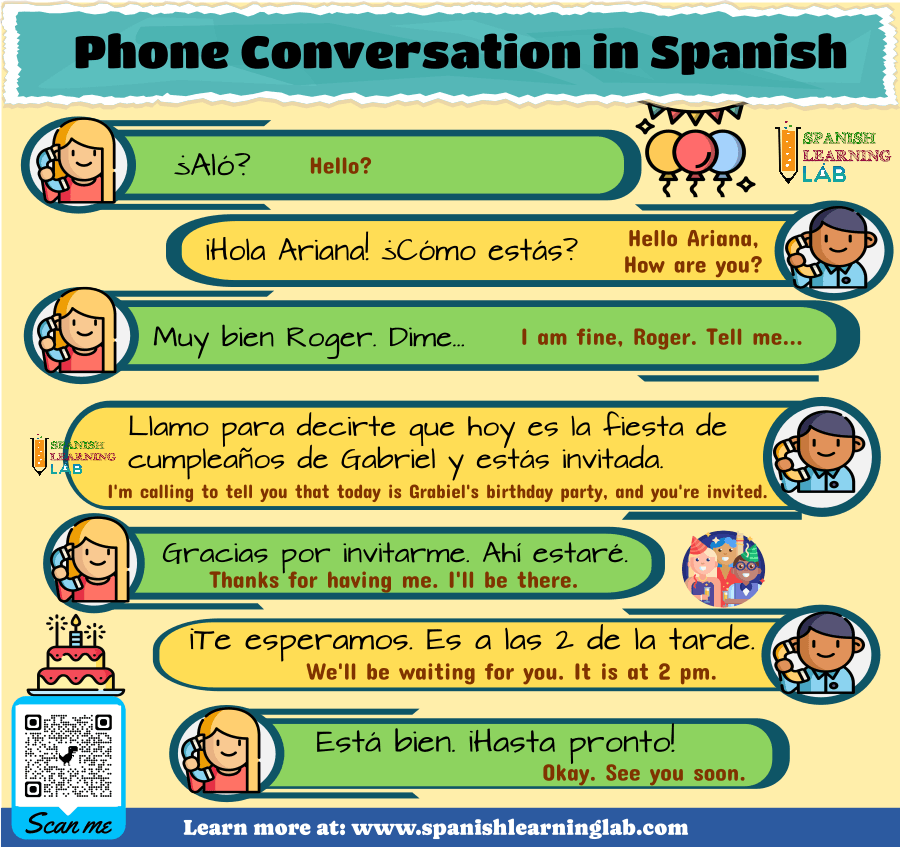
The verb HABLAR will be needed to say who is calling up and also to say the reason of the phone call in Spanish, e.g. : “Hablo para…“, “Estoy hablando para…” and “Hablaba para + purpose”. Remember you can also use the verbs LLAMAR and HABLAR in the past tense as LLAMÉ and HABLÉ.
Phone conversation No. 2
- Ariana: ¿Aló? ¿Podría hablar con Carlos?
- Juan: Un momento por favor.
- Carlos: ¿Aló?
- Ariana: Hola Carlos, habla Ariana. Llamaba para preguntarte si recibiste mi mensaje
- Carlos: Sí Ariana, lo recibí. Gracias por llamar ayer
Useful Spanish expressions and questions for phone conversations
As you can see, there are several ways to answer the phone, greet someone, ask for someone, or leave a message. The image below shows the most important questions and expressions when talking on the phone in Spanish.

- Espere un momento, por favor. (Please wait a moment.)
- Deme un minuto, por favor. (Give me a minute, please.)
- ¿Puedo hablar con María? (Can I speak to Maria?)
- ¿Algún mensaje? (any message?)
- ¿Quiere dejar algún mensaje? (Do you want to leave any message?).
When your call is about to end, you will need expressions like GRACIAS, ADIÓS, NOS VEMOS and other common farewells. Here are a few examples of phone conversations, including some of the expressions and verbs we have covered so far and a few others.
Phone conversation No. 3
- Ariana: ¿Bueno?
- Roger: Sí, buenas tardes. Ariana, llamo para saber si usted tiene mi libro de poesía
- Ariana: Sí Roger… Aquí está. Ayer llamé a su casa para decir que olvidó su libro aquí.
- Roger: Uff… pensé que lo había perdido. Gracias por guardarlo. Llegaré mañana.
- Ariana: Está bien. ¡Hasta pronto!
Phone conversation No. 4
- Ariana: ¿Aló? ¿Está Lila?
- Roger: No está ahorita. ¿Algún mensaje?
- Ariana: Sí, habla Ariana. Dígale a Lila que mañana es mi cumpleaños y está invitada a venir a mi fiesta.
- Roger: Muy bien, yo le digo. No se preocupe.
- Ariana: Muchas gracias. Que tenga buen día.
Phone conversation No. 5
- Ariana: ¿Diga?
- Roger: Sí, disculpa Ariana, solo llamaba para decirte que hoy es el concierto.
- Ariana: ¿En serio? Lo olvidé. Gracias por llamarme Roger.
- Roger: De nada. Nos vemos ahí entonces.
- Ariana: Está bien. Chao.
Another common question in Spanish phone conversations is ¿Se encuentra + name of the person?, for example: ¿Se encuentra Ana?. A more informal way to ask would be ¿Está Ana? Oftentimes, you will hear the questions ¿De parte de quién?, ¿De parte? or ¿Quién habla?, meaning “who is calling?”.
Answering the phone and leaving a message
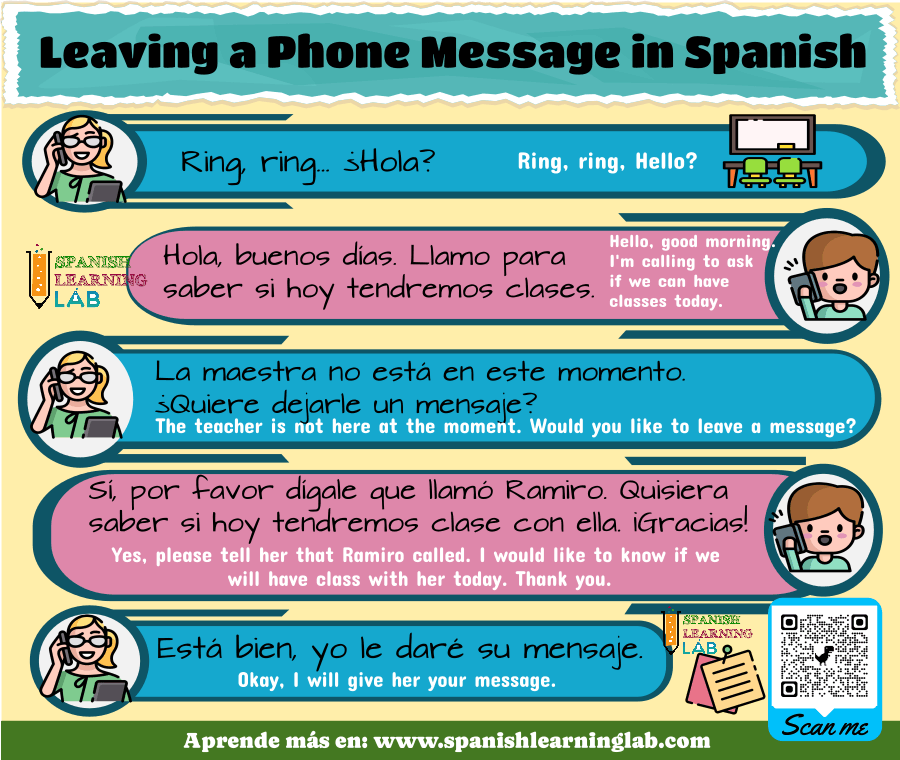
Sometimes people will ask if you want to leave a phone message in Spanish. In order to do so, they will use any of these questions: “¿Algún mensaje?”, “¿Quiere que le diga algo?”, “¿Le va a dejar algún mensaje?” If you are not asked any of these questions, but you need to leave a message, then you can make a simple request this way: “¿Puedo dejar un mensaje?” or “¿Le puede dar un mensaje, por favor?”. Take a look at these short phone conversations in Spanish and notice how people answer the phone and leave a couple of phone messages.
Phone conversation No. 6
- A: Ring…. ¿Aló?
- B: Aló, Sí, habla Marcos. ¿Me puede comunicar con Alan?
- A: Alan salió. ¿Algún mensaje?
- B: Sí, dígale que olvidó su libro de matemática en el aula de clase. Nosotros lo tenemos.
Phone conversation No. 7
Phone conversation No. 8
- A: Ring… ¿Aló?
- B: Aló. Si, ¿se encuentra Alicia?
- A: No, ella salió. ¿Quieres que le diga algo?
- B: Sí, dígale que llamó Alberto. Dígale que estamos planeando un viaje para este fin de semana. Viajaremos en bus. Nos reuniremos esta noche en el “Café Gracia” para discutir los detalles. Gracias.
- A: Está bien. Yo le daré tu mensaje.
Interactive exercise:
Link these common Spanish phone call questions with the most appropriate response. Then, check your answers.
Listening Activity No. 1: Having a telephone conversation in Spanish
Key expressions in the conversation:
- “Estaba pensando en…” means “I was thinking of…”
- “Solo llamaba para decirte…” means “I was calling to tell you that…”
- “¿A qué hora es?”, means “What time is it?”
Listening Activity No.2: On the phone in Spanish
Listening Activity No. 3: Taking phone messages in Spanish
Listening Activity No. 4: What’s the phone message in Spanish?
Key phrases in the conversation:
- “No se encuentra en este momento” means “she is not here right now”
- “Nos vamos a quedar en el hotel” means “We will stay at the hotel”
- “No olvides empacar” means “Don’t forget to pack!”
You made it to the end of this lesson. Hopefully, the examples and activities that we created were very useful for you to learn a couple of things about the way phone calls work in Spanish. Keep practicing Spanish listening with us. ¡Hasta la próxima!