
¡Hola! In this lesson, we will learn the rules behind the Spanish pluperfect tense. This tense is used to talk about actions that happened before other actions, that is, to indicate what someone “had done” before another action—the equivalent of the “past perfect tense” from the English language. This lesson includes simple explanations, many examples, and exercises in several interactive quizzes. Let’s begin…
El pretérito pluscuamperfecto – The past perfect tense in Spanish
The Royal Spanish Academy defines the past perfect in Spanish, called “pretérito pluscuamperfecto”, as follows:
m. Gram A perfect tense that locates the action, the process or the state expressed by the verb in a previous moment to another, yet in the past. The form “había cantado”(had sung) is an example of the past perfect in Spanish.
To put it more simply, the past perfect in Spanish is useful to talk about events that ended before another event in the past. Take a look a these sentences about a kid’s morning routine, all written in the past tense:
|
Marcos se despertó a las 7:00 esta mañana.
Marcos woke up at 7:00 am this morning.
|
| Marcos desayunó huevos revueltos y tomó café a las 7:30. Marcos ate scrambled eggs for breakfast and drank coffee at 7:30 |
|
Marcos tomó el bus de la escuela a las 7:55
Marcos ate scrambled eggs for breakfast and drank coffee.
|
From the information in the last three sentences, we know that “Marcos woke up at 7:00 am” (action No. 1). Before waking up, perhaps he had slept for 8 hours and that’s exactly what we want to talk about, something that happened before something else in the past. Let’s assume Marcos did all these things before waking up:
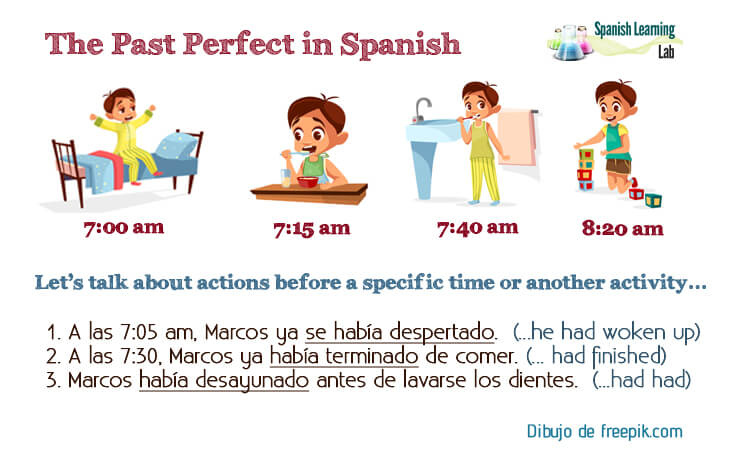
- Antes de despertarse, él había dormido 8 horas. (Before waking up, he had slept 8 hours)
- Marcos se había bañado antes de desayunar huevos revueltos y tomar café. (He had taken a shower before having scrambled eggs and coffee for breakfast)
- A las 7:50, Marcos ya se había alistado para ir a la escuela. (Marcos had already gotten ready for school.)
As you can see, the form “había dormido” and others alike correspond to the “el pretérito pluscuamperfecto“, the way to say things in the past tense in Spanish.
The following image shows a similar timeline and a couple of sentences using the past perfect in Spanish:
The structure behind the past perfect in Spanish
First, you should keep in mind that the past perfect in Spanish, often called “pretérito pluscuamperfecto” or “antecopretérito”, will make use of an auxiliary verb and the participle. Just like in English, we will use the irregular verb “to have” (HABER) in its past forms plus the past participle of the main verb in the sentence. Next, we present the basic structure that we follow to make sentences in the past perfect in Spanish. You need to memorize the forms of the verb “HABER” for each pronoun and know how to conjugate verbs in participle too.
| Subject | HABER | Participio (Escuchar) |
| Yo | había | escuchado |
| Tú/Vos | habías | escuchado |
| El/Ella/Usted | había | escuchado |
| Nosotros | habíamos | escuchado |
| Vosotros | habíais | escuchado |
| Ellos/Ustedes | habían | escuchado |
Interactive quiz No. 1
Drag the conjugations of the verb HABER to the correct spaces in these sentences with the Spanish pluperfect tense.
Just like with the present perfect in Spanish, it is possible to use words like “YA” (already), “Todavía” (yet), Desde (since) and Por (for) to complement sentences in the “pluscuamperfecto”. As you can see in the table above, the verb HABER will have a different form for most personal pronouns. In addition, it is very important that you use the correct form of the participle of the verbs in Spanish, so make sure to check our lesson on the rules to form the participle of verbs in Spanish. There are both regular and irregular participles in the language.
Interactive quiz No. 2
Select the correct form of each verb in parentheses to complete these sentences in the pluperfect tense.
The different uses of the past perfect in Spanish
1. Talking about an action before another past action.
The first and most common use for the past perfect in Spanish is to talk about actions that took place before another past action. This is usually accompanied by adverbs such as “antes de” (before) or “cuando” (when) to establish a relationship between both actions, for example, in the sentence “Antes de ver la película, yo había leído el libro“, the clause “antes de ver la película” refers to a past action and the clause “había leído…” is an action that happened even further in the past. Please analyze the following group of examples:
|
Antes de escribir “Cien años de soledad”, Gabriel había escrito “La hojarasca”.
Before writing “One Hundred Years of Solitude”, Gabriel had written “Leaf Storm”.
|
| Yo todavía no había terminado cuando él me quitó el examen. I had not finished yet when he took my exam. |
|
El venado había escapado antes que los cazadores llegaran.
The deer had escaped before the hunters arrived.
|
|
Vosotros se equivocaron porque habíais entendido mal las instrucciones.
You made a mistake because you had misunderstood the instructions.
|
Interactive quiz No. 3
Look at the picture with activities that a girl did yesterday as part of her routine, and complete the sentences with the Spanish pluperfect form of the verbs in parentheses.
2. Talking about things others said
“El pretérito pluscuamperfecto” can also be used to talk about things other people said, gossip or reports, as that also corresponds to an action before another one. Take a look at these examples:
|
Le mostré el video, pero dijo que ya lo había visto.
I showed him the video but he said he had already seen it.
|
|
Mi amigo dijo que ya había comprado el boleto para el concierto.
My friend said that he had already bought the ticket for the concert.
|
|
¿Qué dijo el doctor? – Dijo que no había visto nada alarmante.
What did the doctor say? He said he hadn’t seen anything alarming.
|
3. To react to statements and show uncertainty
“El pluscuamperfecto” is sometimes used to respond to statements people say in the present tense, especially to information you had heard, seen or found before. It is also common to use it to explain that you are not sure where/when you heard or saw something. Pay attention to these examples:
|
|
|
|
Interactive quiz No. 4
Read this group of sentences and fill in the blanks with the Spanish past perfect forms of the verbs in parentheses. Then, check your answers.
Related Spanish Worksheets:
- The Verb HABER in Spanish (Sentences)
- Spanish Present Perfect Tense
- The Past Participle in Spanish
- The Past Perfect in Spanish