
¡Hola! Thanks for joining us in this lesson. This time, we will learn the vocabulary for transportation means in Spanish and how to use these words to talk about ways to move around cities and other places in the language. We have included lots of examples and two listening activities with interactive quizzes too. Let’s start…
Vocabulary Introduction: Means of transportation in Spanish
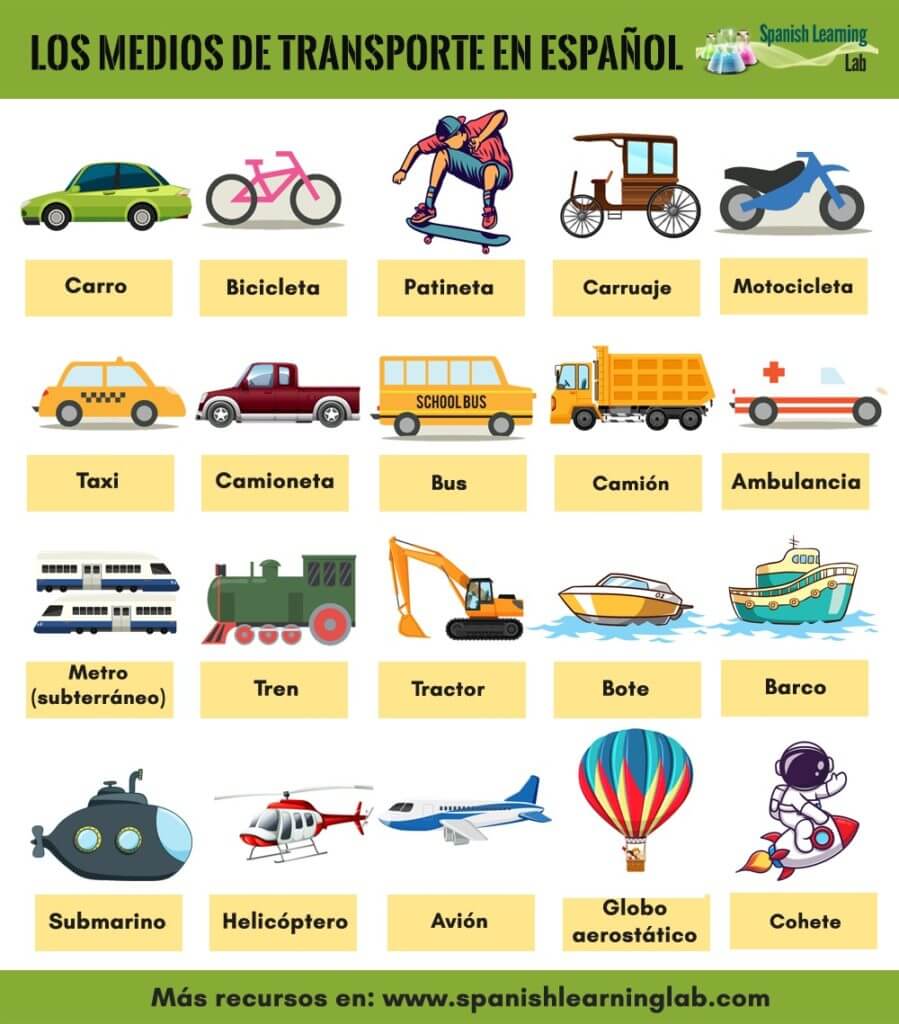
First of all, please pay attention to the following picture showing the key vocabulary for modes of transportation in Spanish that you need to know in order to talk about this topic.
Interactive exercise No. 1
Look at the following vocabulary cards and write the name of each means of transport in Spanish in the blank space below them. Then, check your answers.
Interactive exercise No. 2
Look at the following cards, identify the means of transport in Spanish, and then turn them over to check your answers.
Next, we will use this vocabulary in sentences to talk about different transportation services that are commonly used in cities or the countryside, their description and how they operate . We will include new words besides the ones in the picture. Some of these sentences will be the basis for the listening activity in this lesson so please study them carefully before moving on. We will be using the simple present, the future, the past tense for some of them and some adjectives and adverbs too.
|
CARRO – Mi carro no tiene combustible. Necesito ir a la gasolinera.
CAR – My car is out of fuel. I need to go to the gas station.
|
|
BICICLETA – Esa calle tiene ciclovía, así que es seguro montar bicicleta.
BICYCLE – This street has a bicycle lane, so it is safe to ride a bicycle.
|
|
PATINETA – A los niños les encanta andar en patineta en el barrio.
SKATEBOARD – Kids love to skateboard around the neighborhood.
|
|
CARRUAJE – Puedes tomar un carruaje en Granada y admirar la arquitectura de la ciudad.
CARRIAGE – You can take a carriage in Granada and admire the city’s architecture.
|
|
MOTOCICLETA – Yo puedo manejar autos, pero no puedo manejar motocicletas.
MOTORCYCLE – I can drive cars, but I can’t drive motorcycles.
|
|
TAXI – Los taxis son relativamente baratos en la ciudad. Puedes tomar uno para llegar más rápido.
TAXI – Taxis are relatively cheap in the city. You can take one to get there faster.
|
|
CAMIONETA – ¿Crees que podemos estacionar (parquear/aparcar) la camioneta aquí?
TRUCK – Do you think we can park (park / park) the truck here?
|
|
BUS – La ciudad tiene un buen sistema de transporte público con buses a los lugares más importantes. El pasaje/tarifa es muy accesible.
BUS – The city has a good public transport system with buses to the most important places. The fare is very accessible.
|
|
CAMIÓN – Me mudaré la próxima semana. Necesitaré un camión para mover mis muebles.
TRUCK – I’m moving next week. I will need a truck to move my furniture.
|
|
AMBULANCIA – El hospital ha enviado una ambulancia para recoger a los heridos.
AMBULANCE – The hospital has sent an ambulance to pick up the injured.
|
|
METRO – Puedes usar esta tarjeta para pagar el pasaje del metro.
METRO – You can use this card to pay for the metro fare.
|
|
TREN – El tren que conecta al país ha funcionado por más de 50 años.
TRAIN – The train that connects the country has been in operation for more than 50 years.
|
|
TRACTOR – Los tractores son muy útiles para trabajar en agricultura.
TRACTOR – Tractors are very useful for working in agriculture.
|
|
BOTE – Ellos tuvieron que tomar un bote para cruzar el río.
BOAT – They had to take a boat to cross the river.
|
|
BARCO – El barco tiene capacidad para más de 500 pasajeros y es muy moderno.
BOAT – The boat has capacity for more than 500 passengers and is very modern.
|
|
SUBMARINO – Los submarinos son muy útiles en exploraciones marinas.
SUBMARINE – Submarines are very useful in marine explorations.
|
|
HELICÓPTERO – El gobierno usó un helicóptero para rescatar a los ciudadanos.
HELICOPTER – The government used a helicopter to rescue the citizens.
|
|
AVIÓN – Ya tengo el boleto para el avión. Sale a las 8:00 y llega a las 11:00 al aeropuerto de California.
PLANE – I already have the plane ticket. It departs at 8:00 AM and arrives at 11:00 AM at the California Airport.
|
|
GLOBO AEROSTÁTICO – La vista desde un globo aerostático debe ser magnífica.
HOT AIR BALLOON – The view from a hot air balloon must be magnificent.
|
|
COHETE – La NASA planea lanzar un nuevo cohete hacia Marte el próximo año.
ROCKET – NASA plans to launch a new rocket to Mars next year.
|
Interactive quiz No. 3
Read these sentences and complete them by dragging the name of each means of transport in Spanish to the correct spaces. Then, check your answers.
Listening Activity No. 1: The different types of public transport in Spanish
Listening Activity No. 2: Talking about transportation in Spanish
We got to the end of this practical lesson. We hope that you were able to learn enough to have a basic conversation about the transportation services in your country. Keep practicing Spanish listening with our lessons ¡Hasta la próxima!
Related Spanish Worksheets:
- Around the Streets in Spanish (Vocabulary)
- Modes of Transportation in Spanish (Vocabulary)
- Modes of Transportation in Spanish – PDF Worksheet No. 2 (Crossword puzzle)
- The History of Transportation in Spanish (Reading)