
¡Hola! In this lesson, we will learn the most important vocabulary about sports in Spanish through a video and examples of basic conversations, including key questions and expressions on this topic. You will also have the opportunity to practice with two listening activities and exercises in several interactive quizzes. Let’s get started…
Vocabulary: A list of common sports in Spanish – Los deportes en español
We will begin the lesson by watching a short video introducing the vocabulary for sports in Spanish, “los deportes”. This video includes a list of basic sports in Spanish that we will be using later in the conversation samples. As usual, there are also some tips about the way the vocabulary is used in real situation and each picture has a statement related to the sport on it.
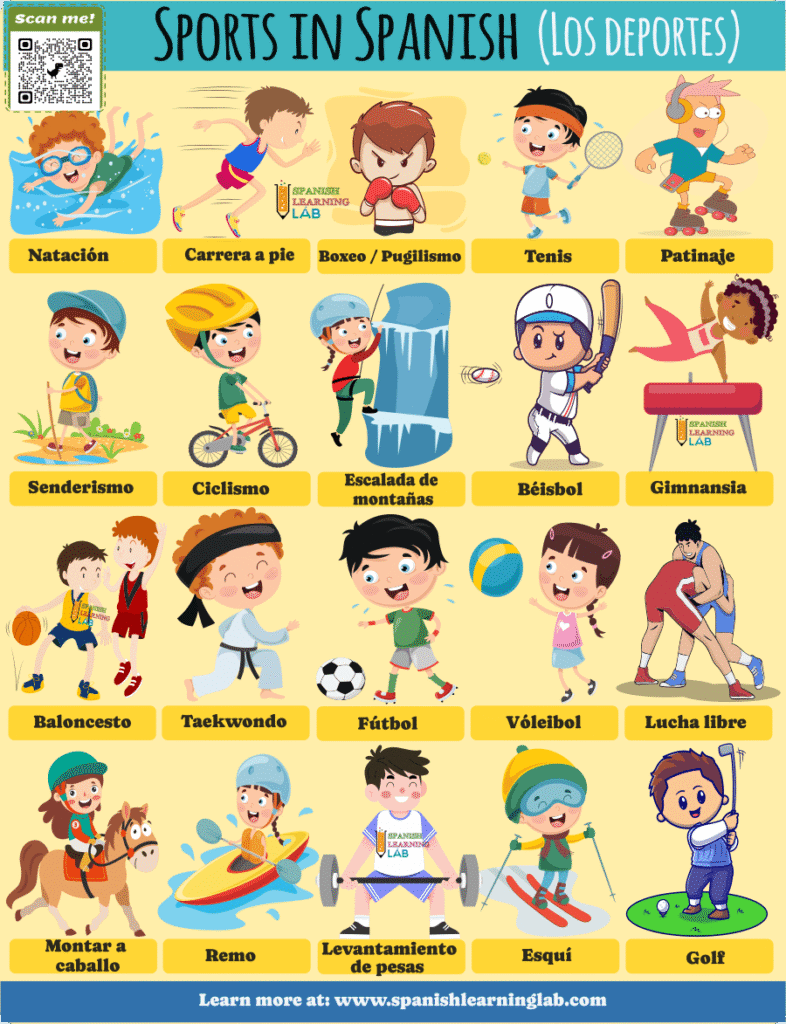
The image below presents a collection of the most common sports in Spanish around the world. Some of these sports have more than one name, for example: “vóleibol/volibol/voleibol“.
Interactive exercise No. 1
Drag the names of each sport in Spanish below the corresponding images and check your answers.
Interactive exercise No. 2
Look at these vocabulary flashcards and write the name of each sport in Spanish underneath them. Then, check your answers.
Common questions and Spanish sports phrases
We will review the vocabulary presented in the video with some conversations using common questions and Spanish sports phrases. Regarding questions, to ask “what is your favorite sport” in Spanish, you can use the question “¿Cuál es tu deporte favorito?”, or being more specific, “¿Te gusta el + deporte? (Do you like…?). In order to say your favorite sport in Spanish, you can use the phrases:
- “Mi deporte favorito es + deporte” (My favorite sport is + sport)
- “El deporte que más me gusta es el / la + deporte” (The sport I like the most is + sport)
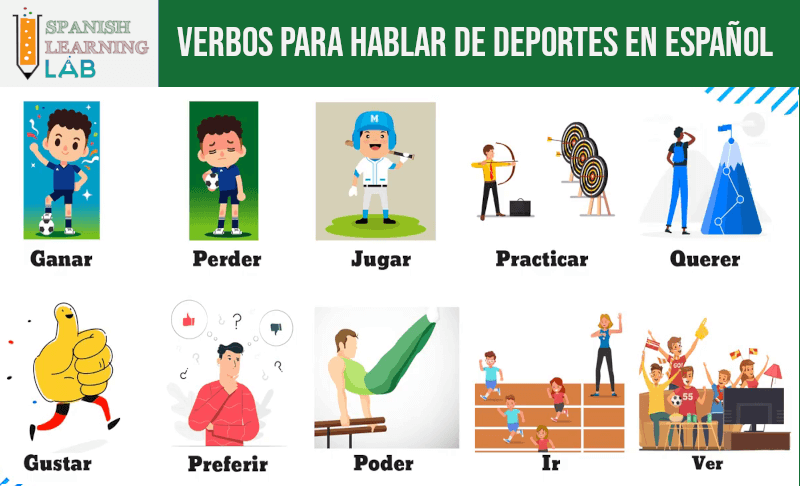
Generally speaking, you will need some of the following verbs when talking about sports in Spanish: GANAR (to win), PERDER(to lose), JUGAR (to play), PRACTICAR (to practice), QUERER(to want), GUSTAR (to like), PREFERIR (to prefer), IR (to go) and VER (to watch). Here are some basic examples of Spanish sports phrases using these verbs, some of which are also included in the conversations.
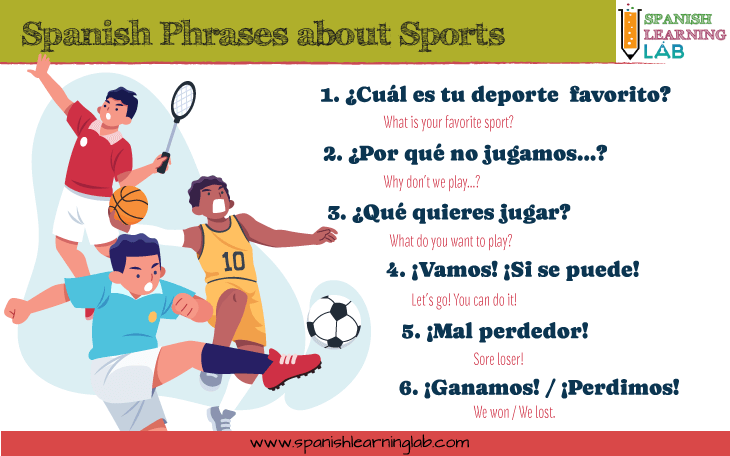
Listen to the following examples of sentences related to sports and physical activities in Spanish, as well as some of the phrases we presented earlier.
- Me gusta practicar deportes como el fútbol, béisbol, baloncesto y el voleibol.
- Go straight ahead, the language department is down the hill.
- Los deportes tienen efecto en nuestra salud física y mental.
- Sports have an effect on our physical and mental health.
- Es importante desarrollar las habilidades motoras y psicosociales.
- It is important to develop motor and psychosocial skills.
- Hacer deportes tiene efectos positivos, pero también negativos.
- Playing sports has positive but also negative effects.
- Las escuelas deben promover el deporte por sus beneficios.
- Schools must promote sport for its benefits.
- Hacer ejercicio dentro y fuera de casa mejora nuestra salud.
- Exercising indoors and outdoors improves our health.
Short conversations about sports in Spanish
Here are some short dialogues with the vocabulary, phrases and questions in Spanish we have covered so far in this lesson.
Example No. 1
- Carlos: ¿Cuál es tu deporte favorito Leo?
- Leo: Uhmm… me gustan varios deportes, pero mi favorito es el fútbol.
- Carlos: A mí me gusta más el béisbol ¿Por qué te gusta el fútbol?
- Leo: Porque es un deporte fácil y divertido. Siempre me divierto mucho jugando con mis amigos.
Example No. 2
Definite articles for sports in Spanish
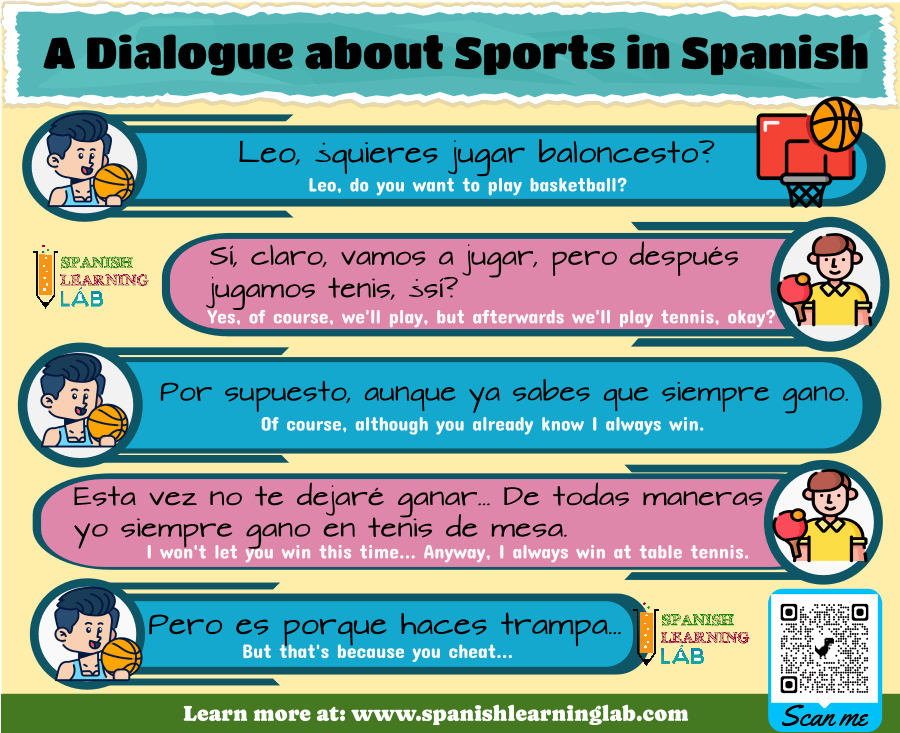
Focusing a bit on the grammatical structure, you should know that we use the definite articles such as EL and LA before most sports in Spanish, especially when they are mentioned individually. EL is used for sports in masculine form such as FUTBOL, TENIS and so on, whereas LA will be used for sports in feminine form like NATACIÓN as in the sentences “Me gusta el fútbol” and “Prefiero la natación”. Make sure not to use EL or LA when the name of the sport is used after the verbs JUGAR and PRACTICAR, so something like “I play hockey” would be translated as “Juego jóquey” not “Juego el jóquey”.
There are many verbs you can use to talk about sports, many of which we used in the previous examples and others that we will see in the other short conversations in this lesson, including the following:
Using adjectives to describe sports in Spanish
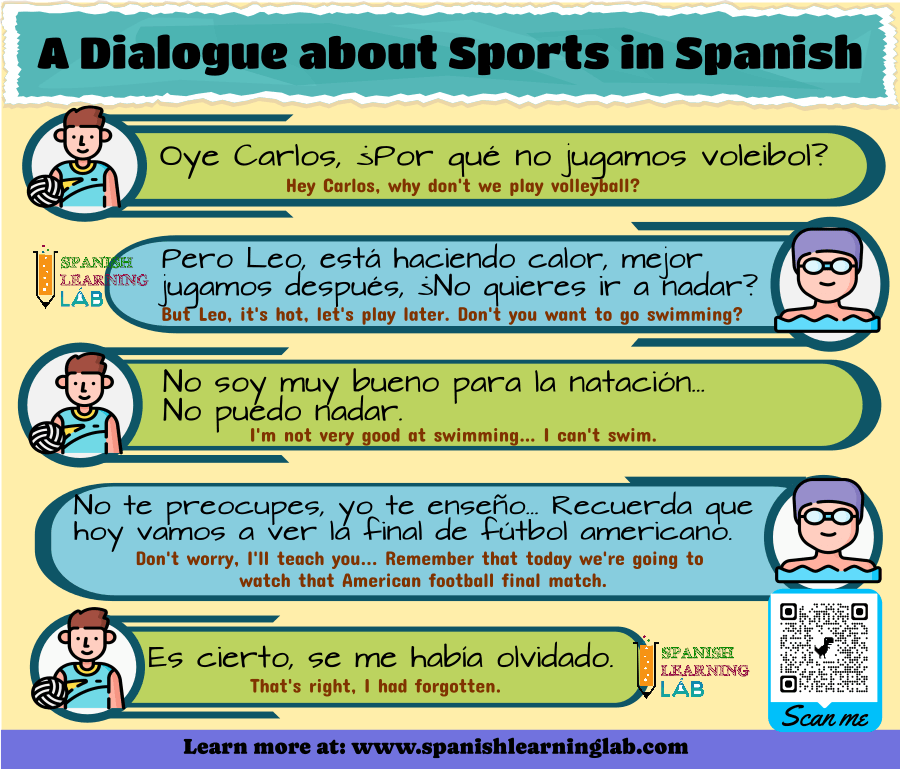
You can use some adjectives to describe sports in Spanish including DIVERTIDO, ABURRIDO, INTERESANTE, ENTRETENIDO, FÁCIL, DIFÍCIL, CANSADO and others. This way you can share your opinion about a particular sport, e.g. “El béisbol es divertido” (baseball is fun). In general, there are different tenses involved in a conversation about sports including expressions in the present tense like “Es un deporte divertido”, in the past tense like “Olvidé ver el partido” (I forgot to watch the match) or the future tense like “Vamos a jugar tenis después”. Please check the examples below and check how both definite articles and adjectives can be used to describe sports in Spanish.
Example No. 3
- Leo: ¿Qué estás viendo en la televisión?
- Carlos: Estoy viendo un partido de jóquey. Ambos equipos son muy buenos.
- Leo: ¿Quién es ese jugador?
- Carlos: Él es Marcos, el capitán del equipo rojo.
Example No. 4
Example No. 5
- Leo: uhmm, ¿Cómo se llama ese deporte?
- Carlos: Se llama fútbol rugby y es bastante común en Inglaterra.
- Leo: Ahh, ¡Qué interesante! Hay muchos deportes divertidos, ¿verdad?
- Carlos: Sí, muchas personas practican boxeo, ciclismo, golf y otros deportes entretenidos y saludables.
Interactive exercise No. 3
Match each question about sports with the most appropriate answer for each case, and then check your answers.
Listening Activity No. 1: Talking about sports in Spanish
Key expressions in the conversation:
- “No soy tan bueno en”, means “I am not that good at”
- “Te apuesto a que…”, means “I bet that”
- “¿Me estás retando?”, means “Are you challenging me?”
Listening practice No. 2: A conversation about sports in Spanish.
Listening Activity No. 3: The effects of sports in our health in Spanish
We got to the end of this lesson. We hope you were able to pick a few phrases and questions that could come handy to talk about indoor and outdoor activities in Spanish. Remember that practice makes perfect. Until next time!
Related Spanish Worksheets:
- Common Sports in Spanish – PDF Worksheet
- Common Hobbies in Spanish – PDF Worksheet
- Pastimes, Likes & Dislikes in Spanish – PDF Worksheet
- My Favorite Hobbies in Spanish – PDF Reading Worksheet
- Let’s talk about Sports in Spanish – Conversation cards