Knowing basic vocabulary about daily activities in Spanish is very important for describing your daily routine. In this lesson, we will present a vocabulary list for daily activities. We will also explain the basic structure for writing sentences about daily routines with a very interesting video about these words and reflexive verbs in Spanish. Let’s begin…
Introduction: Daily routine activities in Spanish, reflexive verbs and examples
We will begin the lesson with a video showing a list of common daily routine activities in Spanish and explaining how to ask what someone does every day, plus the basic way to conjugate reflexive verbs and use them in simple sentences. At the end of the video there is a simple conversation integrating most of the major points in the video, so please make sure to stick until the end as it also includes some things you will not find in the rest of the lesson and pay special attention to the vocabulary, phrases and questions.
Interactive quiz No. 1
Drag the name of each daily activity in Spanish below the correct images and check your answers.
Reflexive verbs as daily activities in Spanish
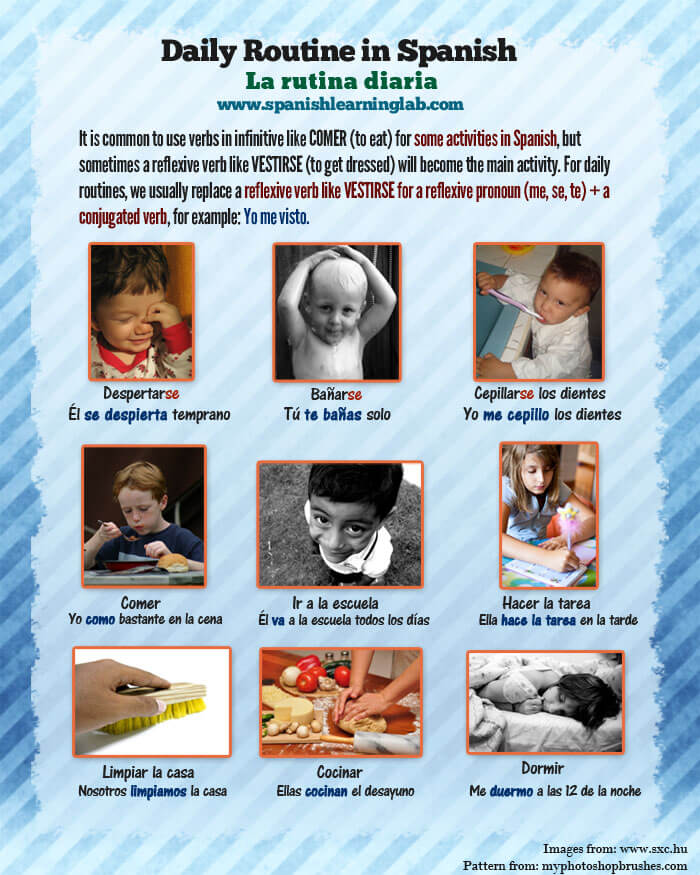
If you watched the video, then this part will be easier to understand. First, we will see a list of daily routine activities in Spanish that are represented by reflexive verbs. Basically, a reflexive verb like LEVANTARSE (to get up) will change to SE LEVANTA or ME LEVANTO depending on who is getting up. For example, to say “She gets up early” we would say “ELLA SE LEVANTA TEMPRANO” but to say “I get up early” we have to say YO ME LEVANTO TEMPRANO. Both ME and SE in these two examples are reflexive pronouns. We often follow this structure for many of the activities:
Subject pronoun + reflexive pronoun + conjugated verb + complement
Here are some sentences using reflexive verbs as daily activities in Spanish. Listen to the audio and pay attention to their pronunciation.
|
Despertarse – Yo me despierto al sonar la alarma
To wake up – I wake up when the alarm rings
|
|
Levantarse – Yo me levanto temprano.
To get up – I get up early
|
|
Bañarse – Usted se baña en poco tiempo
To take a shower – You take a shower in a short time
|
|
Cepillarse los dientes – Carlos se cepilla los dientes todos los días.
Brush my teeth – Carlos brushes his teeth every day
|
The role of reflexive pronouns in Spanish
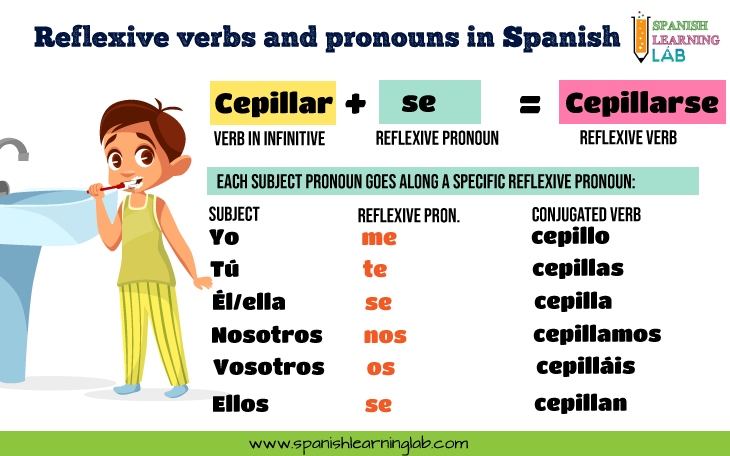
As you can see in the examples, reflexive pronouns are very important for this topic. They are placed before the main verb of the sentence, and we use a different reflexive pronoun depending on the subject of the sentence: “Me” is used after “Yo”, “Se” after “Él, ella, ellos, ellas, ustedes”, “Te” after “Tú” and “Nos” after “Nosotros”.
Adding a reflexive pronoun or leaving it out actually depends on what we are trying to say, and it will change the meaning of a sentence. For example, the sentence “Ella nos cocina el desayuno” means “She cooks breakfast for us”, and here “Nos” is actually an indirect object pronoun as it tells “for whom” the food is cooked. However, if we follow the chart and say “Ella se cocina el desayuno”, it would mean “She cooks breakfast for herself” and now it has a reflexive meaning. Notice that you need to conjugate the verb properly depending on the subject of the sentence and depending on whether the verb is regular or not. Pay attention to this chart:
Other verbs just need a reflexive pronoun to make clear who is being affected by the action, for example, saying “Yo bañar” is incorrect because we are not saying who is taking the shower but if we add “me” and say “Yo me baño”, we clarify that I am the one taking the shower. It’s time to listen to some more examples using reflexive verbs and daily activities in Spanish in sentences.
|
Afeitarse/Rasurarse – Él se rasura la barba todos los días
To shave – He shaves his beard every day
|
|
Vestirse – Mercedes se viste en su habitación.
Get dressed – Mercedes gets dressed in her bedroom
|
|
Ponerse maquillaje – Tú te pones maquillaje todos los días.
Put on makeup – You put on makeup every day
|
|
Alistarse – Yo me alisto para ir a la escuela.
Get ready – I get ready to go to school
|
|
Dormir – (Nosotros) Nos dormimos a las 10 de la noche.
Sleep – We sleep at 10 at night
|
Interactive quiz No. 2
Drag the reflexive pronouns or the conjugations of these verbs in thepresent tense to the correct spaces, following the rules, and then check your answers.
A list of daily routine activities in Spanish using non-reflexive verbs.
Not all the daily routine activities in Spanish are reflexive verbs. In fact, many of them are plain verbs in infinitive such as COCINAR (cook) and LIMPIAR (clean), including a few common sports and household chores. This means we will not need a reflexive pronoun before the conjugated verb and will follow the most basic structure for sentences:
Subject + conjugated non-reflexive verb + complement
Just be careful with some verbs as some of them are stem changing verbs, even the ones who need a reflexive pronouns like DESPERTARSE and VESTIRSE. Here are some examples of sentences using non-reflexive verbs.
|
Arreglar la cama – Yo arreglo mi cama en la mañana.
Make the bed – I make my bed in the morning
|
|
Cocinar el desayuno/almuerzo/la cena – Mi mamá cocina el desayuno
Cook breakfast/lunch/dinner – My mother cooks breakfast
|
|
Desayunar/almorzar/cenar – Nosotros cenamos juntos.
Eat breakfast/lunch/dinner – We eat together
|
|
Limpiar la casa – Ella ayuda a limpiar la casa.
Clean the house – She helps to clean the house
|
|
Lavar los platos – Ustedes lavan los platos
Wash the dishes – You wash the dishes
|
|
Ir a la escuela – Yo voy a la escuela todos los días
Go to school – I go to school every day
|
|
Ir al trabajo – Ellas van al trabajo juntas.
Go to work – They go to work together
|
|
Recoger a los niños – Joel recoge a los niños en la tarde
Pick up the children – Joel picks up the children in the afternoon
|
|
Regresar a casa – Yo regreso a casa antes del anochecer.
Go back home – I go back home before nightfall
|
Interactive quiz No. 3
Follow the instructions in the following test to solve three different exercises on reflexive pronouns and verbs, and other verbs used as daily activities in Spanish. ¡Buena suerte!
Related Spanish Worksheets:
- Daily Activities in Spanish
- Daily Routine Activities in Spanish (Vocabulary)
- Verbs for Daily Routines in Spanish – Crossword Puzzle
- My Daily Routine in Spanish (Reading)
- Daily Activities & Time in Spanish
- Telling Time in Spanish
- Household Chores in Spanish
- Dialogues about daily routines in Spanish
- Messi’s Daily Routine in Spanish (Reading)
- Days of the Week & Activities in Spanish (Reading)