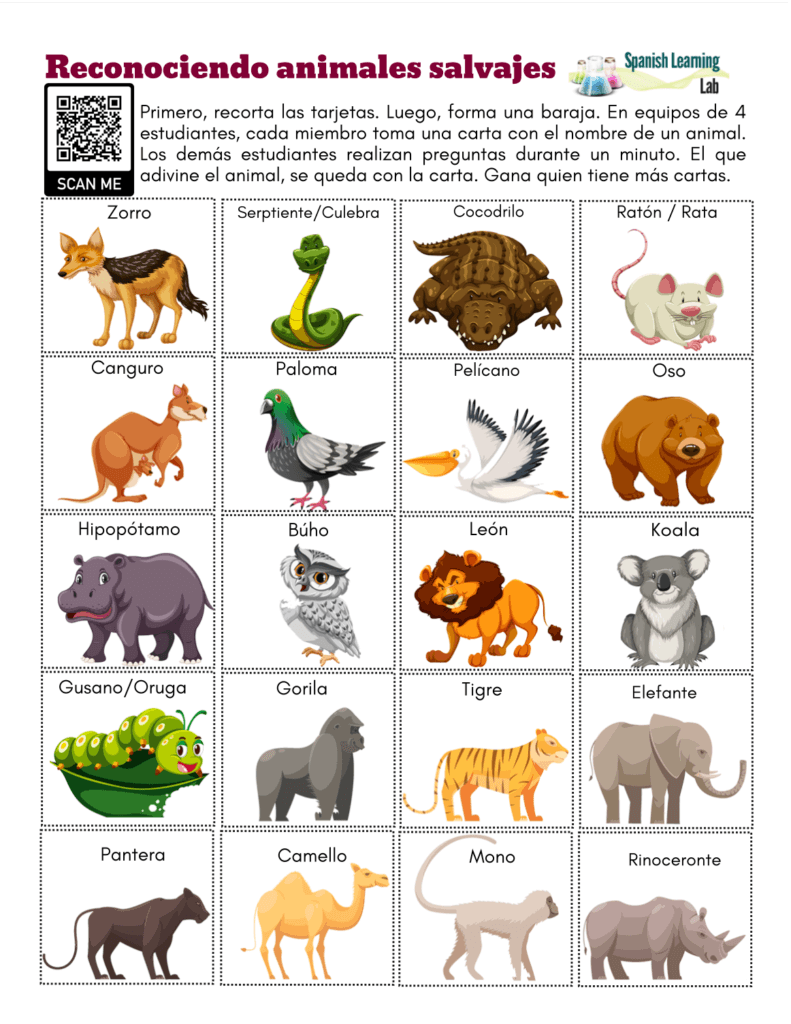
¡Hola! We designed this worksheet to help you practice vocabulary for wild animals in Spanish through a card conversation game in teams. We hope you like the game and that you can talk a lot about animals and their characteristics with your friends or classmates.
Directions:
Students work in pairs or groups of four to practice with the exercises on this worksheet.
Each group of students gets a worksheet. First, they must cut out the cards with pictures and names of different wild animals in Spanish. Their teacher could also do it before the class so that they don’t see the cards before playing the game. Then they form a deck and each student draws a card. The other students can ask 5 questions about the animal (one student at a time). If a student guesses, he keeps the card, but if he doesn’t then the one who drew it keeps it. Whoever has the most cards at the end of the game wins.
Spanish worksheet information:
Level: Intermediate
Skill: Vocabulary/Speaking
Related Lessons:
- Zoo Animals in Spanish: List, Phrases and Listening Practice
- Domestic Animals and Pets in Spanish: Listening Practice
- Common Farm Animals in Spanish: Vocabulary and Listening Practice
Practice online!
Interactive exercise No. 1
Look at these cards with wild animals in Spanish, listen to some interesting facts, guess the animal’s name, and then check your answer by turning the cards over.
Interactive exercise No. 2
Look at the flashcards and write the names of the wild animals in Spanish that appear on them, many of which are part of the worksheet. Good luck!
Interactive exercise No. 3
Find the names of these 20 wild animals in Spanish in the following interactive word search.
flamenco / lobos / águila / capibara / pelícano / lince / jaguar / venado / lémures / tiburones / orcas / ballenas / pingüinos / focas / iguanas / tortugas / gaviotas / tucán / guacamaya / escorpiones
Extra activity:
The teacher calls the winner of each group to the front of the class. Then, he/she shuffles a deck with the cards. Students should take a card and talk about the animal they got for at least one minute non-stop. The student who speaks using the vocabulary and grammar the best way wins.