Hello! Thanks for visiting our site. This time, you will find a PDF worksheet including three exercises focused on the simple past tense in Spanish, called “pretérito perfecto simple” or “pretérito indefinido” in the language. We hope you make the most of it. Let’s get to work!
Instructions:
Students can work on this material individually or in pairs. They can also work on these exercises online on this page.
The pretérito perfecto simple in Spanish—also known as the pretérito indefinido—refers to actions, processes, or states that occurred during a time period prior to the moment of speaking; in other words, it refers to completed past actions, for example:
- El último día de vacaciones fuimos a la playa.
- “On the last day of our vacation, we went to the beach.”
To solve the first exercise, students must fill in ten separate sentences using the pretérito perfecto simple (simple past tense in Spanish) forms of the verbs provided in parentheses, making sure they make sense when conjugated. In the second exercise, they must read a short text in Spanish about past actions, identify the verbs in the pretérito indefinido (simple past), and either circle or highlight them. Finally, for the third exercise, students must read several sentences and correct the main verb (indicated in parentheses) by using the pretérito perfecto simple. Students may use a conjugation tool to verify the correct verb forms for each instance.
Worksheet information:
Level: Beginners
Skills: Grammar
Related lessons:
- Regular and Irregular Verbs in the Past Tense in Spanish
- The Imperfect Past Tense in Spanish: Rules and Audio Examples
- Past Actions in Spanish (short texts and conversations)
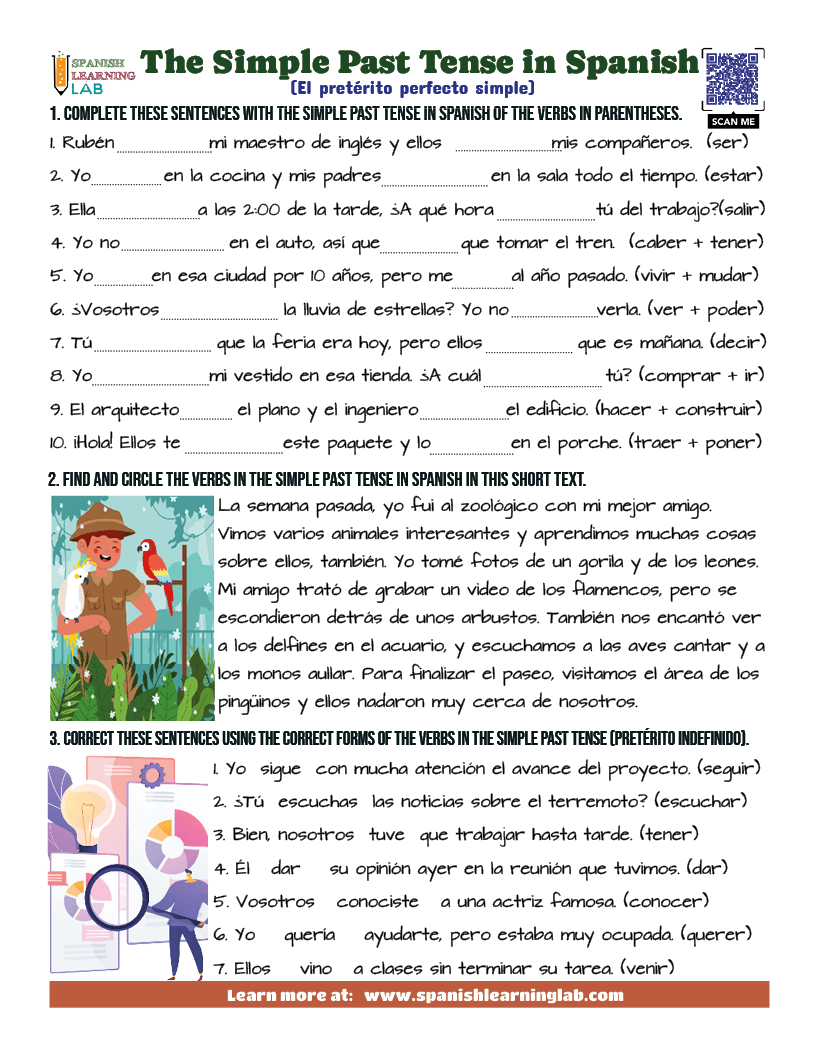
Solve it online!
Exercise No. 1
Fill in the blank boxes with the Spanish simple past (pretérito perfecto simple) conjugations of the verbs in parentheses. Then, check your answers.
Exercise No. 2
Mark the words in the pretérito indefinido (simple past tense) in this short text about past actions in Spanish.
Exercise No. 3
Correct the main verb in these sentences by using the appropriate Spanish simple past tense forms of the verbs in parentheses.