Hello! Thanks for joining us. This time, we are sharing another great PDF worksheet to help you practice the non-argumentative indirect object pronouns in Spanish— a very common structure in the language. Let’s get to work!
Instructions:
Students can work individually or in pairs to solve the exercises. They can also solve them online on this page.
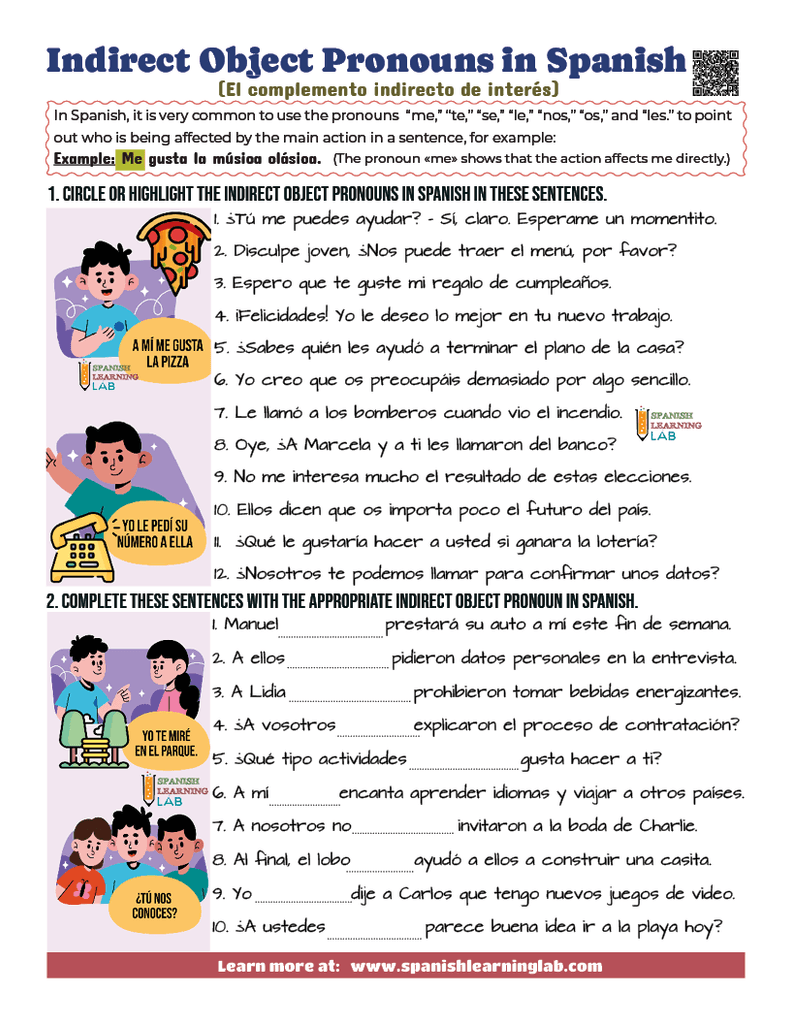
As briefly explained in this material, another form of the indirect object in Spanish is the so-called “ complemento indirecto de interés”. Essentially, it has to do with using the pronouns “me,” “te,” “se,” “le,” “nos,” “os,” and “les.” to point out who is being affected by the main action in a sentence, for example:
- Me gusta la música clásica. (The pronoun «me» shows that the action affects me directly.)
- Os compré unos libros de fantasía. (The pronoun «os» shows that you are the one being affected by the action)
To solve the first exercise, students must read several sentences, identify the Spanish indirect object pronouns in them, and either highlight or circle them in each sentence. In the second exercise, they must complete each sentence with the appropriate indirect object pronoun, based on who the recipient of the main action is—taking into account cues such as “a mí,” “a Pedro,” etc.
Worksheet information:
Level: Intermediate
Skill: Grammar
Related lessons:
- How to use Indirect Object Pronouns in Spanish
- Borrowing and Lending Things in Spanish: Examples and Practice
- Object Pronouns in Spanish (Worksheets)
Solve it online!
Exercise No. 1
Read these sentences and click on the words working as Spanish indirect objects pronouns. Then, check your answers.
Exercise No. 2
Fill in the blanks with the appropriate indirect object pronouns in Spanish to complete these sentences