¡Hola! In the previous lesson, we covered a list of family members and explained a little about how to describe them using SER plus adjectives. In this lesson, we will learn more about this topic and explain how to describe your family in Spanish correctly through many examples, illustrations, recordings about family descriptions in Spanish and several interactive exercises. Let’s start…
Introductory video: The family in Spanish – La familia
Let’s start by watching a short video to review the vocabulary for family members in Spanish. Pay attention to the vocabulary presented in the video, as well as some of the grammar rules that will be applied in the descriptions later. Remember that you can activate the subtitles if you need them.
Interactive exercise No. 1
Drag the names of the family members in Spanish to the correct boxes in this interactive family tree.
Gender and plural of family members in Spanish
The gender and plural of nouns in Spanish
In order to describe your family in Spanish, first it’s necessary to understand that family members are common nouns, that is, they undergo changes of gender and number. As for grammatical gender, words that end in the letter -A such as “Mamá, Nieta, Hija” and “Abuela“ are considered feminine nouns, whereas those that end in -O such as “Abuelo, Nieto, Hijo“ and “Tío“ are masculine nouns. Basically, if we make a simple change at the end of the word, we will have two words with different meanings. Pay attention to how we can refer to different family members with a simple change in gender and number, as shown in the following image:
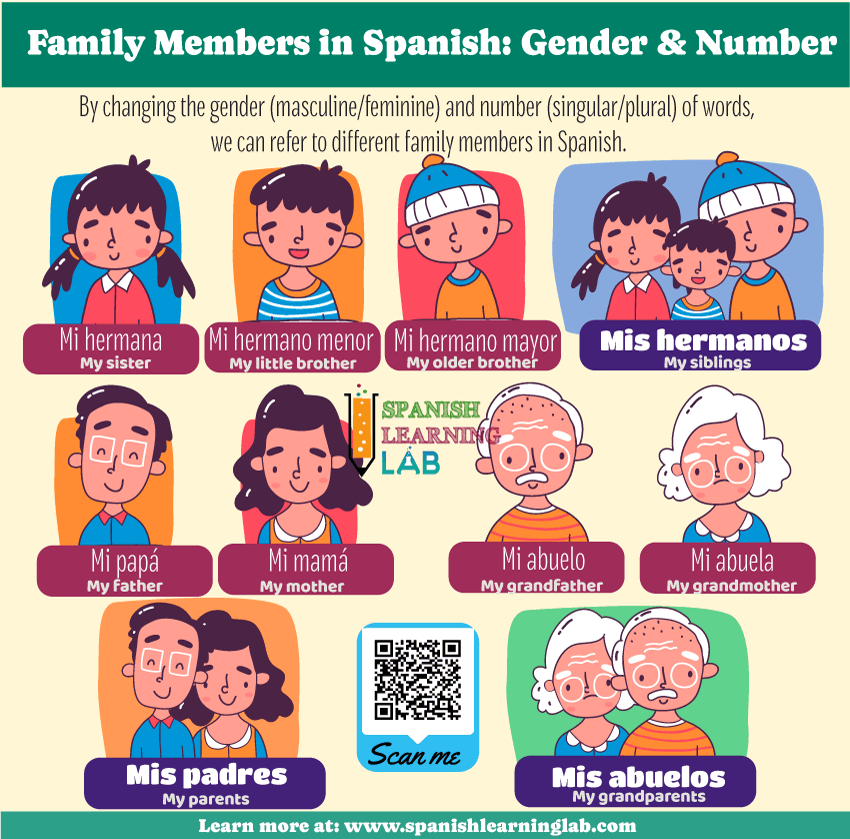
The word “papá” is considered a masculine noun even though it ends in -A, and it has the same meaning as “Padre”, but is a bit more informal than its counterpart. As for their plural or singular forms, most words for family members are common nouns, so they will change from singular to plural and vice versa, as shown in the examples in the previous image: “Mis padres” o “Mis abuelos“. Generally, the plural form is created by adding -S or -ES to the nouns. You simply have to add -S when the noun ends in a vowel, such as NIETA → NIETAS, and -ES when it ends in a consonant.
Interactive exercise No. 2
Read these sentences about family members in Spanish, and complete them with the correct number (singular or plural) and gender of the words in parentheses.
Creating family relations in Spanish
Lastly, we will always use possessive adjectives like MI, TU, SUS, NUESTROS and others along with the vocabulary for family members. These words indicate possession, just like we would use MY, YOURS and so on from the English language. These types of adjectives must agree with the word they accompany; that is, if it is a plural masculine noun, such as “hermanos” (brothers), then we must use a possessive adjective such as “mis, sus, nuestros o vuestros“, as shown in the examples in the image below:
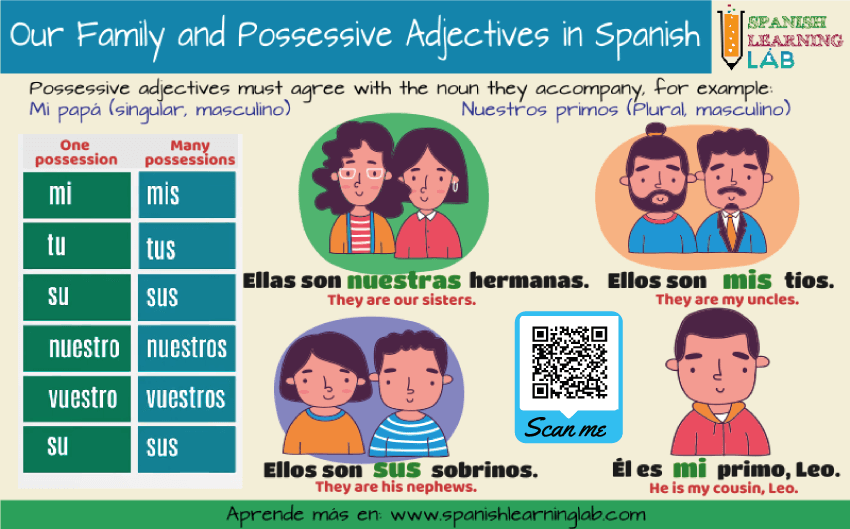
Following the grammatical pattern in the image above, we can talk about other family relationships in Spanish and say things like this:
- Mi familia es grande. (My family is big.)
- Él es su hermano menor. (He is her/his little brother.)
- Tus tíos son muy amables. (Your aunts and/or uncles are very kind.)
- Ellos son nuestros padres. (They are our parents)
Interactive exercise No. 3
Describing your family in Spanish using SER and adjectives
Describing your family in Spanish is really easy as most of the time we will need only three things: a family member, the verb SER and an adjective in Spanish, that is words to describe personality or physical appearance. The subject goes first and then the verb SER, which will change to ES if the word is in singular form like MAMÁ and HERMANO, just like this:
- Mi mamá es muy inteligente. (My mom is very intelligent.)
- Mi papá es alto. (My dad is tall)
- Mi tía es cariñosa. (My aunt is affectionate)
The form “son” from the verb SER will be used to refer to several people like PADRES and ABUELOS as in “Mis padres son..”. Similarly , the adjective will also take a singular form when describing a single person, as in: “Mi mamá es amable” and a plural form when describing many people: “Mis abuelos son amables”. Before moving on, solve the exercises on the next grammar quiz.
- Mis primos son necios. (My cousins are naughty)
- Mis abuelos son buena gente. (My grandparents are good)
Interactive exercise No. 4
Complete the sentences describing some family members in Spanish with the correct adjective, and for the second exercise, write the forms of the verb “SER” in the boxes.
Resultados


#1. Mi madrastra es muy __________ conmigo. Me trata muy bien. (bueno)
#2. Mis sobrinos son muy __________. Siempre están saltando y jugando. (enérgico)
#3. El papá de Lucas es ___________. Le pone reglas y le asigna tareas. (estricto)
#4. La mamá de Leticia es ____________. Se pone enojada con facilidad. (enojón)
#5. La suegra de Alicia no la quiere. Ella es muy ____________ con Alicia. (odioso)
#6. Mi hijo es un niño ____________. Él siempre saca A+ en clases. (inteligente)
#7. Nuestro primo es _________. Siempre quiebra o daña las cosas de la casa. (travieso)
#8. Mis tíos son muy altos y ___________. Ellos hacen ejercicio a diario. (musculoso)
#9. Mi padrastro tiene barba, bigote y tiene el pelo __________. (castaño)
#10. Los hijastros de Lidia son ____________. Son buenos mecánicos. (trabajador)
Interactive exercise No. 5
Fill in the blanks with the conjugations of the verb SER to complete these sentences about family in Spanish.
Examples of family descriptions in Spanish
Next, you will be able to read and listen to some short descriptions of families in Spanish using possessive adjectives, the main vocabulary of the lesson, and other important structures in the language.
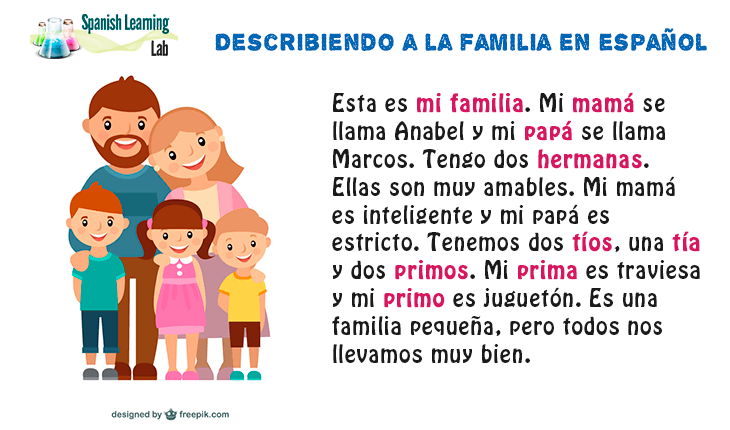
Example No. 1
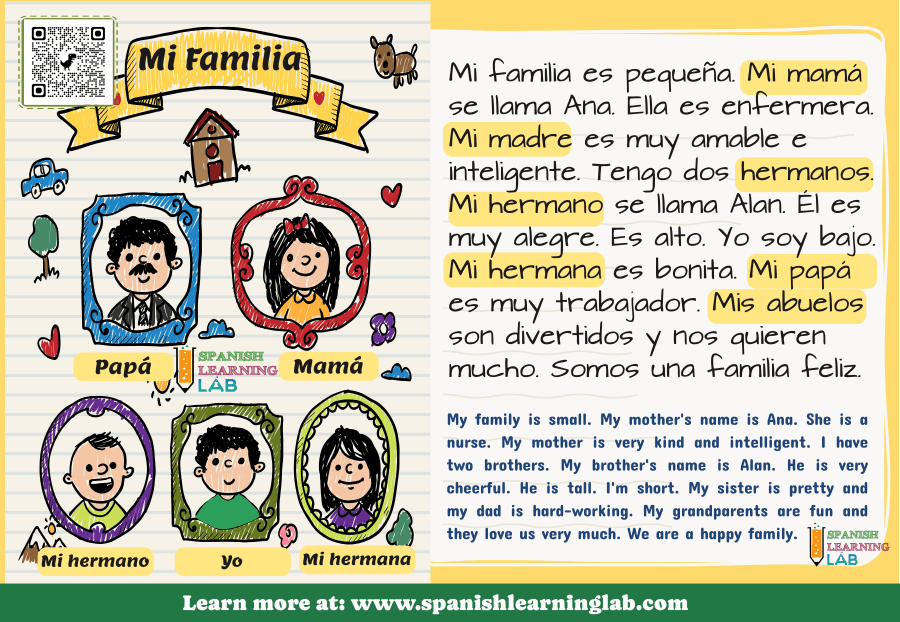
Example No. 2
Mi familia es grande. Vivo con mis padres. Mi mamá es empresaria y mi papá trabaja en un banco. Tengo dos hermanas, Alicia y Mercedes. También tengo dos hermanos, Javier y Hernán. Todos nos llevamos muy bien. Alicia es la mayor de todos. Ella es inteligente y le gusta leer libros. Mercedes es la menor y le gusta ver televisión. Javier es necio y a veces es travieso. Javier es un buen niño. A Hernán le gustan los deportes y él es muy chistoso. Yo soy alto y creativo. Nosotros visitamos a nuestros tíos y a nuestros primos a veces. En vacaciones vemos a los abuelos. Ellos son estrictos y muy amables.
Example No. 3

Listening Activity No. 1: Talking about my family in Spanish
Key expressions in the conversation:
- “¿Puedes ayudarme con…?”, means “Can you help me with…?”
- “¿De qué se trata la tarea?”, means “What is the homework about?”
Listening Activity No. 2 : Describing my family in Spanish
Key expressions in the recordings:
- “Ellos me quieren mucho”, means “They love me so much!”
- “Llevarnos muy bien”, means “Get along well with each other”
- “Estar emocionado por conocer a…”. means “I’m excited to meet…”
Time to Practice: Writing about my family in Spanish
Write a 100-word paragraph “describing your family in Spanish.” You can use the examples in this lesson or parts of the listening activity to get some ideas. Then, read your paragraph to a native speaker to get feedback on your writing, pronunciation, and mastery of the topic. ¡Hasta la próxima!
Related Spanish Worksheets:
- Family Tree in Spanish (Vocabulary)
- Questions about the Family in Spanish(Speaking)
- Making Questions in Spanish (Speaking)
- Family Relationships in Spanish (Reading)
- Writing Physical Descriptions in Spanish (Writing)
- Dialogues about the family in Spanish
- Introducing my Family in Spanish (Reading)
- Family Members in Spanish (Tree + Sentences)
wonderfully presented. Easy to understand. Do you sell all the videos presented?
Thanks! They are all free 🙂
This was fantastic! Thank you1
¡De nada! 🙂
¡Muchas gracias! Estoy estudiando para un examen y esto me ha ayudado mucho. Gracias.
¡De nada! Nos alegra mucho que la lección te ayude. Buena suerte en tu examen 😉
muchas gracias
¡De nada! 🙂
gracias
Listening quiz question no.4, the answer is questionable, pls check, thx!
¡Muchas gracias! We fixed the mistake 🙂
I learned that the people in our families are used in day today conversations and are essential to knowing and using the Spanish language.